

In short
- New runway models are paid anything from clothes ("trade") to a few hundred dollars per show. New York agency owners quote $500–2,500 for experienced models and more than $20,000 for stars.
- One working model's 2013 New York Fashion Week brought about $4,200 in cash; several shows paid only in clothes, and transport and rent still had to come out of it.
- In France, models are employees and a runway contract must pay at least two hours of show and one hour of rehearsal or fitting.
- For newcomers the runway is an investment in visibility. It leads to campaigns and catalogue clients, which is where the money is.
- Fashion weeks run twice a year, so for most models show income is a small part of the year's earnings.
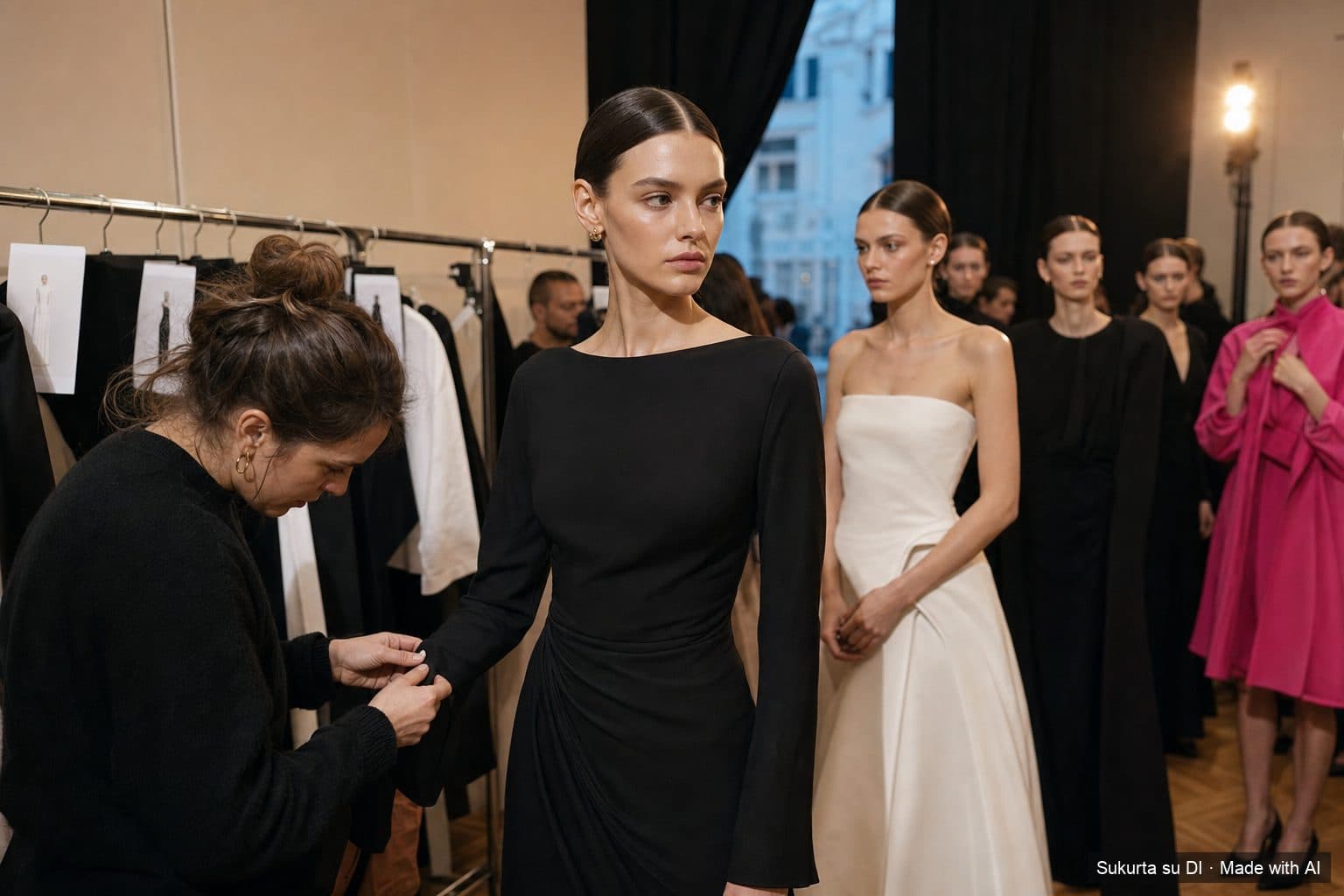
The runway is the most visible part of modeling: the Paris, Milan, London and New York shows, the backstage pictures, the clips on social media. So anyone asking "how much do runway models make?" expects a big number. For most of them it is the opposite: shows are among the worst-paid jobs a model does, and the money arrives later, from clients who saw them walk.
This guide uses Supermodels' experience preparing models for fashion week, plus figures published by the press and agency owners. For the wider picture of model pay, see how much do models make.
How much runway models get paid per show
| Model | Fee per show | Source |
|---|---|---|
| New face | Unpaid, clothes, or $200–1,000 | New York agency owners (Backstage) |
| Working runway model | $150–500, often partly in trade | Former model (Fashionista, 2018) |
| Experienced model | $500–2,500 | New York agency owners (Backstage) |
| Supermodel | More than $20,000 | New York agency owners (Backstage) |
The gap is between clients as much as between models. Mass-market brands usually pay in cash; independent designers with small budgets often offer clothes; the big houses pay well, but few models get into their shows.
 Model training with SupermodelsThe walk is best seen on videoWe film how you walk now and work on posture, stride and the turn until the walk is yours.About the trainingfrom €69
A Paris example shows what reaches the model. In 2018 a model told AFP that a big Paris show carried a €1,100 fee, of which she received €400. The rest went to agency commission and repaying advanced costs.
One fashion week in numbers
In 2013, Refinery29 published one working model's complete New York Fashion Week:
| Booking | Pay |
|---|---|
| Mass-market brand show | $800 |
| Presentation | $1,000 |
| Another large show | $1,000 |
| Independent designers | Clothes only: $1,500, $800 and $2,500 worth, plus one more show for unvalued clothes |
| Two smaller shows | $300 plus clothes, $100 plus clothes |
| One more show | $1,000 |
| Total cash | about $4,200 |
She spent about $400 on transport that week, and her costs were deducted from future earnings. In Paris she stayed in a model apartment at €40 a night. Others fare worse: a model interviewed by AFP came home from New York Fashion Week $8,000 in debt to her agency, and another was left €3,000 in debt after one week in Paris with a car and driver charged at €300 a day.
Why the runway pays so little
- Too many models, too few slots. Each show casts a few dozen models out of hundreds who come to castings.
- Visibility as currency. Designers know a show is advertising for the model and pay less, or in clothes.
- A short job. The show lasts 10–20 minutes; fittings, rehearsal, hair, make-up and waiting are not always paid.
- Daily costs. Apartment, transport between castings and pocket money run every day, show or no show.
Some places now limit this. In France, models are employees, and the collective agreement requires a runway contract to pay at least two hours of show and one hour of rehearsal or fitting. In New York, the Fashion Workers Act (in force since June 2025) requires a deal memo before the job with the pay and payment terms, caps agency commission at 20%, and makes clients pay time and a half after 8 hours. Earlier drafts of that law included a 45-day payment deadline, but the enacted version does not; the payment term has to be in writing.
When the runway pays off
- Clients and campaigns. Houses whose shows a model walked often book them for campaigns or lookbooks. A campaign fee with usage can be many times a show fee.
- A name in the market. Show credits in Paris and Milan help win better contracts abroad and stronger guarantees in Asia.
- Exclusives. A house sometimes signs a model exclusively for the season, to open or close its shows. Those deals pay far better.
- Portfolio. Runway pictures and video show how a model walks, which matters at castings.
A good mother agency does not send a new model to fashion week to "try their luck". It first checks that the model's look suits the runway and that the local agency has castings lined up. How castings run and how to prepare is in how to prepare for a model casting.
The fashion week calendar and money
Women's fashion weeks run in February–March and September–October: New York, London, Milan, Paris. Men's run in January and June: Florence, Milan, Paris. Haute couture shows in Paris are in January and July. Exact dates are in our fashion calendar.
In money terms, runway work exists for a few weeks in four to six months of the year. The rest of the time, models work catalogues, e-commerce and advertising; how those are priced, including usage fees, is in modeling rates.
Runway in Lithuania and the Baltics
Lithuania has fewer collection shows, mostly for local designers and brands, and no published fee figures. Practice mirrors the big markets: young designers' shows are often walked for pictures or clothes, while brand events and commercial shows are paid. For Lithuanian models a Vilnius show is good practice before the first trip abroad, not an income. Before agreeing to walk for free, ask whether the show gives you good pictures, contacts or experience. If the images then advertise a brand, it is commercial work and should be paid.
How to keep fashion week out of the red
- Get every cost before you travel: apartment price per night and how many share, pocket money, transport, cards.
- Ask your agency how many castings are planned and which clients have shown interest.
- Log every show: designer, date, agreed fee, cash or clothes.
- Ask for a statement after the week and check it; see how do models get paid.
- Train your walk beforehand. At castings you rarely get a second try.
Runway walking, posing and casting preparation can be learned in practical lessons; Supermodels runs individual and group sessions, described on the model training page. How the fashion markets work, which suit runway models and how to plan a season so it does not end in debt are covered in module two of the Supermodels Masterclass, which is in Lithuanian.
Supermodels Masterclass (in Lithuanian): fashion markets and planning a season
Frequently asked questions
How much do runway models get paid per show?
New faces are often paid in clothes or $200–1,000; experienced models $500–2,500; stars more than $20,000, according to New York agency owners. A big Paris show can pay around €1,100 before the agency's share and deductions.
Do models get paid for fashion week?
Usually, but not always in cash. Independent designers sometimes pay in clothes, larger brands in money. In France a runway contract must pay at least two hours of show and one hour of rehearsal or fitting.
How much do supermodels make per show?
New York agency owners put star fees above $20,000 a show. Shows are still a small part of their income, which comes mainly from long-term beauty and fashion contracts; see the highest-paid models.
Why do runway models earn less than catalogue models?
A show lasts minutes, there are many models, and designers count visibility as part of the pay. Catalogue and e-commerce clients pay a day rate and rebook every season.
What does fashion week cost a model?
Reported apartment costs include $50 a night for a shared room in New York and €40 a night in Paris, plus transport and pocket money. The agency usually advances these and deducts them from earnings.
Can any model do runway?
No. Runway needs height, precise measurements and a look the houses are casting. Commercial models work more in catalogues and advertising, where income is steadier.
Sources
- Experience of the Supermodels model agency preparing models for fashion week.
- Refinery29, How Much Money Do Models Make?, February 2013.
- Backstage, How Much Do Models Make? (New York agency owners).
- Fashionista, models, agencies and apartments, 13 March 2018.
- France 24 / AFP, Fashion models speak out about catwalk misery, 27 September 2018.
- WWD, Models Wait to Be Paid, 11 September 2019.
- Légifrance, collective agreement, art. 3.4 (runway pay in France).
- New York State Senate, Fashion Workers Act (S9832); New York State Department of Labor, FAQs.




Comments (0)
No comments yet. Be the first!
Only logged-in users can comment. Register — and you'll be able to share your thoughts on this article.
Register