

In short
- Models are paid a fee per job. The client pays the agency, and the agency pays the model after commission and expenses.
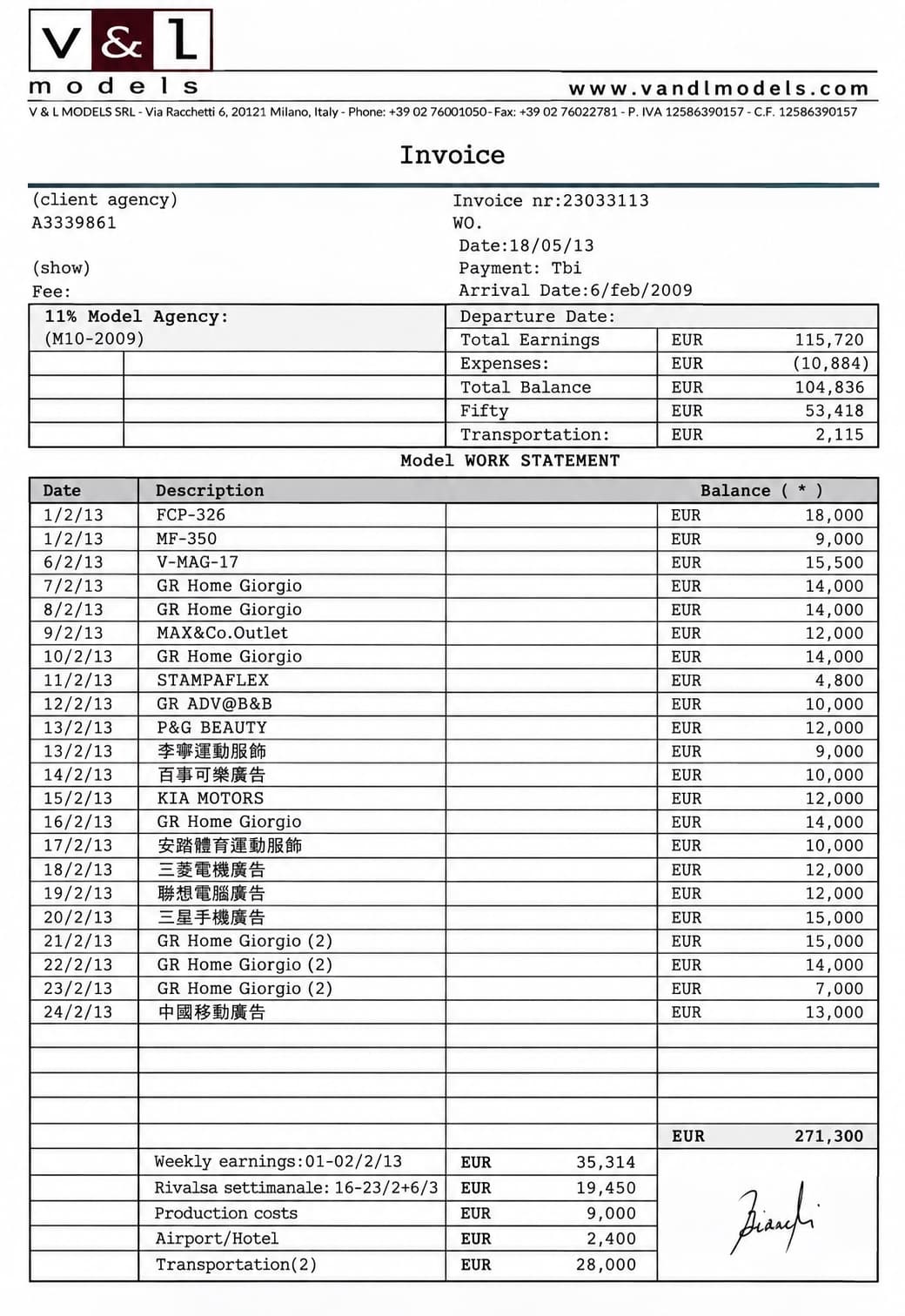
- The model statement is the account of it all: every job, the commission, every advanced expense and the final balance.
- You should receive one after every trip to an agency abroad, even if you did not work a single job.
- Balance = fees minus commission, taxes and advanced expenses. A positive balance is paid out; ask about a negative one before you travel.
- Check every line against your own notes and booking confirmations, and ask for receipts for the larger costs.
Every model who goes abroad to work needs to see what she or he earned and what it cost. The full account of income and expenses for the stay is set out in the model statement. It is the second most important document after the modeling contract, and every mother agency owes it to the model. We wrote this guide because we know of many models who travelled the world, worked steadily and were still short-changed, some without ever learning what a statement is. Do not simply take an agency's word that two months of constant work earned you nothing. It may be true, but the numbers have to be shown on a statement.
This guide explains how models get paid, what a statement contains, how a fee turns into take-home money, what a sample statement looks like, what a negative balance means and how to check that the numbers are right.
How do models get paid
A model is usually not an employee on a monthly salary. Each job has its own fee, agreed between the client and the agency. The client pays the agency, often weeks or months after the job. The agency keeps its commission, deducts whatever it paid for the model in advance, and pays out the rest. That is why the honest answer to "how much do models get paid" is never the fee alone.
 Model training with SupermodelsTry it in practice with an agency teamIn the model training we work on the walk, posing and working on camera, one to one or in a small group.About the trainingfrom €69
The statement, sometimes called a statement of account, is the document that records all of this for a given period: what you earned, what the agency kept, what it advanced and what is left for you. It is prepared by the agency you worked through: the agency abroad after a trip to its market, the mother agency for jobs at home. Without it you can neither check a payment nor decide whether that market is worth going back to.
What is on a model statement, line by line
| Line | What it is | What to check |
|---|---|---|
| Jobs and fees | Each job on its own line: date, client, type of work, amount | That every job is listed and the amounts match your booking confirmations |
| Agency commission | The percentage of the fee the agency keeps | That the percentage is the one in your contract |
| Taxes | In some countries part of the fee is withheld for tax | Ask for a certificate of tax paid; you will need it for your own tax return |
| Travel and visa | Flights, visa and work permit fees | That the price is real: ask for a copy of the ticket and the invoice |
| Housing | A model apartment or a hotel | The weekly price, how many people shared, and whether it matches what was agreed |
| Pocket money | A weekly advance for food and small costs | That the amounts and the number of weeks match what you received |
| Comp cards, portfolio, tests | Printing of comp cards and pictures, test shoots | That they were ordered with your knowledge and consent |
| Transport and other costs | Driver, courier, SIM card, agency website fee | That you were told about them in advance |
| Balance | Fees minus commission, taxes and expenses | A positive balance is paid to you; if negative, ask what happens to it |
A good statement shows every amount separately. A single line reading "expenses" tells you nothing, so ask for the itemised version. For what an agency may advance and what you should never pay up front, see how to choose a modeling agency.
A sample statement: a two-month trip
The example below is invented. The figures are there only to show how the arithmetic works: real fees, commissions and prices depend on the market and on your contract.
| Line | Amount | Check it against |
|---|---|---|
| Catalogue shoot, 2 days | €2,400 | The booking confirmation and your own notes |
| E-commerce shoot | €1,200 | The booking confirmation |
| Three runway shows | €1,500 | Booking confirmations, one per show |
| Magazine editorial | €300 | Editorials pay little, but the pictures stay in your portfolio |
| Total fees | €5,400 | The sum of all jobs before any deduction |
| Agency commission, 20% | −€1,080 | The percentage written in your contract |
| After commission | €4,320 | Expenses are taken off this amount |
| Flights | −€380 | A copy of the ticket and the invoice |
| Model apartment, 8 weeks at €150 | −€1,200 | The price you were told before the trip, and how many shared |
| Pocket money, 8 weeks at €80 | −€640 | Your notes: when and how much you received |
| Comp cards and printing | −€90 | The printing invoice and your consent |
| Test shoot | −€150 | Whether the test was ordered with your knowledge |
| Transport to jobs | −€120 | How many times you were actually driven |
| Agency website fee | −€60 | Whether you were told about this fee in advance |
| Total expenses | −€2,640 | Every line should have a basis |
| Balance paid to the model | €1,680 | The amount that should reach your account |
The example makes the main point: out of €5,400 in fees the model keeps €1,680, less than a third. Pocket money is not a gift; it is an advance on your own earnings. So the question is not only "what was I paid for the job" but also "what did my stay cost".
From fee to take-home pay
balance = fees − agency commission − taxes − advanced expenses
- Fee. What the client pays for the job. You should know it before you work, from the booking confirmation.
- Commission. The agency's income, typically around 20% of the fee. When you work abroad, the agency there takes the commission and your mother agency receives a share of it. The exact percentages belong in the contract.
- Taxes. They depend on the country. In some, tax is withheld from the fee before it reaches you.
- Advanced expenses. Everything the agency paid for you up front: flights, housing, pocket money, comp cards, test shoots.
The shorter the trip and the fewer the jobs, the larger the share eaten by fixed costs: the flight and the apartment cost the same whether you worked ten days or two.
When and how you receive the statement
Sometimes you can get the statement from the agency's accounts department on the day you leave. If it is not ready, it is sent later to your mother agency. You have the right to see it, and your mother agency must show it to you if you ask, yet models are often not told about this right. A statement is normally a dated, signed document used in the bookkeeping of the agency you worked for. If a mother agency never produces one, something is wrong and you have reason to suspect you are being cheated. It can take a while for a statement to reach the mother agency, but once it has, the agency should tell you and go through the result with you.
A final statement is often late for an innocent reason: clients do not pay agencies at once, so some fees reach the account only weeks or months later. In that case ask for an interim statement that marks which jobs are still unpaid, and agree when the final one will follow. Many agencies now send statements by email or show them in their own system, so "the document has not arrived yet" should not last long.
A negative balance and modeling agency debt
If expenses exceed what you earned after commission, the statement ends in a minus. On a first trip that is not unusual: a new model has no clients yet, while the flight and the apartment cost money from day one. What matters is what happens to the minus next, and that should be clear before you travel.
- Who carries the debt. Usually the minus stays on your account with that agency and is covered from your earnings if you return to it. Whether the agency can demand it back in cash depends on the contract. Ask, and get the answer in writing.
- Guaranteed contracts. Contracts with a guaranteed minimum for the whole trip are common in Asian markets. The statement should then show both the guarantee and the conditions you had to meet. Our guide to modeling in China explains how they work.
- Interest and fines. An advance should not grow. If you find interest or fines nobody mentioned, ask to be shown the clause of the contract they rest on.
What to check: a fair statement and the red flags
It is not only mother agencies that hide statements; agencies abroad sometimes do it too, to keep a larger share of what the model earned. Going through a statement together with the model often turns up expenses that never happened or income that was never entered. That is why a model must always see the statement: it decides how much money she or he actually made.
- Every job on its own line: date, client, amount.
- The commission percentage matches the contract.
- Expenses are itemised, with invoices for the larger ones.
- The apartment costs what you were told before the trip.
- Jobs not yet paid by the client are marked.
- The document is dated, signed and carries the agency's details.
- There is no statement, or it is only "told to you".
- One lump sum for "expenses" with no breakdown.
- Jobs you certainly worked are missing.
- The model apartment costs far more than similar housing in that city.
- Charges nobody mentioned: website, "administration", interest.
- The agency gets angry when you ask for receipts or a copy.
Do not let an agency do as it pleases: ask for a statement after every trip abroad. Even if you did not work a single job, you need to see it to know whether that agency is worth returning to. If you were housed in a plain flat and charged well above the local market rate for it, the agency was not being honest and is not worth a second trip.
These are not isolated stories. In a New York State Senate release on the Fashion Workers Act bill, a model says that in a career of more than a decade they never once received a receipt for the thousands of dollars in deductions found on agency statements, and that $1,200 a month was deducted for a bunk bed in a room shared with four other models.
Keep your own records on the trip
You can only check a statement if you have something to compare it with. From the first day keep notes on your phone or in a notebook:
- Every job: the date, the client, the hours you worked and the fee that was agreed.
- Booking confirmations and the vouchers the client signs after a job: photograph each one.
- Pocket money: when and how much you received.
- Housing: the address, how many people shared, and the price you were told.
- Every expense you were told about: tests, comp cards, a driver.
- Messages and emails with the agency about money: do not delete them.
A model has to know her or his rights and ask for the money earned, and without a statement that is impossible. Always copy your statements and keep the copies.
If you get no statement, or find a mistake
- Ask in writing. Email your mother agency: which trip's statement you want and by when. An email is evidence; a phone call is not.
- Compare it with your notes. Mark every line that does not match: a missing job, a different amount, an unknown expense.
- Ask for documents. Copies of the ticket, the apartment rent and the printing invoices. A fair agency has them.
- Involve your mother agency. It is its job to represent you to the agency abroad and to sort out discrepancies.
- If you are under 18, involve your parents. They signed the contract and have the right to see every statement.
- If nothing helps, see a lawyer. Bring the contract, the statements and your own notes. And draw your conclusions about the agency: our agency catalogue carries models' reviews.
Where the rules are heading
In some places what used to be good practice is becoming law.
- New York State. Under the Fashion Workers Act, in force since June 19, 2025, a model management company must give the model a deal memo with the total compensation and the payment term before the job. Any cost it plans to pay up front and deduct later needs the model's written approval before the charge is made. Commission may not exceed 20%, and a fee to sign is prohibited.
- Northern Ireland (UK). Government guidance for models says an agency can only deduct sums from your earnings if it has set out the fee and services in writing. Money received from a hirer must be passed on within ten days of receipt and held in a separate client account.
Most countries have no such law for modeling agencies, so write the same rules into your contract: an itemised statement after every trip, expenses agreed in advance, and invoices for the larger ones.
The agency's side: why a good agency wants the statement too
For an honest mother agency the statement is a working tool, not a burden. It shows in which market a model earns and in which she or he only runs up costs, whether the partner abroad behaves properly and whether it is worth working with again. A good agency therefore goes through the statement with the model, and with the parents if the model is a minor, and asks the partner about every unclear line itself.
Before your first trip, ask the agency to show you what its partner's statement looks like, and ask what the apartment will cost, what the pocket money will be and what happens if the balance is negative. Still looking for an agency? See the Supermodels open call.
Frequently asked questions
How do models get paid?
Per job. The client pays the agency, the agency keeps its commission, deducts the expenses it advanced and pays the rest to the model. The statement shows each of these steps.
What is a model statement?
An account of income and expenses prepared by the agency: every job and fee, the agency's commission, the costs it paid in advance and the final balance.
When does a model receive the statement?
After every trip to an agency abroad: sometimes on leaving, more often later through the mother agency. If some clients have not paid yet, ask for an interim statement and agree when the final one will follow.
Which expenses are charged to the model?
Flights, visa, the model apartment, pocket money, comp cards, test shoots, transport and other costs the agency paid up front. Each should be shown separately.
How much of the fee does a model keep?
The balance is fees minus agency commission, taxes and advanced expenses. On a short trip with few jobs the costs can take most of the earnings, so the real figure is visible only on the statement.
What happens if the balance is negative?
Usually the debt stays on your account with that agency and is covered from future earnings there. Whether the agency can ask for it in cash depends on the contract, so ask before the trip and get the answer in writing.
What if the agency will not show a statement?
Ask in writing and set a date. If it still does not come, treat it as a serious red flag: take the contract and your own notes to a lawyer and stop travelling through that agency.
Can parents see a minor's statement?
Yes. A parent or guardian signs for a minor and has the right to see every statement and to ask about every line.
Sources
- The Supermodels agency's experience of working with models, their parents and agencies abroad.
- New York State Department of Labor, New York State Fashion Workers Act FAQs.
- nidirect, the Northern Ireland government website, Entertainment and modelling work.
- New York State Senate, release announcing the Fashion Workers Act bill, with models' statements gathered by the Model Alliance.


Comments (0)
No comments yet. Be the first!
Only logged-in users can comment. Register — and you'll be able to share your thoughts on this article.
Register