

In short
- A viking beard is a full, long beard grown without shaving the cheeks, often shaped at the chin and sometimes braided. It takes about four to six months for a full shape and a year or more for a braid.
- The main styles are the full viking, braided, forked, ducktail, short viking and square beard. Your face shape decides which one looks balanced.
- History supports well-groomed beards: combs are among the most common Viking Age finds. Braided beards are possible, but there is little hard evidence for them.
- Care is simple: wash two or three times a week, dry gently, oil or balm the skin and comb downward every day. Trim the edges, not the length.
The viking beard came back with television. When Travis Fimmel appeared as Ragnar Lothbrok in Vikings in 2013, the long, half-wild beard became one of the most copied men's looks of the decade, and it never quite went away. Today it sits somewhere between costume and everyday grooming: a long, full beard, shaped with intent, sometimes braided, sometimes finished with a bead or a ring.
This guide covers the styles, how long each one takes, how to braid a beard yourself, what to buy (and what you can skip), and what the Viking Age itself tells us about beards. If you want the matching hair, read our guide to viking hairstyles.
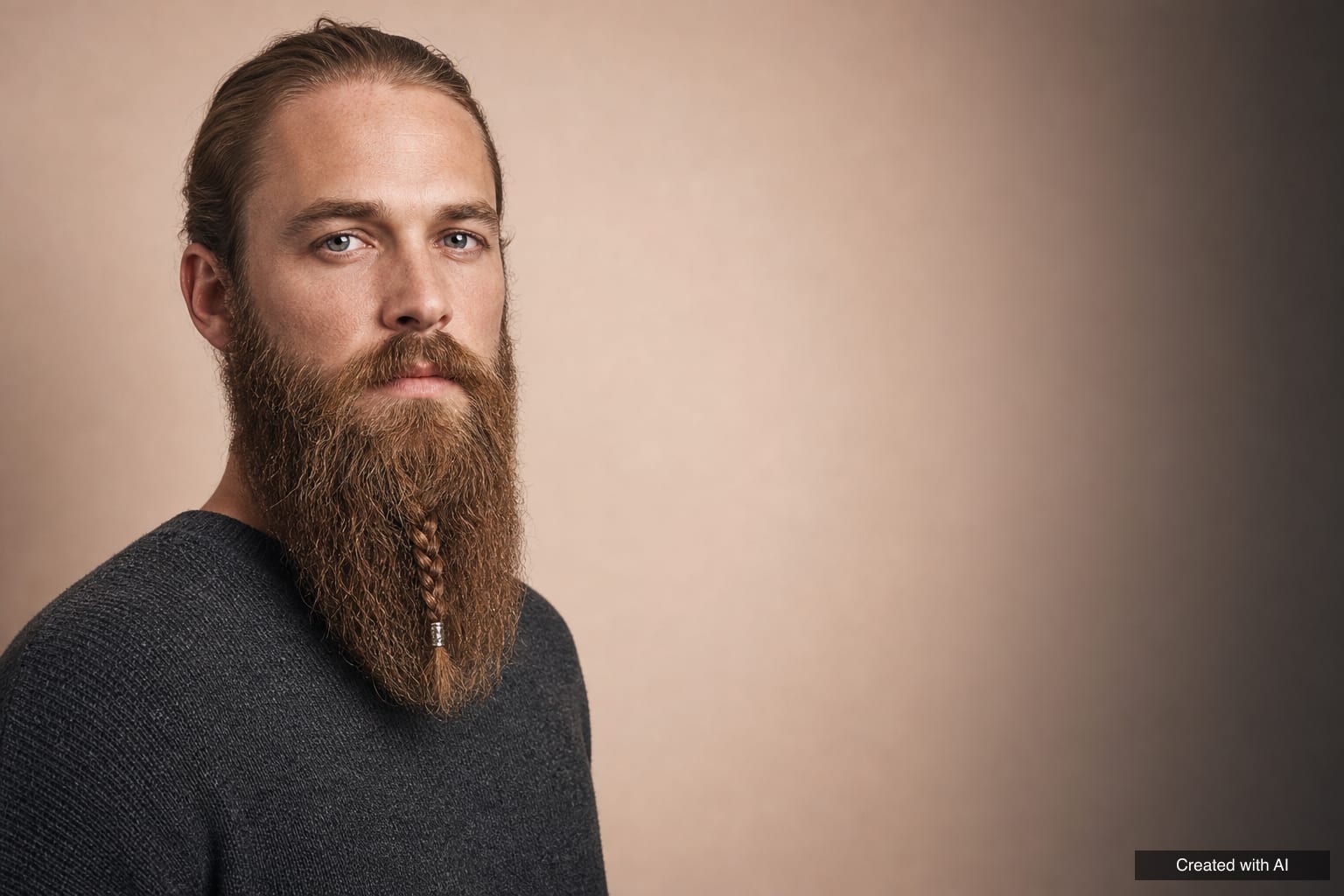
What is a viking beard?
There is no official definition, but barbers and the people who search for the term mean roughly the same thing: a beard that is grown long and full on the cheeks, chin and neck, with a strong natural shape rather than a sharp, sculpted outline. The length is usually at least 8 to 10 cm at the chin. Below that it reads as a regular full beard.
What separates a viking beard from an untrimmed one is intention. The neckline is set, the moustache is kept off the lip, the sides are combed down, and the chin is shaped: rounded, squared, pointed, split or braided. That is also why the style works in a modern wardrobe. With a clean neckline and a combed shape, it looks deliberate next to a suit as well as a knit, and it fits the relaxed end of most men's dress codes.
Viking beard styles
Six shapes cover almost every viking beard you will see, from the short office-friendly version to the long forked one. The photos below show the same model with each style, so you can compare the shapes directly.
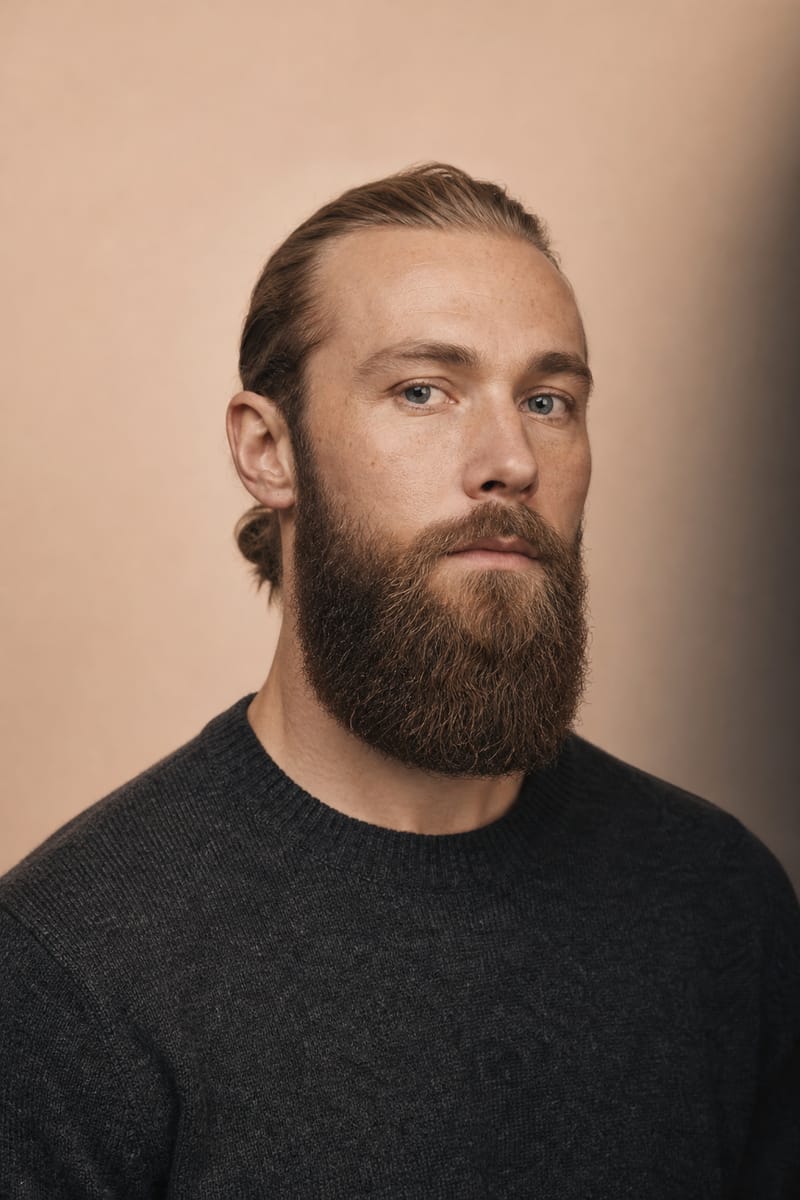
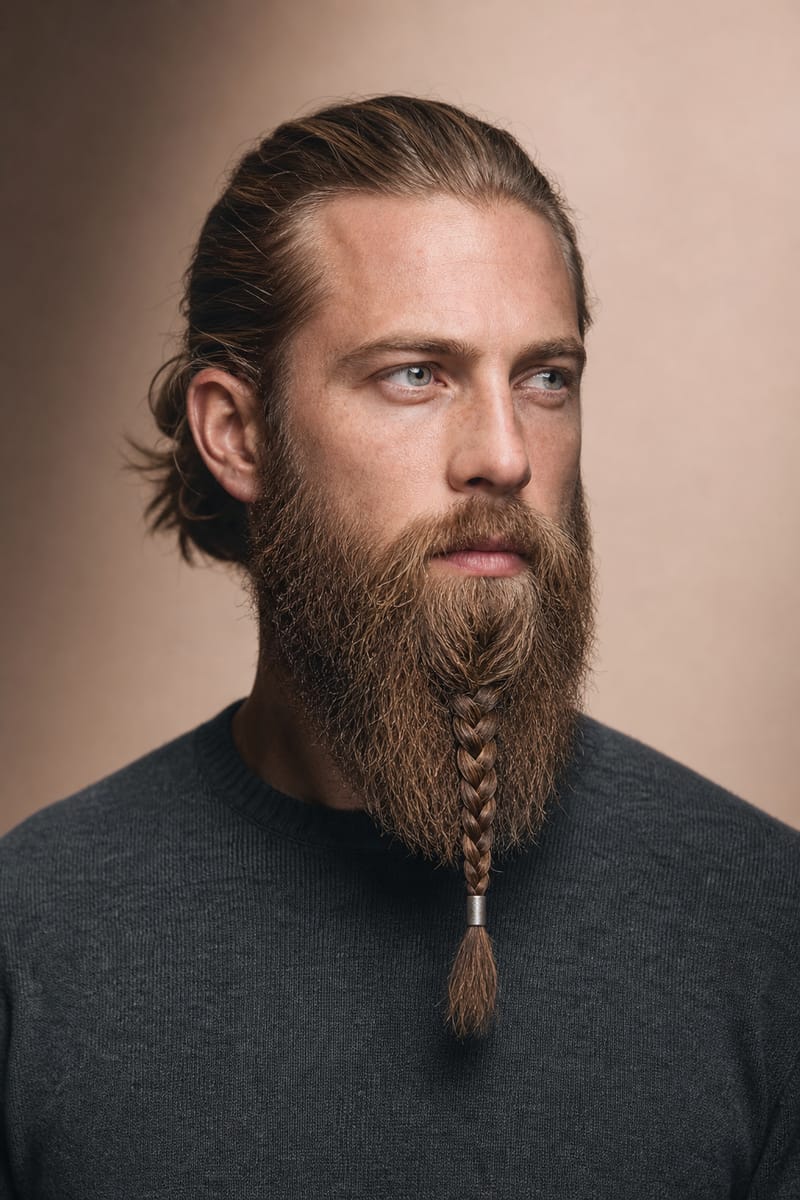
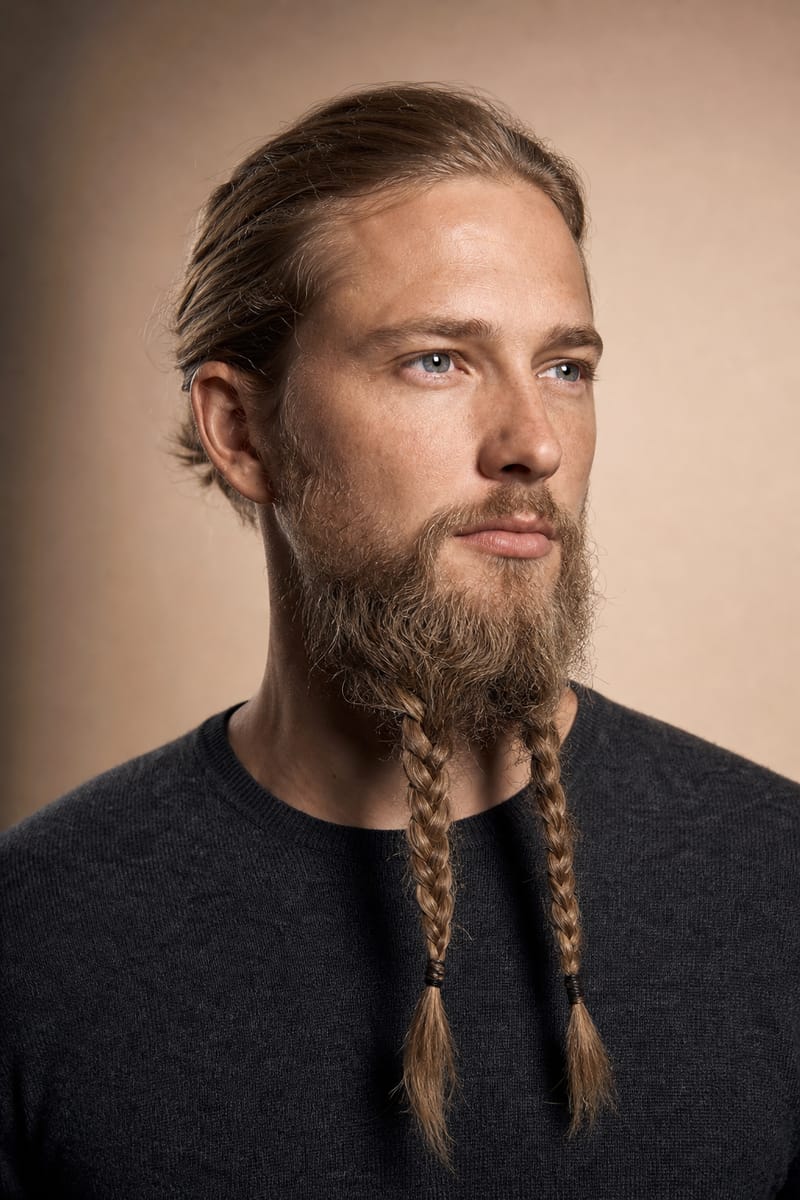
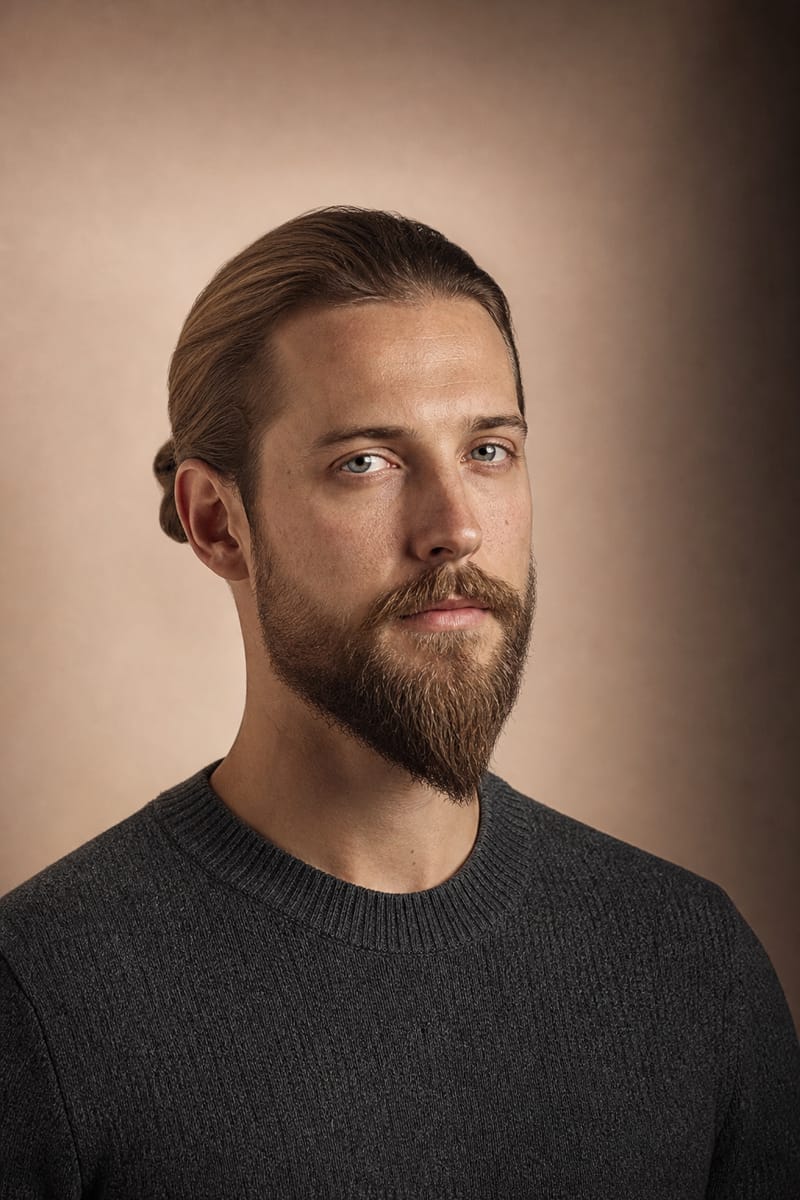
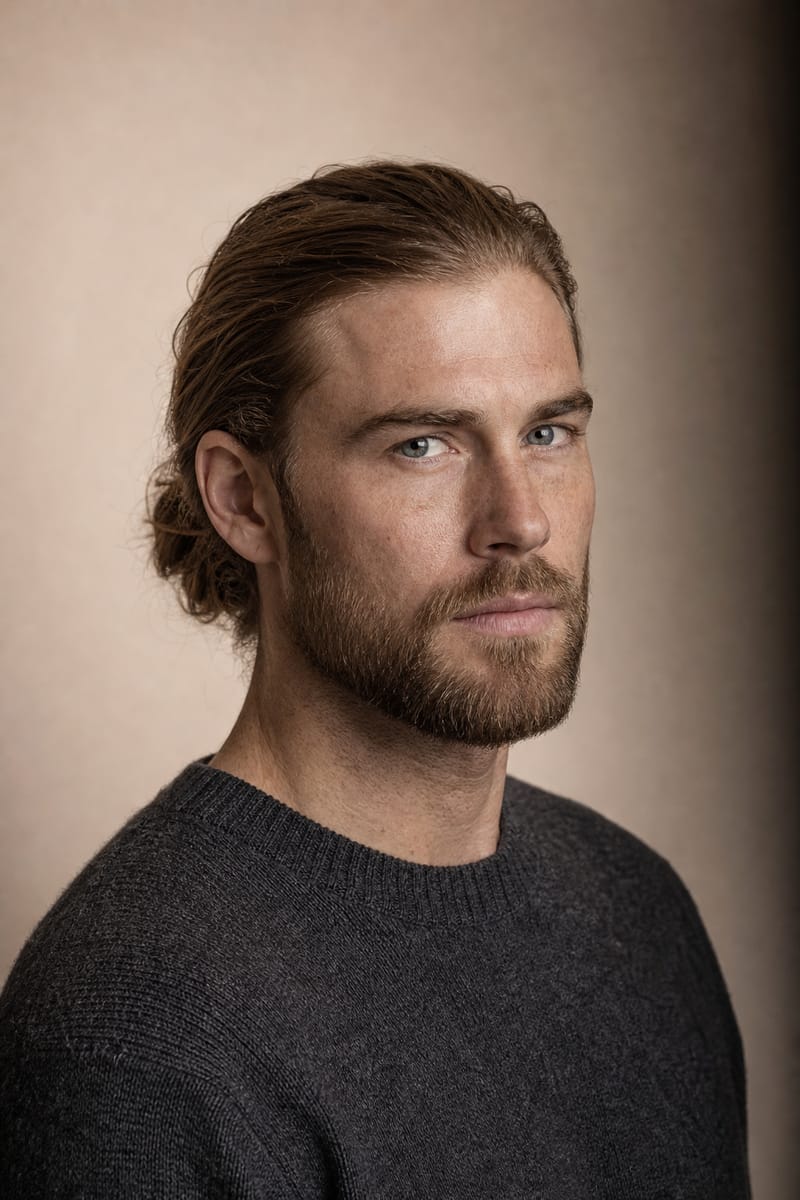
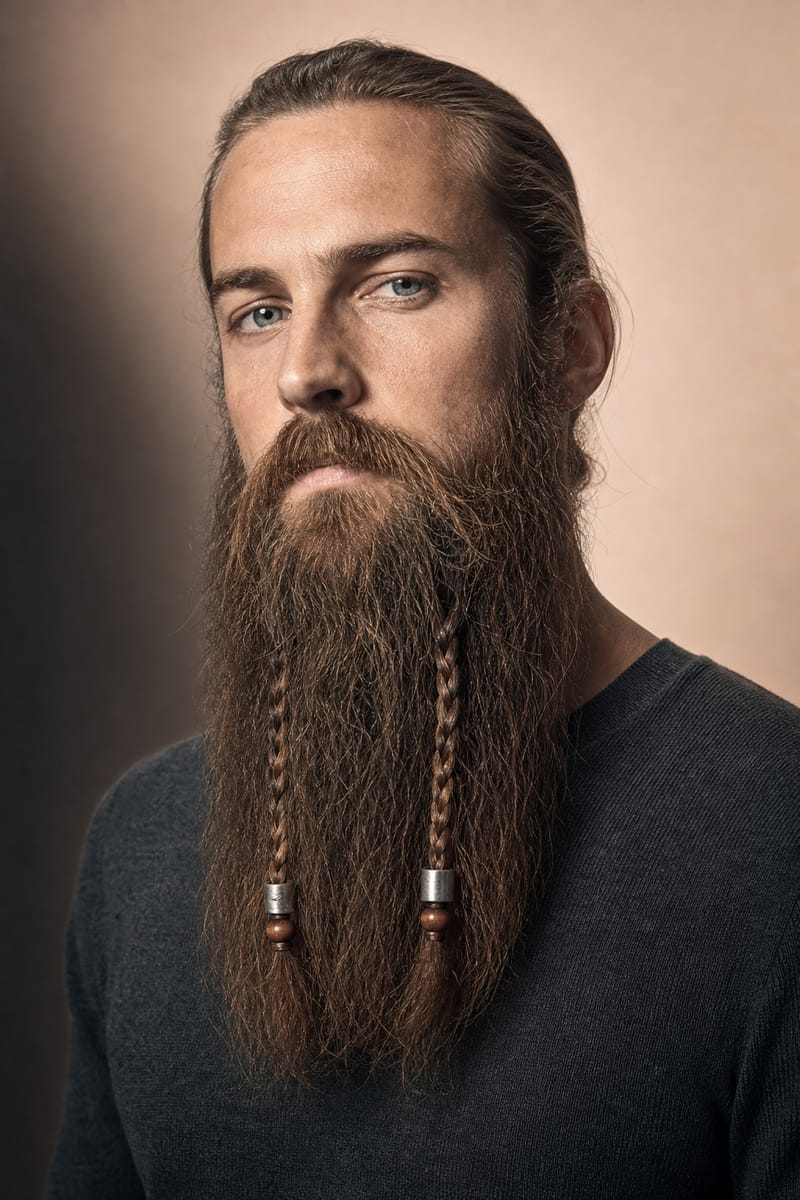
| Style | Length at the chin | Time to grow* | Daily effort | Best for |
|---|---|---|---|---|
| Short viking beard | 2–4 cm | 2–3 months | Low | Work, first beard, long faces |
| Square viking beard | 5–8 cm | 4–6 months | Medium (edges) | Round and oval faces |
| Ducktail | 6–10 cm | 5–8 months | Medium | Round, oval and diamond faces |
| Full viking beard | 8–15 cm | 7–12 months | Medium | Oval, square and heart faces |
| Braided beard | 12 cm + | 10–14 months | High | Oval, round and heart faces |
| Forked beard | 15 cm + | 12–24 months | High | Oval and round faces |
*Estimated from a growth rate of roughly 1 to 1.3 cm a month. Your own speed may be faster or slower.
Modern viking beard styles
The modern version keeps the length but tidies the frame: a clean cheek line, a neckline set about two fingers above the Adam's apple and a moustache trimmed so it does not cover the lip. It pairs well with an undercut or a tied-back knot. The long-beard version with braids and rings is closer to festival or historical reenactment styling and needs more daily work.
 Image consultationOutfits for your own occasionsIn the consultation we put together outfits for your work, events and weekends from what suits your figure and colours.About the consultationfrom €79
Which viking beard suits your face shape
A beard changes the outline of the face more than any haircut. The rule is simple: add length where the face is wide, add width where it is long. If you are not sure of your face shape, our face shape guide explains how to measure it in a mirror.
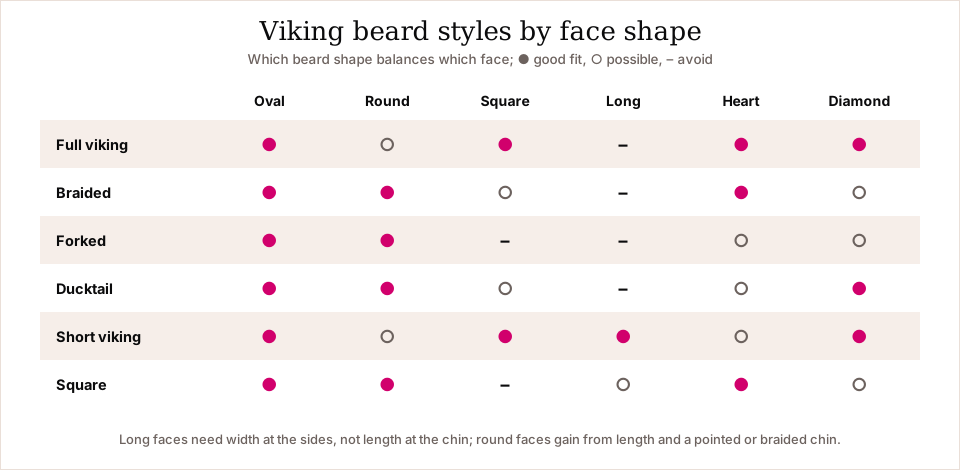
- Round face: choose length at the chin (ducktail, braided, forked) and keep the cheeks shorter so the face looks longer.
- Square face: a full rounded beard softens a strong jaw. Avoid a hard square shape that repeats the jawline.
- Long face: keep it short or medium and fuller on the sides. Very long beards stretch the face further.
- Heart face: a full beard adds weight to a narrow chin.
- Oval face: almost every style works.
How to grow a viking beard, month by month
Beard hair grows roughly half an inch, or about 1.3 cm, a month, with large differences between people. The first months decide whether you keep going, so it helps to know what is normal.
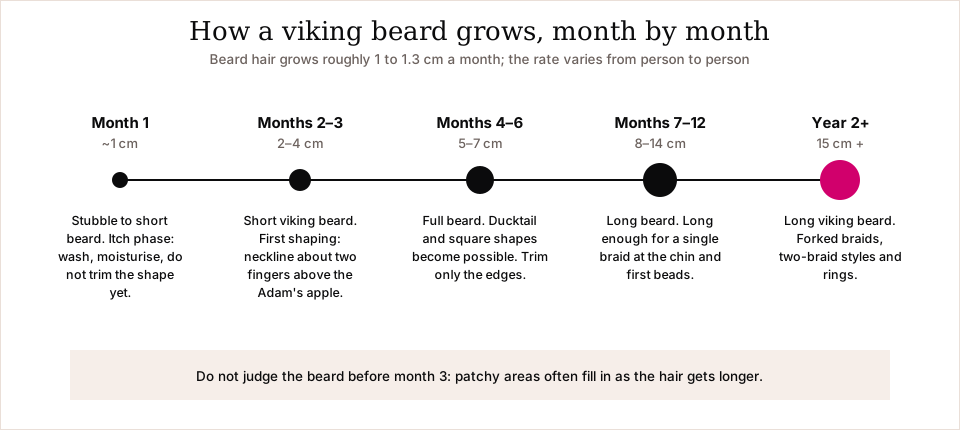
- Month 1: stubble becomes a short beard. The skin may itch as the new hairs curve. Wash the beard and the skin underneath, use a little oil or moisturiser, and do not trim the shape yet.
- Months 2–3: you have a short viking beard. Set the neckline and the cheek line once, and trim the moustache off the lip. Patchy cheeks are normal at this stage.
- Months 4–6: the beard is full enough to shape. Decide on the chin: rounded, square or ducktail. From now on trim only the edges and stray hairs, never the overall length.
- Months 7–12: at 8 to 14 cm a single chin braid becomes possible. Start brushing daily to train the hair downward.
- Year 2 and later: long viking beard. Forked braids, two-braid styles, beads and rings. Split ends appear, so a barber trim of a few millimetres every two to three months keeps the ends neat.
- Brushing downward every day so the hair lies in one direction.
- Letting the moustache and chin grow before shaping the sides.
- Regular sleep, food and patience: growth speed is mostly genetic.
- Trimming the length "to even it out" in the first three months.
- Setting the neckline too high, on the jawline itself.
- Hot water and harsh soap every day, which dry the skin and cause itching.
Trimming and shaping without losing length
A viking beard is shaped at the edges and at the chin, not shortened all over. You need sharp scissors, a trimmer with guards and a fine comb.
- Neckline: imagine a curved line from just below each earlobe down to a point about two fingers above the Adam's apple. Shave or trim everything below it.
- Cheek line: follow the natural line or lower it slightly. Keep it soft rather than razor sharp for a viking look.
- Moustache: comb it down and trim along the lip so you can eat without it getting in the way. Leave the ends long if you want them to blend into the beard.
- Chin shape: comb the beard straight down, hold the shape with the comb and cut the outline with scissors: round, square or a soft point for a ducktail.
- Stray hairs: cut single long hairs that stick out after combing, nothing else.
Trim a dry, combed beard. A wet beard looks longer, and cutting it wet is the most common way to take off more than you intended.
How to braid a viking beard, step by step
A simple three-strand braid works from about 10 to 12 cm of length. Shorter hair slips out. Practise in front of a mirror for the first few times.
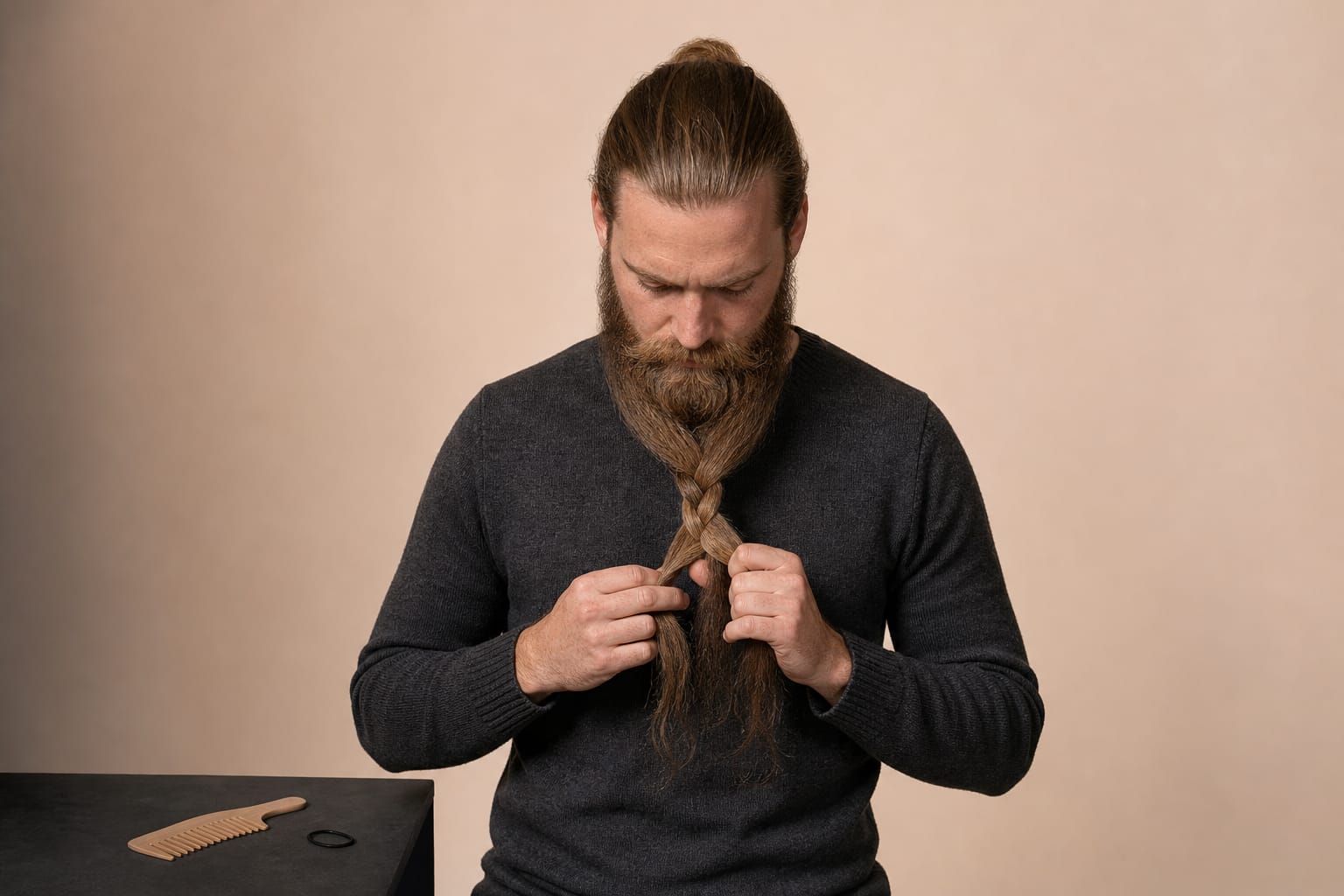
- Wash and dry the beard, then work in a small amount of balm or oil so the hair has some grip and does not frizz.
- Comb the beard straight down and choose a section at the chin about two fingers wide. For a forked beard, take one section on each side of the chin.
- Split the section into three equal strands.
- Cross the right strand over the middle one, then the left strand over the new middle one. Keep the tension even and the braid close to the face for the first crossings.
- Continue to about 2 cm from the end and secure it with a small elastic, a thin leather cord or a bead.
- Comb the rest of the beard down around the braid so it frames it.
Take the braid out at night and comb the beard through: a braid left for days tangles and pulls at the skin.
Viking beard beads and rings
Beads and rings are mostly a modern addition, but they are the easiest way to make a long beard look finished. A few practical points:
- Size: the opening must match the thickness of the braid. Too tight and you pull out hairs; too loose and the bead slides off.
- Material: light materials like wood, bone and thin metal are more comfortable than heavy solid metal. Stainless steel and silver do not discolour the hair.
- How many: one or two are enough. More starts to look like a costume.
- Fitting: thread the end of the braid through with a small hair loop or a folded strand of floss, then secure the braid below it.
- Work and sport: take beads off for contact sports, machinery and anything with moving parts.
Viking beard care: wash, oil, balm, comb
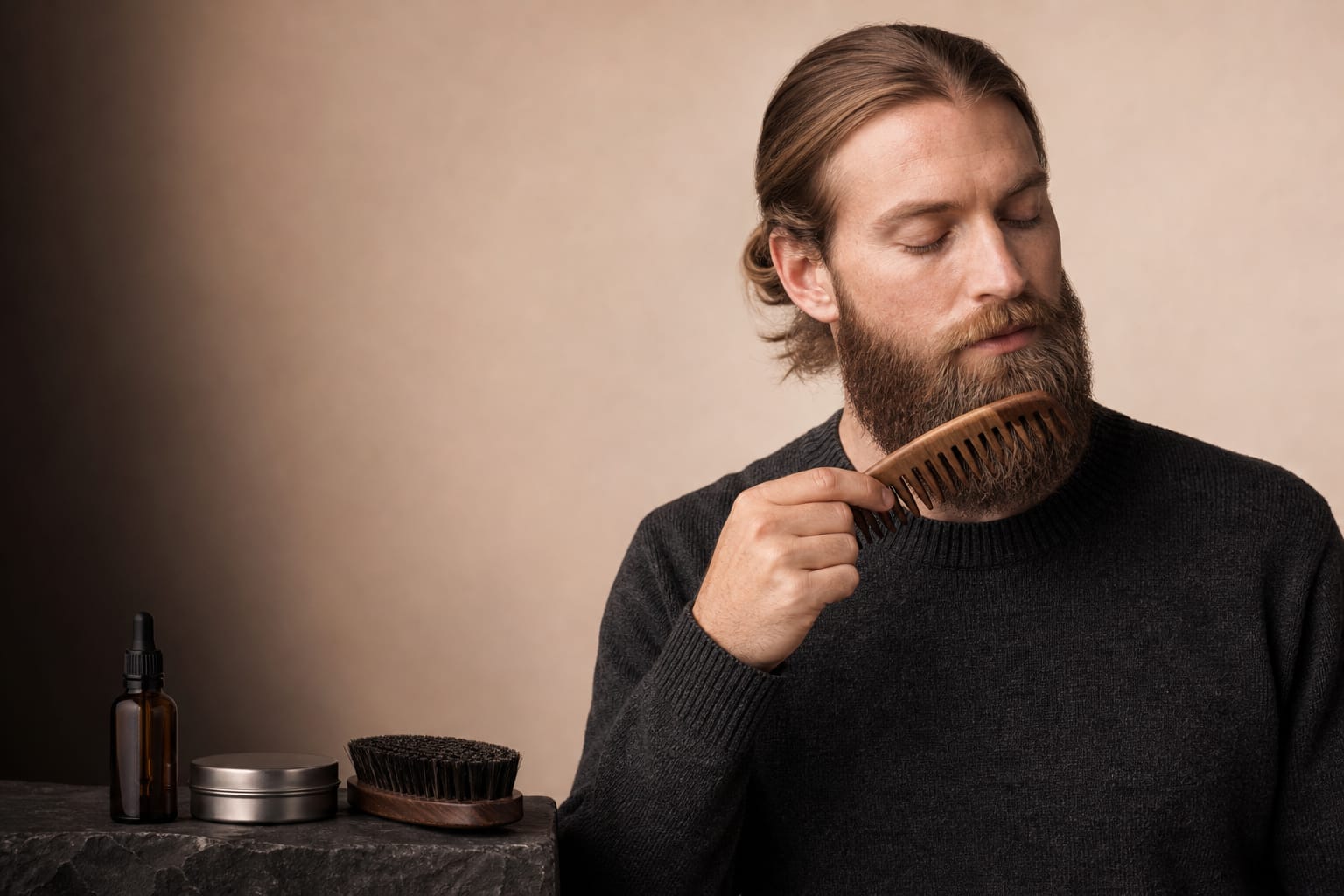
A long beard collects food, dust and dead skin, and the skin underneath dries out more than you notice. The routine below is enough for most men.
| Step | How often | What it is for |
|---|---|---|
| Wash with a mild beard wash or shampoo | 2–3 times a week | Removes dirt and oil without drying the skin every day; rinse with water on other days |
| Towel dry by pressing, not rubbing | After every wash | Less frizz and fewer broken hairs |
| Beard oil | Daily, a few drops | Moisture for the skin under the beard and softer hair |
| Beard balm | As needed | Light hold for stray hairs and braids |
| Wide-tooth comb | Daily | Detangles long hair without pulling |
| Bristle brush | Daily | Trains the hair to lie flat and spreads the oil |
| Barber trim | Every 2–3 months | Removes split ends, keeps the outline |
You do not need a full kit. Search results for viking beard products are dominated by branded oils and gift sets, but what matters is that a product is unscented or lightly scented and that it does not irritate your skin. Test any new oil or balm on a small patch of skin first, and stop if it itches or burns.
Did Vikings have beards?
Yes, as far as the sources show, and many of them looked after them carefully. Combs of bone and antler are among the most common objects found in Viking Age graves and settlements, and they belonged to both men and women. The archaeologist Elisabeth Arwill-Nordbladh notes that a well-groomed beard may have signalled rank and status, and that washing, cutting, combing and braiding could also have been done with help from another person.
The images back this up. On the Gotland picture stones, the most pronounced feature of the male figures is the beard. Two of the most famous rulers of the period carried hair in their names: Svein Forkbeard of Denmark and Harald Fairhair of Norway. The Icelandic sagas, written down two to three centuries after the Viking Age, use the beard as a sign of manhood: in Njal's Saga, men are mocked for being beardless.
What the sources do not show clearly is the modern braided beard with beads. Braiding is possible and is mentioned by researchers as one of the grooming options, but there is little direct evidence of how common it was. The look most people picture today owes as much to film and television costume design as to archaeology.
Ragnar's beard: the look from Vikings
For many people the reference is Ragnar Lothbrok, played by Travis Fimmel in the first four seasons of Vikings (2013–2017). The character's beard grew longer and rougher as Ragnar aged, worn with a shaved head or a braid on top. Off screen, Fimmel wore his own long beard while the series was in production, as in this 2015 photo from San Diego Comic-Con.
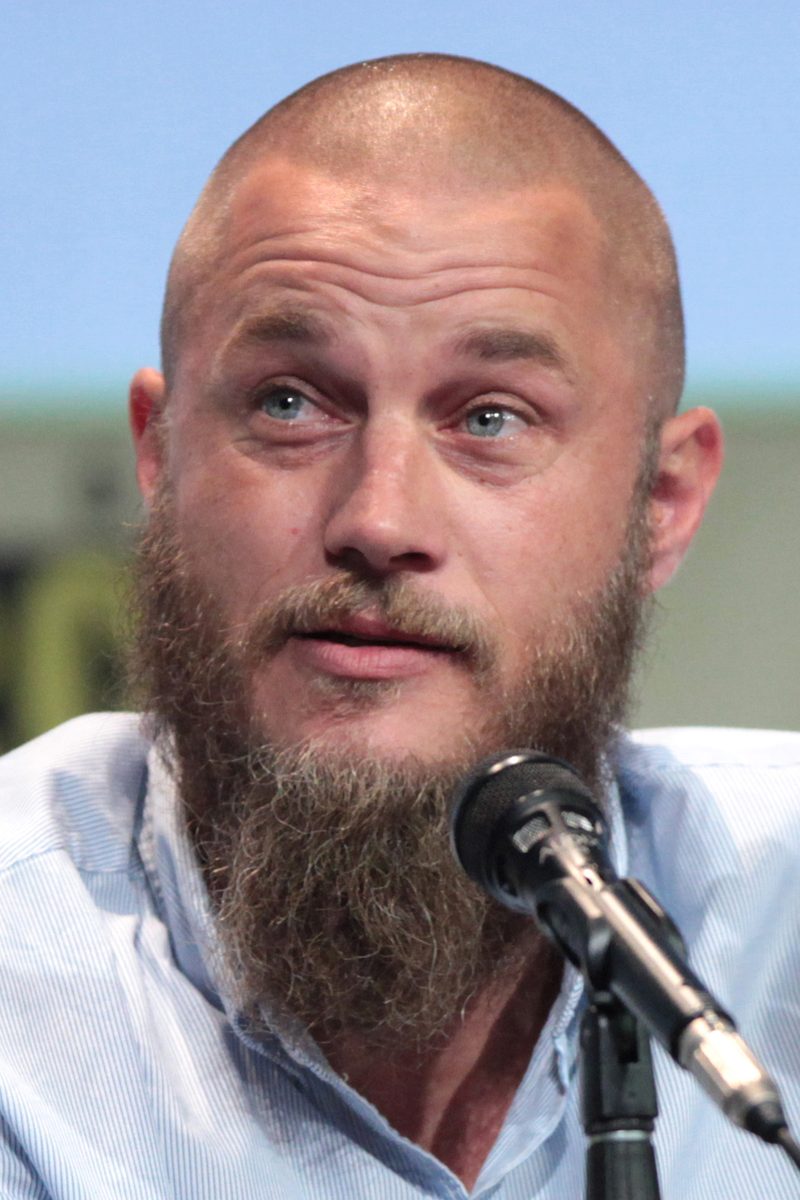
To get close to the Ragnar beard you need a full viking beard of at least 10 to 12 cm, a soft neckline, a moustache that blends into the beard, and less shaping than for an office version. The character's styling changed from season to season, so there is no single "correct" Ragnar beard. Fimmel himself started as a model before acting; read his story from Calvin Klein campaigns to Ragnar in our Travis Fimmel profile, and see every series and film in Travis Fimmel's movies and TV shows. For the hair, from undercuts to braids, see viking hairstyles.
Viking beard at work and on set
A well-kept viking beard is accepted in most workplaces today, but length and braids still read as casual. For interviews and formal events, take out the beads, comb the beard straight and trim the outline the day before. Male models with long beards are booked regularly for grooming, outdoor and heritage brands, though agencies usually want a clean outline in the digitals so clients can picture both a styled and a trimmed version. More on how the industry works for men is in our guide to male models.
Frequently asked questions
How long does it take to grow a viking beard?
About four to six months for a full beard that can be shaped, and ten to fourteen months for a beard long enough to braid. Beard hair grows roughly 1 to 1.3 cm a month, but the speed varies from person to person.
How long does a beard need to be to braid it?
At least 10 to 12 cm at the chin for a single braid. A forked beard with two braids usually needs 15 cm or more.
What is a short viking beard?
A full beard of about 2 to 4 cm, squared at the jaw, with a clean neckline. It keeps the rugged look but is easier to maintain and works in most offices.
Did Vikings braid their beards?
Braiding is possible and researchers list it among Viking Age grooming practices, but there is little direct evidence of how common braided beards were. Well-groomed beards and combs, on the other hand, are well documented.
Do I need beard oil for a viking beard?
It is not required, but a few drops a day help with dry, itchy skin under a long beard and make combing easier. Any mild, lightly scented oil works; test it on a small patch of skin first.
How do I keep beard beads from falling out?
Choose a bead whose opening matches the thickness of the braid, thread it on before you finish the braid and secure the end below the bead with a small elastic.
Sources
- Elisabeth Arwill-Nordbladh, "Viking Age Hair", in S.P. Ashby (ed.), Archaeologies of Hair: the head and its grooming in ancient and contemporary societies, Internet Archaeology 42, 2016, doi:10.11141/ia.42.6 (combs, picture stones, beard grooming and status, Njal's Saga).
- Museum Nord, "Hygiene in the Viking Age", checked October 2026 (combs for hair and beards made of bone, wood and antler).
- Business Insider, "6 dermatologist-approved tips to grow a healthy, full beard", checked October 2026 (beard growth of about half an inch a month).
- Wikimedia Commons, "Travis Fimmel by Gage Skidmore.jpg", Gage Skidmore, 11 July 2015, CC BY-SA 3.0.
- Search demand: DataForSEO, Google Ads keyword data for the United States, October 2026 (viking beard 6,600 searches a month, viking beard styles 2,900, braided viking beard 2,400, viking beard beads 880).


Comments (0)
No comments yet. Be the first!
Only logged-in users can comment. Register — and you'll be able to share your thoughts on this article.
Register