In short
- Ireland's model market is concentrated in Dublin: 12 of the 19 agencies in our catalogue work in the capital, and the other seven one each in Cork, Limerick, Waterford, Killarney, Kinvara, Kildare and Bettystown.
- The catalogue lists every business that represents models and does not vouch for them: each profile shows what we found, including fees charged to applicants with their prices, courses, the company's status in the register and press reports.
- Ireland has no licence written for model agencies and no agency association. Two catalogue agencies are on the official list of licensed employment agencies: Fraser Models + Actors and Casting Ireland.
- Nobody sets the commission: the one published scale we found is 10% to 20%. The law forbids an employment agency to charge a fee solely for agreeing to look for work.
- As an EU citizen you need no permit. A model under 16 may work only under a licence, which the employer requests at least 21 days ahead.
The model market in Ireland
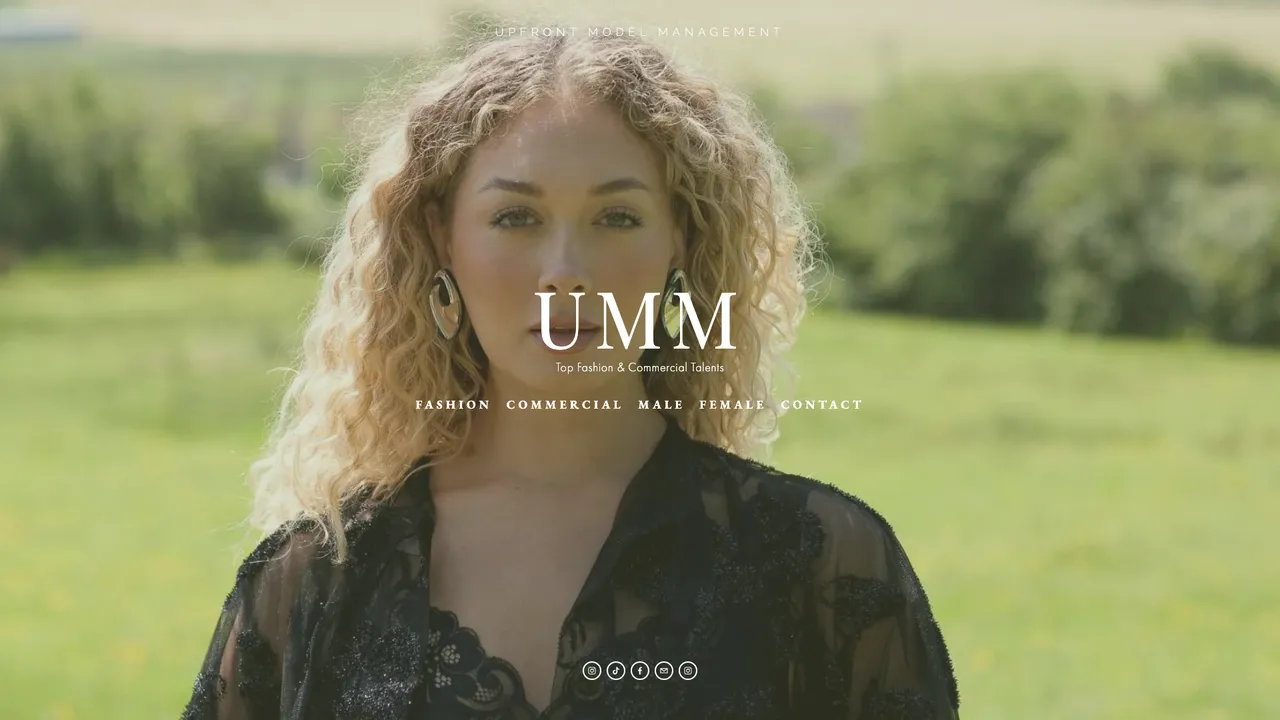
Fashion and advertising work in Ireland is concentrated in the capital. Our catalogue has 12 of its 19 agencies in Dublin. One agency each works in Cork, Limerick, Waterford, Killarney in County Kerry, Kinvara in County Galway, Kildare and Bettystown in County Meath. In Galway city, Kilkenny, Sligo and Wexford we found only dissolved companies or phone-book entries with no website and no model board.
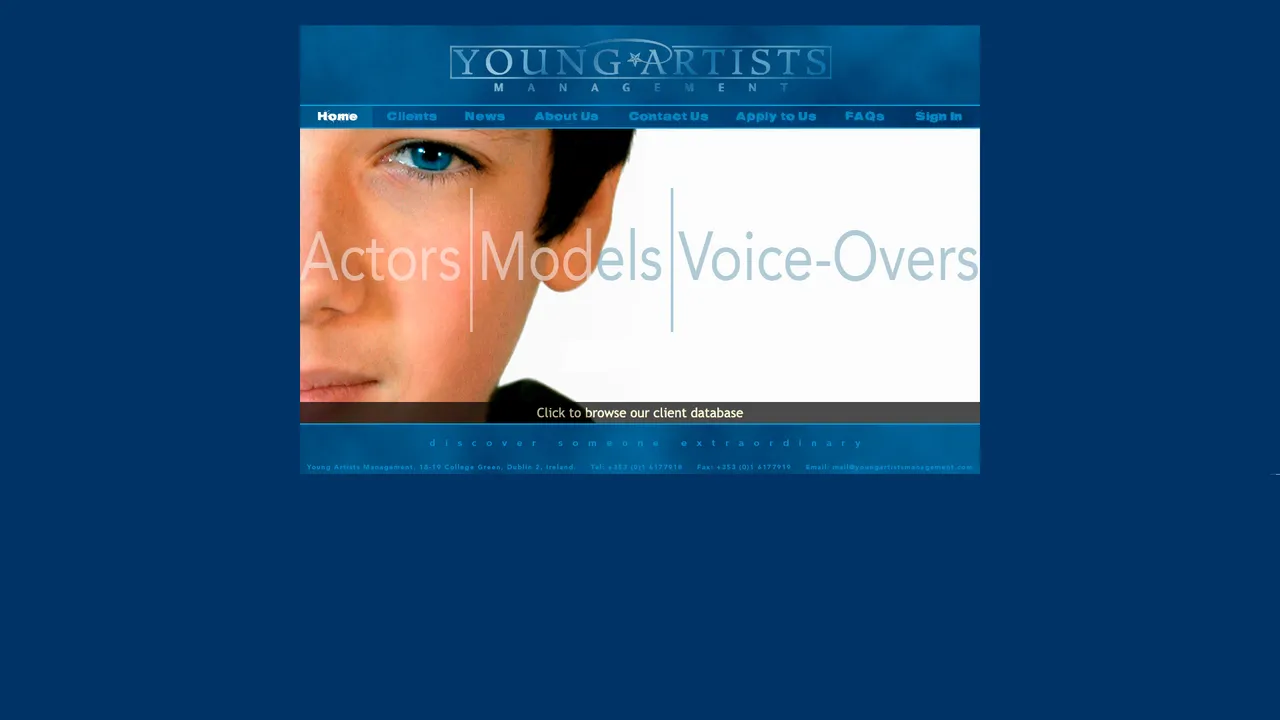
Irish agencies rarely represent fashion models alone. Morgan The Agency represents actors, commercial talent, photographers, stylists, make-up artists and content creators alongside its models. Fraser Models + Actors works with actors for film, television and stage, with models for editorial, catalogue and show, and with children and families. Assets Model Agency has a separate Munster board for the south. Commercials and film bring much of the work: Young Artists Management says most of its casting calls are for TV commercials and feature films. So Ireland is above all a commercial market in which people of every age and look find work.
Local clients include the retailer Primark: it was founded in Ireland in 1969, its first store opened in Dublin, and in Ireland it still trades as Penneys, with 38 stores. The Brown Thomas Arnotts department stores are in Dublin, Cork, Limerick and Galway. We found no data on how many Irish models work through agencies in London or other markets abroad, so we give no figures.
The country's fashion week is Ireland Fashion Week, founded by Ashley McDonnell; the organiser calls it the country's first national fashion week. The first edition ran from 6 to 10 October 2025: by the organiser's count, 55 designers showed across seven shows and more than 2,000 people attended. The second edition runs from 7 to 12 October 2026 with more than 90 designers; it opened at Slane Castle, and some of the shows are in Dublin. The organiser has not announced dates for 2027. The organiser itself supplies the models for every show: it sends the casting details to agencies first, the agencies propose their models, and bookings go through the agencies. The event is also in our fashion calendar.
A few agencies also work as mother agencies that place models in markets abroad. Distinct Model Management, founded by the model agent Anne Morgan, describes itself that way, and the founders of Not Another Intl began putting Irish models forward for international campaigns in 2021.
Northern Ireland is a separate catalogue
This guide covers the Republic of Ireland only. Agencies in Belfast and the rest of Northern Ireland are in our United Kingdom catalogue. The rules there are different: there is no licence, but the conduct regulations name models directly, allow commission from earnings and ban upfront fees charged to fashion and photographic models for a listing on a website or in a book.
How agencies work and what contract you sign
Ireland has no licence written for model agencies and no register of them. It has only the general regime for employment agencies: the Employment Agency Act 1971, in force since 1 November 1972. The Act defines the business of an employment agency widely: it covers seeking work on behalf of others and also supplying, for reward, people who will render services to others. Models, entertainers and artists are not named in the Act or in its regulations.
The Act prohibits carrying on that business without a licence. The Minister for Enterprise, Tourism and Employment grants it, and the Workplace Relations Commission (WRC) processes applications and inspects agencies. A licence costs €500 and lasts one year. To get it, an agency files Garda vetting, two independent references, a statement that its premises meet the standards, proof that its business name is registered and a statement that it will never charge a candidate a fee.
The WRC publishes the list of licensed agencies. The list as at 1 October 2026 has about 1,084 licence numbers, and we found two agencies from our catalogue on it:
- Fraser Models + Actors (Fraser Models and Actors Limited, licence EA 3637);
- Casting Ireland (Production Operations Limited, trading as The Production People and Casting Ireland, licence EA 2180).
We did not find the other catalogue agencies on the list, either by trading name or by the legal names we know; an entry under a legal name we do not know cannot be ruled out. Whether a model agency must hold the licence is not confirmed: the WRC writes that all employment agencies operating in the State must hold one, but we found no official statement, no prosecution and no court ruling about model agencies. So we do not write that an agency without a licence works unlawfully. An entry on the list is a plus, and its absence proves nothing.
What the law says about fees
Section 7 of the Act sets two rules. An employment agency may not charge any fee solely for agreeing to seek employment for someone. Other fees and expenses for services rendered may not exceed a scale approved by the Minister, and a licence-holder must show that scale on demand. The wording does not ban commission from earnings, and the Act has no special rule for models.
The WRC's practice is stricter than the wording: on the licence application form it asks for the fee structure to make sure the agency does not charge the job-seeker a fee. How the WRC treats a model agency's commission on a self-employed model's fee is not confirmed. So we write neither that every fee charged to applicants in Ireland is unlawful nor that the Act does not apply to model agencies.
Commission
No law or association sets the commission. The one published scale we found is that of Young Artists Management: 10% for theatre and radio work, 15% for film and television, and 20% for commercials and print advertising. The application pages of Morgan The Agency, Fraser Models + Actors and Assets Model Agency mention no fee for applicants, and we found no commission rate there. We also found no published Irish agency terms that add a commission for the client on top of the model's fee. Before you sign, ask which commission will apply to you, on what amount it is calculated, and whether the agency also takes a share of payments for usage rights and of a buyout.
Fees for applicants and courses
Some agencies in the catalogue take money from applicants or sell services next to representation. This is what we found on their own websites:
- Casting Ireland: a one-off administration and registration fee of €14.99 per person; it is non-refundable and guarantees no work. The agency also takes a percentage of fees.
- Young Artists Management: no interview or registration fee, but a combined photographic and maintenance fee on registration: €60 for one child, €80 for two, €90 for three and €100 for four (the page gives the amounts without a currency sign).
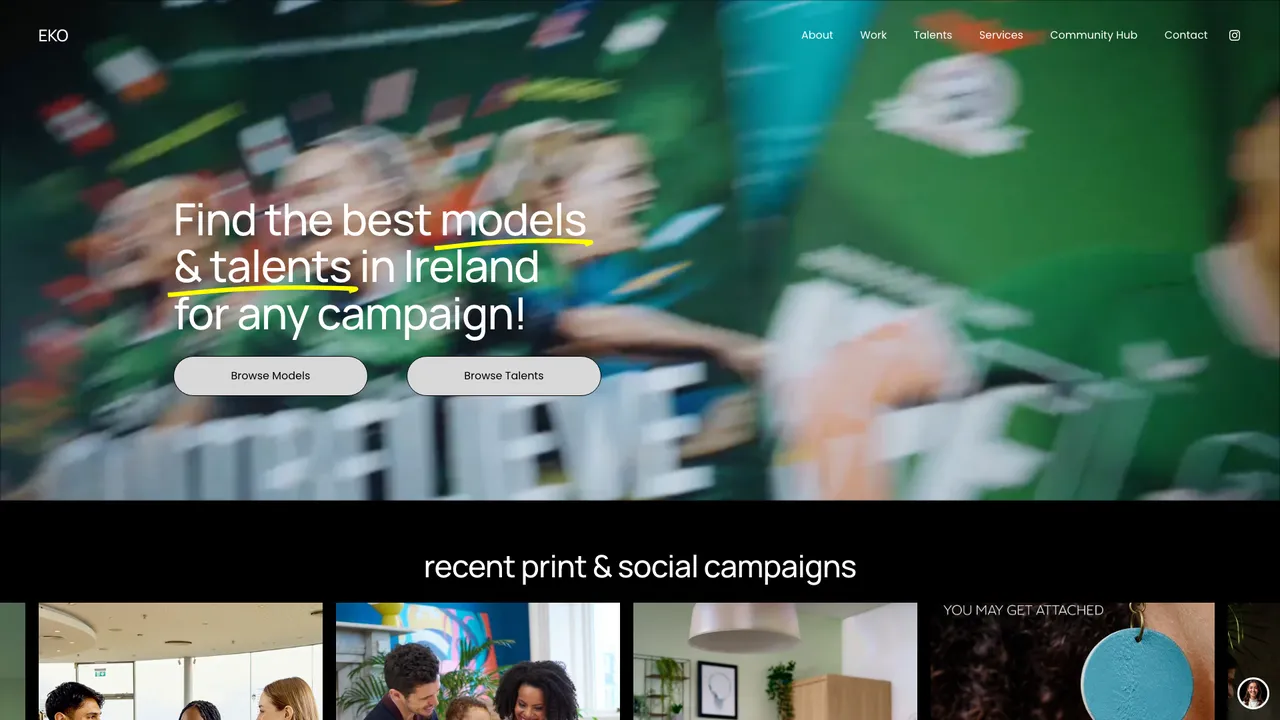
- Eko Model Management: joining is free. The agency calls itself a promotional platform first, with formal representation only while it negotiates a specific job. It sells optional services: a studio headshot day at €60 (4 unedited images), portfolio builds, workshops and one-to-one sessions.
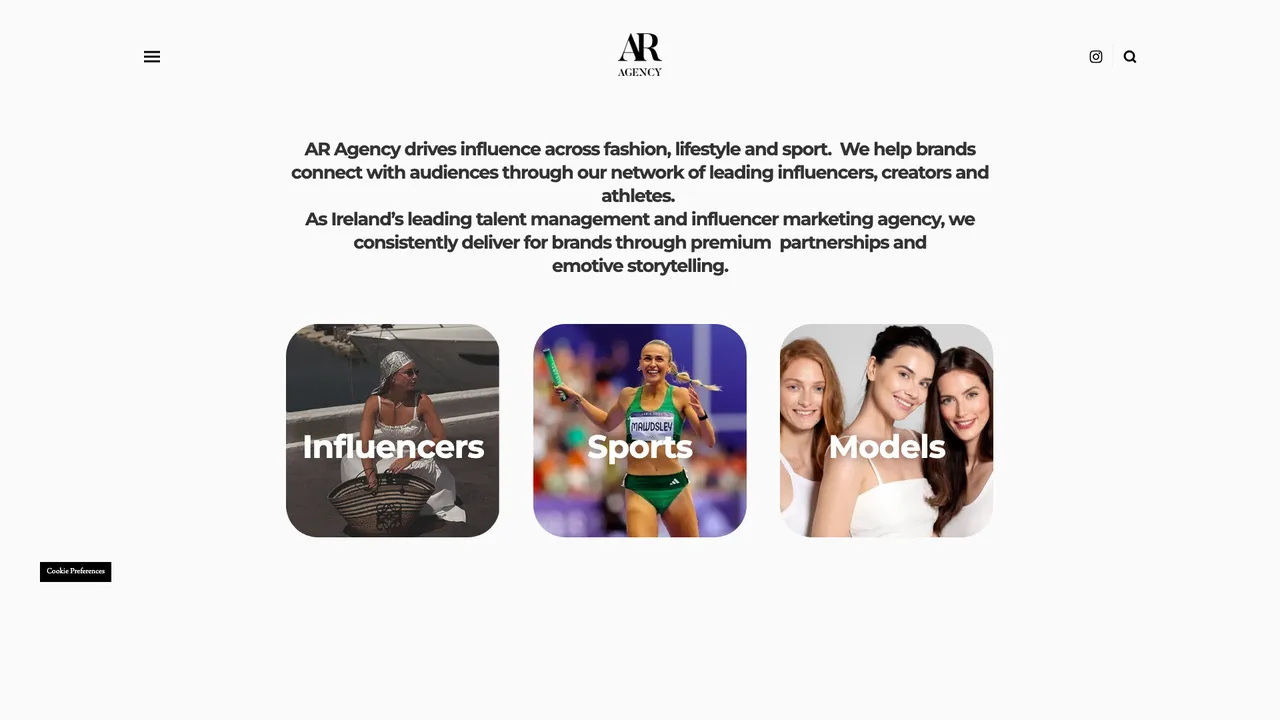
- AR Agency: sells a one-day Become A Model Bootcamp with advice from Andrea Roche, make-up, a portfolio shoot and catwalk lessons. We found no price on the page, so ask for it.
- Prima Model Agency: says it trains its new models; no fee is mentioned.
Young Artists Management describes its payment term publicly: the client is paid once the production company has paid, usually within about a month and sometimes up to three. Ask other agencies about the term yourself, and ask them to confirm it in writing.
Employment status and insurance (PRSI)
Ireland has no separate statute on the status of models. Whether someone is an employee or self-employed is decided under the five-step test that the Supreme Court set out in the Karshan case and that is described in the Code of Practice on Determining Employment Status. The questions are whether there is a bargain to work for pay, whether you must do the work personally, how much control the client has over you, all the other circumstances, and what any specific legislation says. Three bodies decide, each for its own purposes: Revenue, the Department of Social Protection and the WRC. We found no decision about a model or a model agency.
In practice we saw both routes. Young Artists Management pays out a fee after deducting its commission. One licensed extras agency, which is not in our catalogue, pays through payroll and deducts income tax, contributions and USC. Read in your contract which route applies to you.
- A self-employed model pays Class S social insurance (PRSI): 4.2% of income up to 30 September 2026 and 4.35% from 1 October, with a minimum of €650 a year. No PRSI is due if self-employed income is under €5,000 a year. It is paid to Revenue with the annual return and covers pensions and a limited set of benefits.
- An employee pays Class A contributions: 4.35% from 1 October 2026. The minimum hourly wage applies as well: €14.15 in 2026 from the age of 20, and €14.94 has been announced from 1 January 2027, subject to legislation. The minimum wage does not apply to a self-employed booking.
Under EU rules a person who works temporarily in another EU country stays insured at home and proves it with an A1 certificate. We did not check the Lithuanian side, so ask Sodra before you travel. For a short stay a European Health Insurance Card is enough: it covers necessary treatment in the public system. Someone who lives in Ireland, or intends to live there, for at least a year is entitled to public health services.
Boards and requirements
Irish agencies divide their models into boards. In our catalogue 15 agencies each have a women's and a men's board, 9 a talent board, 8 a new faces board, 7 each a kids and a commercial board, 2 each a curve and a senior board, and 1 a sport board. Two agencies have no boards assigned in the catalogue: the Casting Ireland talent pool is visible only after login, and Lockdown Models in Cork has no working website. The mix matches the market: next to fashion models, agencies represent actors, children, families, influencers and commercial models, and two Dublin boards are for mature models.
Fashion boards set height requirements. Morgan The Agency asks for at least 5'8" (about 173 cm) for women and 6' (about 183 cm) for men, and points everyone else to its commercial board. AR Agency takes fashion models from the age of 14 and from 5'9" (about 175 cm), and commercial models from the age of 2. Prima Model Agency in Waterford takes only adults based in the South East: women from 5'7" (about 170 cm) and men from 6'. Runway requirements are covered in the guide runway model, and the types of modelling work are compared in types of modeling.
You can filter the catalogue by board: women, men, talent, new faces, kids, commercial, curve, senior, sport.
How to choose an agency
We do not rank agencies and we do not vouch for them. The catalogue lists every business in the Republic of Ireland that represents models. That includes agencies that charge applicants a registration or photo fee, agencies that sell courses and photo shoots, agencies that also supply promotion staff or extras, and agencies about whose company we found little data. We left out only hostess and promotion staffing firms without models, databases where anyone can sign up, actor-only agencies, schools that represent nobody, and agencies that have closed.
Each agency profile shows what we found, good and bad: the address, boards, founding year and history, the company's name, number and status in the Companies Registration Office (CRO) register, the WRC licence number if the agency is on the list, and also fees charged to applicants with their prices, courses and press reports. We show no association membership, because Ireland has no association of model agencies: the register holds only Irish Model Agency Association Limited, registered in 1985 and dissolved in 1993.
A few facts are useful to know in advance:
- Two companies are listed for strike-off in the register. The company behind Lockdown Models, Lockdown Events & Model Management Limited, has the CRO status "Strike Off Listed", its last annual return is dated 2020 and its website does not open; even so, models credited to Lockdown Models appear in Cork fashion coverage from the past year. The Promo Models website prints no company name; the register has a Promo Models Limited, registered in 2016, whose status is also "Strike Off Listed" and whose last annual return is dated 2019. We made that link by name only.
- Two websites had problems on the day we checked. On 11 October 2026 the pages of Not Another Intl carried dozens of injected links to betting sites, a sign that the website has been compromised. The Distinct Model Management domain showed only a registrar's page that day, so we took its details from archived copies of the site.
- Two agencies are mainly another kind of business. Promo Models mostly supplies event and promotion staff and has a board of commercial models, and Casting Ireland is a casting agency whose talent pool is open to people of all ages and levels of experience.
You can check a company yourself. Section 151 of the Companies Act 2014 requires a company to show, in a prominent place on its website, its name and legal form, its place of registration and number, and the address of its registered office. The CRO's CORE register searches free of charge both companies and business names, which sole traders must register if they trade under a name other than their own. A VAT number can be checked in the EU's VIES system with the prefix IE; small agencies with a turnover under €42,500 may have none. Before you sign, check:
- that the agency has a board that suits you and a live model board;
- whether the website names a company, whether you can find it in the CRO register and what its status is;
- that the contract is in writing and states in figures the commission, duration, scope of exclusivity and how to end it;
- whether the agency charges for registration, photos or courses, how much, and whether the charge is compulsory;
- how long after a job you will be paid, and how you will see deductions on your statement;
- that you can take the contract home and show it to a lawyer.
A longer checklist is in the guide how to choose a modeling agency, and risky contract clauses are covered in modeling contract.
Under-age models
The Protection of Young Persons (Employment) Act 1996 treats as a child anyone under 16 or still under the school-leaving age, and as a young person anyone older than that but under 18. Children under 16 may not be employed, except for light work from 14 and licensed work in cultural, artistic, sports or advertising activities. The WRC issues the licence on the Minister's behalf if the work is not likely to harm the child's safety, health or development or to interfere with school.
- The employer applies in writing, at least 21 days before the work starts.
- The application gives the child's details, the consent of a parent or guardian, the nature of the work, the reasons for employing a child of that age, the duration including rehearsals, any night work and the sums the child will earn; the signed contract and the school principal's agreement to any absence are attached.
- The conditions the WRC publishes for film licences depend on age: a child under 7 may be at the place of work for up to 5 hours a day, between 09:30 and 16:30; from 7 to 13, up to 7½ hours, between 09:00 and 17:00; over 13, up to 8 hours, between 09:00 and 19:00.
- Performing or rehearsing without a rest is limited to 30 minutes, 45 minutes and one hour respectively, and to 2, 3 and 4 hours a day.
- There is a one-hour meal break and a 15-minute rest for every 3½ hours, and work on no more than 5 days in 7.
- One chaperone looks after no more than 12 children, unless a parent is in charge of the child. If more than a week of school is missed, teaching must be arranged, and the employer arranges the journey home.
- No nude or partly nude work without the parent's express permission.
In 2025 the WRC issued 615 such licences covering 1,342 children. It says itself that applications are typically for television commercials and films. Whether a licence is sought in practice for a photo shoot or a fashion show with a child model, and who counts as the employer when an agency stands between the child and the client, is not confirmed, so ask the agency before the job who files the application.
At 16 and 17 you may work up to 8 hours a day and 40 a week, not before 06:00 and not after 22:00. You are entitled to a 30-minute break after 4½ hours of work, 12 hours of unbroken rest a day and two days off a week. We found no Irish rule on a minimum age or body mass index for runway models.
The agencies' own rules differ: Eko Model Management takes no under-18s, Prima Model Agency takes applicants from 18, First Management asks applicants under 18 for parental consent, and Young Artists Management works with children and young adults from babies to the age of 25.
For parents before a trip to Ireland
- Ask the agency to show you the WRC licence for the specific job, or the application for it.
- Agree in advance who will be the chaperone and where the minor will live.
- Do not let a child go alone to "castings" in hotel rooms or private apartments.
- Do not agree to unlimited usage rights for the child's images.
Taxes
You become tax-resident in Ireland if you spend 183 days or more in the country in a tax year, or 280 days over two consecutive years; if you are present for 30 days or fewer in a year, you do not become resident. A day counts if you are in the country for any part of it, and the tax year is the calendar year. Most Lithuanian models who fly in for jobs remain non-residents.
A resident who works self-employed pays at these rates in 2026 (Budget 2027 was announced on 6 October 2026, so the figures may change from January):
| Tax | Rate in 2026 |
|---|---|
| Income tax | 20% on the first €44,000 (single person), 40% on the balance |
| Universal Social Charge (USC) | 0.5% on the first €12,012, 2% on the next €16,688, 3% on the next €41,344, 8% on the balance |
| Class S PRSI | 4.2% up to 30 September, 4.35% from 1 October |
| VAT | standard rate 23%; registration is compulsory once turnover from services passes €42,500 |
The tax is reduced by the personal tax credit of €2,000 and by the Earned Income Tax Credit of up to €2,000. The return is filed, and the tax paid, by 31 October of the following year.
A non-resident pays Irish tax on income from work done in Ireland. Our sources do not settle how this works for a visiting model, so we do not print a single percentage. This is what is known:
- We found no general withholding tax on a model's fee. The 20% Professional Services Withholding Tax (PSWT) is deducted only by government departments, local authorities, the health service and state-owned bodies; the services listed include marketing and advertising. So 20% may be withheld when the public broadcaster RTÉ or another state body pays, but not when a private brand or agency pays. A non-resident can claim the tax back.
- We found no special withholding tax on visiting entertainers on Revenue's website.
- The Ireland–Lithuania double tax treaty was signed on 18 November 1997, given effect by S.I. No. 503 of 1997 and has applied to income tax since 6 April 1999. Under its article 14, income from independent work is taxed only in your country of residence unless you have a fixed base in the other country; a stay of more than 183 days in any twelve months is treated as such a base.
- Article 17 of the treaty lets the income of entertainers be taxed where they perform. Whether a model counts as an entertainer, and whether a fee for image rights counts as a royalty, to which a limit of 5% or 10% applies, is not confirmed.
- If the client or agency pays you as an employee, income tax, PRSI and USC are deducted through payroll.
So before your first job, ask the agency in writing how it will pay you and what it will deduct, and talk to a tax adviser in Lithuania. We did not check how VAT works when a model living in Lithuania invoices an Irish company. Model taxes in general are covered in the guide model taxes.
Papers and registration (PPS number)
An EU citizen can enter Ireland and stay for up to three months without conditions, and longer when working, self-employed work included. You do not register with the immigration authorities and you need no residence card. Your travel document is a passport or national ID card; Ireland is not in the Schengen Area, so documents are checked at the border. If you only fly in for jobs and keep living in Lithuania, you may not need the steps below at all: ask the agency whether it needs your PPS number in order to pay you.
- PPS number. You need it to register with Revenue and to be paid through payroll. Apply online at MyWelfare.ie with a MyGovID account, then attend an appointment in person; the number arrives by post. You will need a passport or national ID card and proof of address no older than 3 months: a utility bill, an official letter, a bank statement, a tenancy agreement or a letter from your accommodation provider.
- Applying from abroad. If you live outside Ireland and need the number to deal with a specific body, such as Revenue, you can apply online or by post and add proof of the reason. If you intend to move to Ireland, apply once you have arrived.
- When an agency may ask for it. An employer or agency may ask for your PPS number only when you start work, not during recruitment.
- Registering with Revenue. A self-employed person registers for income tax through Revenue's myAccount or ROS; the PPS number becomes the tax reference number. Non-residents who cannot use the online services file Form TR1 (FT).
- Bank account. A bank asks for proof of identity and of address. Whether an agency will pay into a Lithuanian account is a matter for your contract: ask in advance.
Scams and warning signs
We found no warnings from Irish authorities about paid model castings. The agencies themselves have seen the danger: in 2010 the directors of the Cork agency Lockdown told the Irish Examiner that bogus talent scouts posing as its representatives were asking young people for personal details and photographs.
A fee on its own does not mean a scam: some agencies in the catalogue openly charge a registration or photo fee or sell courses, and we say so on their profiles. What matters is whether the price is clear in advance, whether you can take your time to decide and whether anyone is pressing you. Warning signs:
- someone writes in an agency's name from a personal account, and the agency's website shows no such contact;
- a fee whose amount nobody states in advance, or one you must pay at once;
- a contract you may not take home, or one without the commission;
- the website gives no company name and number, and you cannot find the company in the CRO register;
- you are asked for your PPS number or a copy of your ID while you are still being recruited;
- you are invited to a "casting" in a private apartment or hotel, or asked to come without your parents;
- you are asked for nude or underwear photos, especially of minors.
If someone contacts you in the name of an Irish agency, check the contact on the agency's official website or ask your mother agency. No agency should ask for money for a comp card in a social media message. More signs are listed in the glossary entry modeling scams.
How to apply
The safest route to Ireland is through a mother agency: it sends Irish agencies digitals, measurements and a video, and once there is an offer it negotiates the terms. If you apply directly:
- Choose agencies by city and board: the catalogue above can be filtered.
- Read on the agency's profile what we found about fees for applicants, courses and the company's status in the register.
- Take photos in daylight without make-up: face from the front and in profile, and full length. Morgan The Agency asks for plain phone snapshots and writes that it does not require professional photos; Assets Model Agency asks for natural photos too.
- Measure your height, bust, waist and hips accurately and compare them with the agency's requirements.
- If you are under 18, include your parents' contact details and be ready to provide their consent.
- You may have to wait for a reply: Fraser Models + Actors writes that an answer can take four weeks. On the day we checked, Eloi Models was not taking new model applications.
- When invited, ask in writing for the contract, the commission, the payment term, every fee you would pay and who will cover travel and housing.
- Prepare for castings with the guide model castings: how to prepare.
Jurgita.com is owned by the model agency Supermodels, which works as a mother agency and places models with agencies abroad. Applying and the open call are free; how they work is described in Supermodels open call.