

In short
- A runway model presents designers' collections live: at fashion weeks, presentations, showrooms and buyer previews. It is the narrowest branch of modeling, with the strictest physical requirements.
- As a guide: women are usually 174–181 cm (about 5'8.5" to 5'11"), men 183–190 cm (6'0" to 6'3"), with a women's sample size of FR 34–36 (US 2–4). The LVMH and Kering charter bars models under 16 and requires a recent medical certificate.
- Most of the work happens in four cities twice a year: New York, London, Milan and Paris. Before every show a model goes through castings, go-sees and a fitting.
- From a smaller market the route runs through a mother agency, which places the model with agencies abroad. Applying to Supermodels is free and done online.
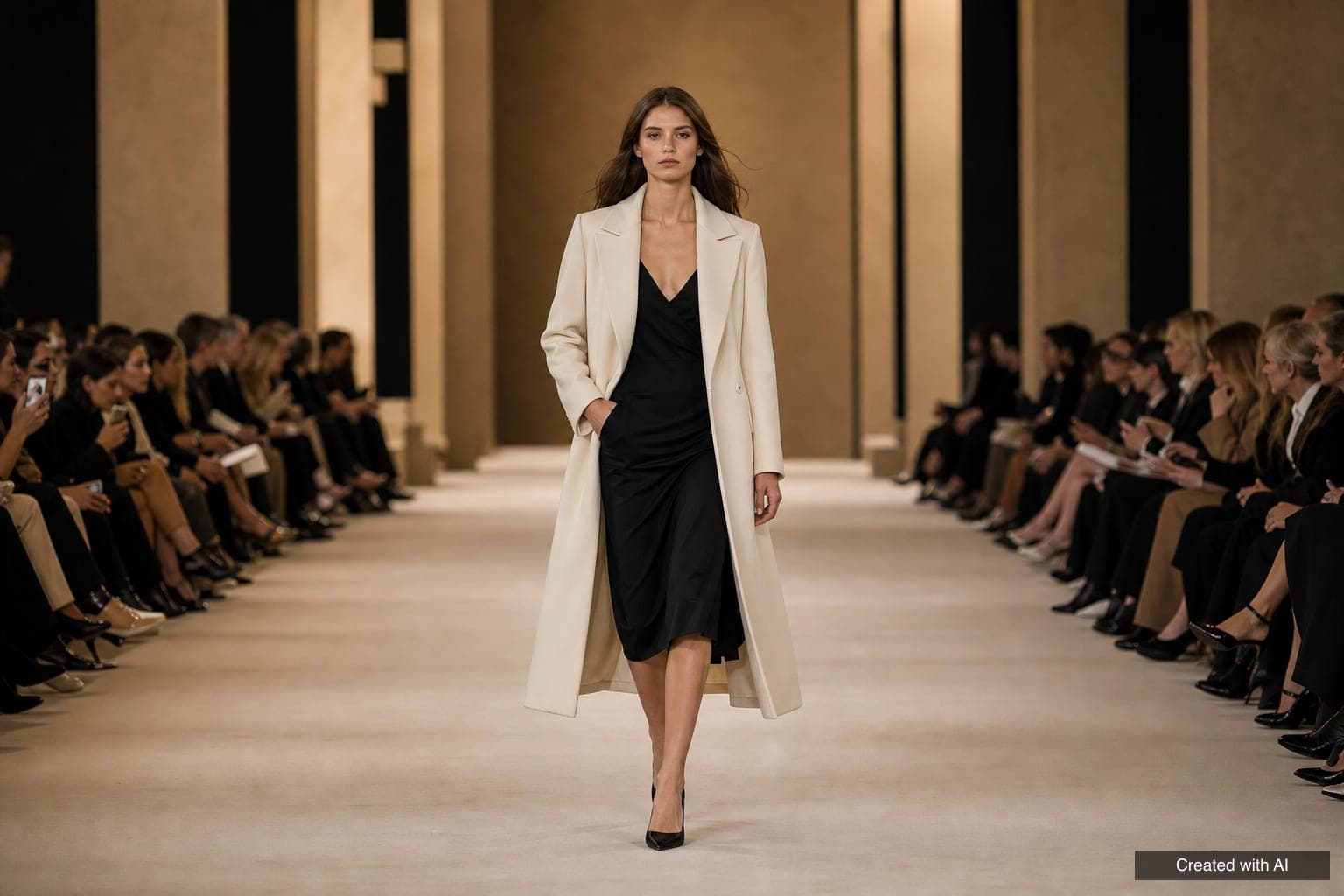
When people say "fashion model", most of them picture the runway: a long dark catwalk, a wall of photographers at the end and a model who has a few seconds to show a garment the way the designer imagined it. In reality it is only one kind of modeling work, and not the best paid. Yet the runway is what opens the door to major campaigns and magazine covers, which is why so many fashion careers start there.
This guide explains what a runway model is, how the work differs from editorial and commercial modeling, the measurements agencies look for, how a season runs from the first casting to the show, what the industry's health charter requires and how to start. For an overview of every kind of modeling work, see our guide to types of modeling.
What is a runway model?
A runway model works in live fashion presentations: fashion week shows, designer presentations, buyer previews and fashion house events. The job is to show how clothes look in motion: how the fabric falls, how the silhouette changes with each step, how a look reads from the front, the side and the back. There is a short definition in our modeling glossary as well.
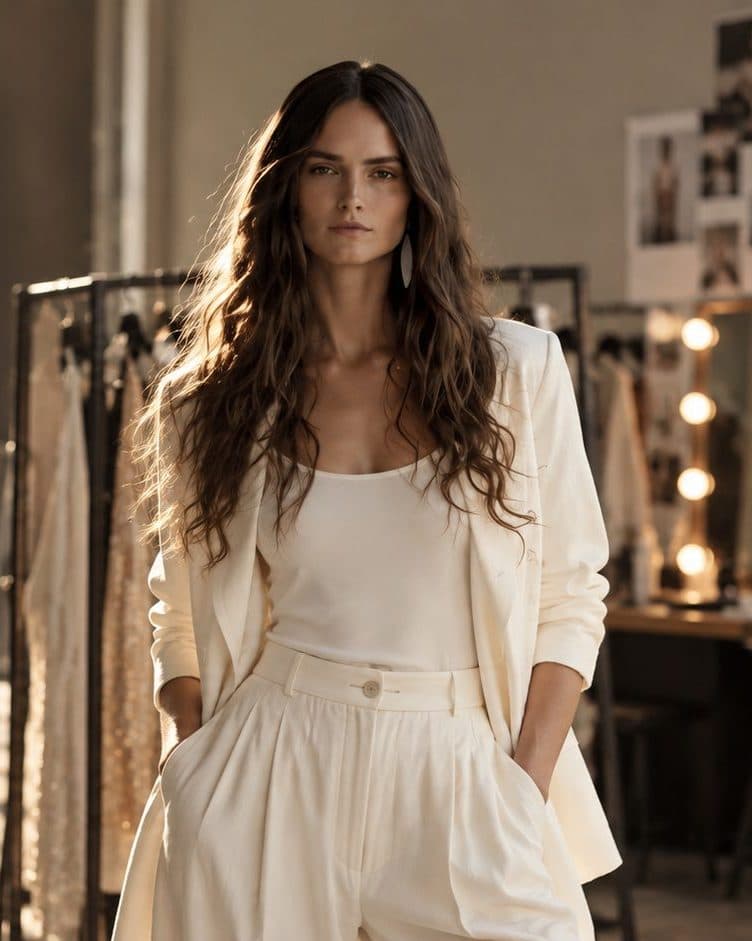 Model training with SupermodelsThe walk is best seen on videoWe film how you walk now and work on posture, stride and the turn until the walk is yours.About the trainingfrom €69
Several overlapping terms are used. "Catwalk model" means the same thing. "Fashion model" is broader and covers anyone modeling for fashion. A "high fashion model" works for luxury houses: their shows, their campaigns and the top fashion magazines. An "editorial model" is booked mainly for magazine stories. In practice most runway models also shoot editorials, so agencies usually keep them on the same fashion board.
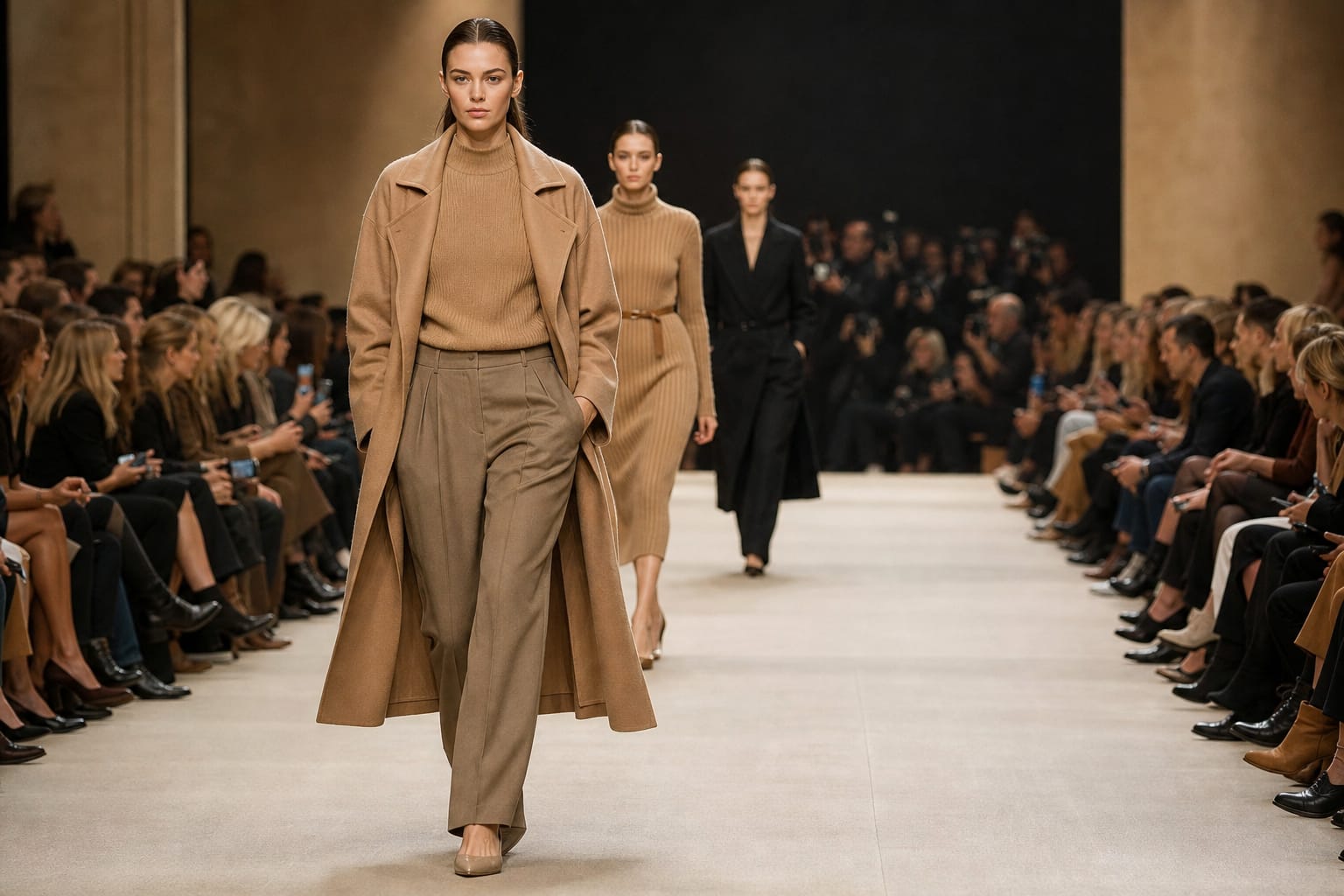
Runway work is not only the big fashion weeks. Houses show resort and pre-fall collections between seasons, haute couture in Paris, private showroom presentations for buyers, and smaller designers show at regional fashion weeks and brand events. In smaller markets, runway work is mostly designer presentations and retail or brand events.
Runway vs editorial vs commercial modeling
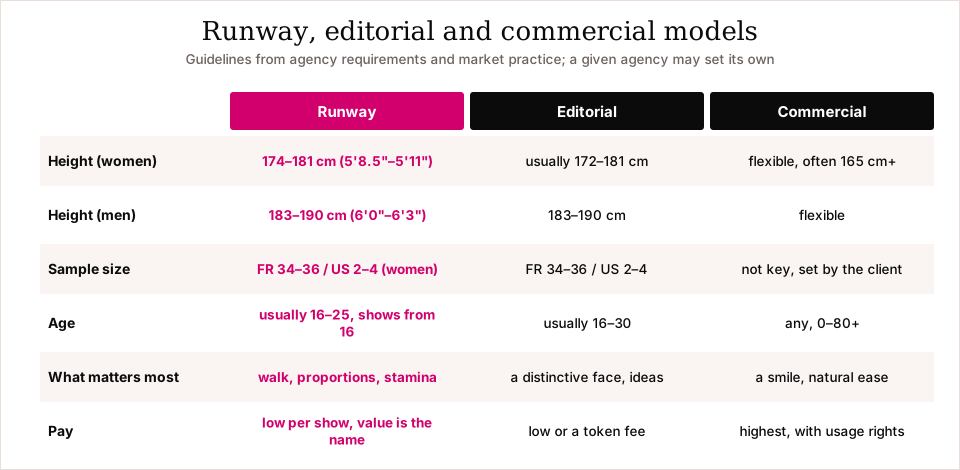
Agencies sort models by the work they suit best. The same person can work across all three, but one of them usually becomes the main line. The difference lies not just in the requirements but in what the client expects from the model.
Runway model
What counts most is proportion, the walk and the ability to wear sample garments without alterations. The clients are designers and fashion houses. A single show often pays little, especially for a new face, but a strong fashion week raises a model's value for every other kind of booking.
Editorial model
An editorial model works on magazine fashion stories, where a photographer and a stylist build a series of images around an idea and the model plays a character. A distinctive, memorable face and the ability to pose in unconventional ways matter most. Editorials pay little or a token fee, but a tearsheet from a good magazine is the strongest advertising a model can have. More in the glossary entry on editorial modeling.
Commercial model
A commercial model sells products to a broad audience: in catalogues, e-commerce, print and TV ads. Height, age and size requirements are far looser; natural ease and believability count most. This is the largest and best-paid part of the market, covered in our guide to commercial modeling.
Runway model requirements: height, measurements, age
There is no single global standard, but the major agencies and houses look for similar numbers. The reason is practical: collection samples are cut in one size, and the runway and lighting are built around tall bodies. Treat the figures below as a guide, not a rule an agency applies mechanically.
| Requirement | Women | Men |
|---|---|---|
| Height | Usually 174–181 cm, about 5'8.5" to 5'11" (Europe usually from 174 cm; Asian markets sometimes from 170–172 cm) | Usually 183–190 cm, 6'0" to 6'3" |
| Measurements | Bust about 80–86 cm, waist 58–63 cm, hips 86–90 cm (roughly 32-24-35 in) | Chest about 92–100 cm, waist 74–80 cm |
| Sample size | FR 34–36 (US 2–4, UK 6–8) | Suit IT 48–50 (US/UK 38–40) |
| Starting age | Usually 15–21; shows for charter houses from 16 | Usually 16–25 |
| Other | Healthy skin and hair, straight posture, comfort in heels, stamina, punctuality, at least basic English |
One important point: nobody should change their body to "reach" these numbers. Agencies look for people who naturally fit what the fashion market needs. If your numbers are different, another kind of work may suit you better: petite models work in commercial and beauty, and plus size models have their own agency boards. How to measure yourself is explained under model measurements, and why height matters so much under model height requirements.
Requirements and work for men are covered separately in our guide to male models. A broader answer to whether anyone can model is in how to become a model.
What a fashion season looks like
The major women's fashion weeks happen twice a year. In February and March designers show fall and winter collections, in September and October spring and summer. The order is always the same: New York, London, Milan, Paris. Men's collections are shown in Milan and Paris in January and June, haute couture in Paris in January and July. Exact dates are in our fashion calendar, and the term itself is explained under fashion week.
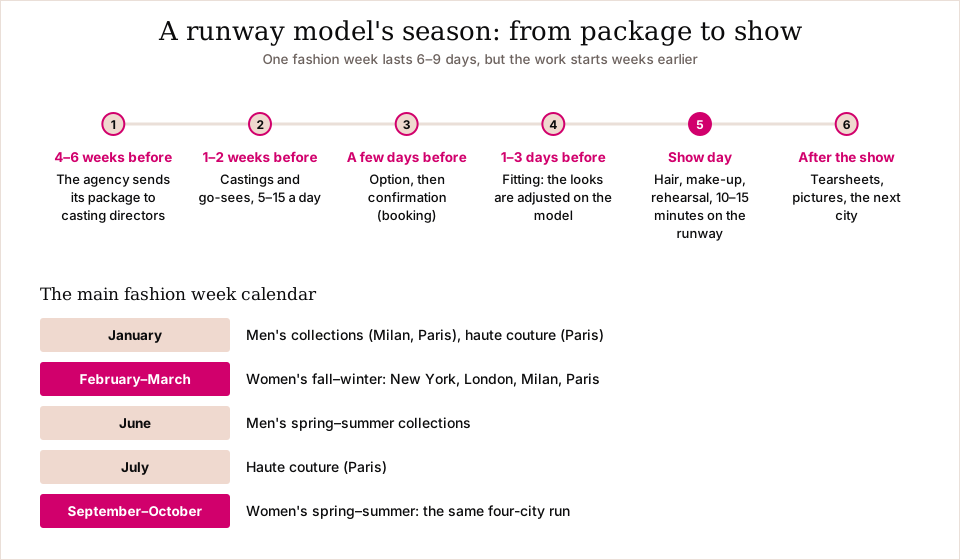
1. The package and casting directors
A few weeks before a fashion week the agency sends casting directors and houses its package: pictures, measurements and short videos of its models. The casting director decides whom to call in. For a new face this stage counts for a lot: with a strong package, a newcomer can get more calls than an experienced model.
2. Castings and go-sees
In the days before the shows a model can attend 5 to 15 castings a day. At a casting they walk a few metres so the team can see the walk, sometimes try on one look, and the agents and designers take pictures. A go-see is a short meeting with a client without a specific job attached, so the client can get to know the model. How to prepare, what to wear and what to bring is in our guide to model castings, and the term is defined under go-see.
3. Option, confirmation and exclusives
If the client likes the model, they place an option and later confirm the booking. Sometimes a house offers an exclusive: the model agrees to walk only their show that season, or only their show in that city. It is a strong career signal, but it means fewer shows and less income that week. How such a deal works is explained under show exclusive.
4. The fitting
Before the show the model comes in for a fitting. The designer and stylist finalise the look, choose the shoes and accessories and photograph the final version. Fittings can take hours and often run late into the night. More on this in our guide to fittings and fit models.
Show day and backstage
On show day the model arrives three to five hours before the start. Backstage, hair and make-up teams get to work, then there is a rehearsal where the producer walks everyone through the route, the turning points and the pace. The show itself lasts 10 to 15 minutes, and each exit on the runway takes a few dozen seconds. If a model wears more than one look, the change takes a couple of minutes with the help of a dresser.
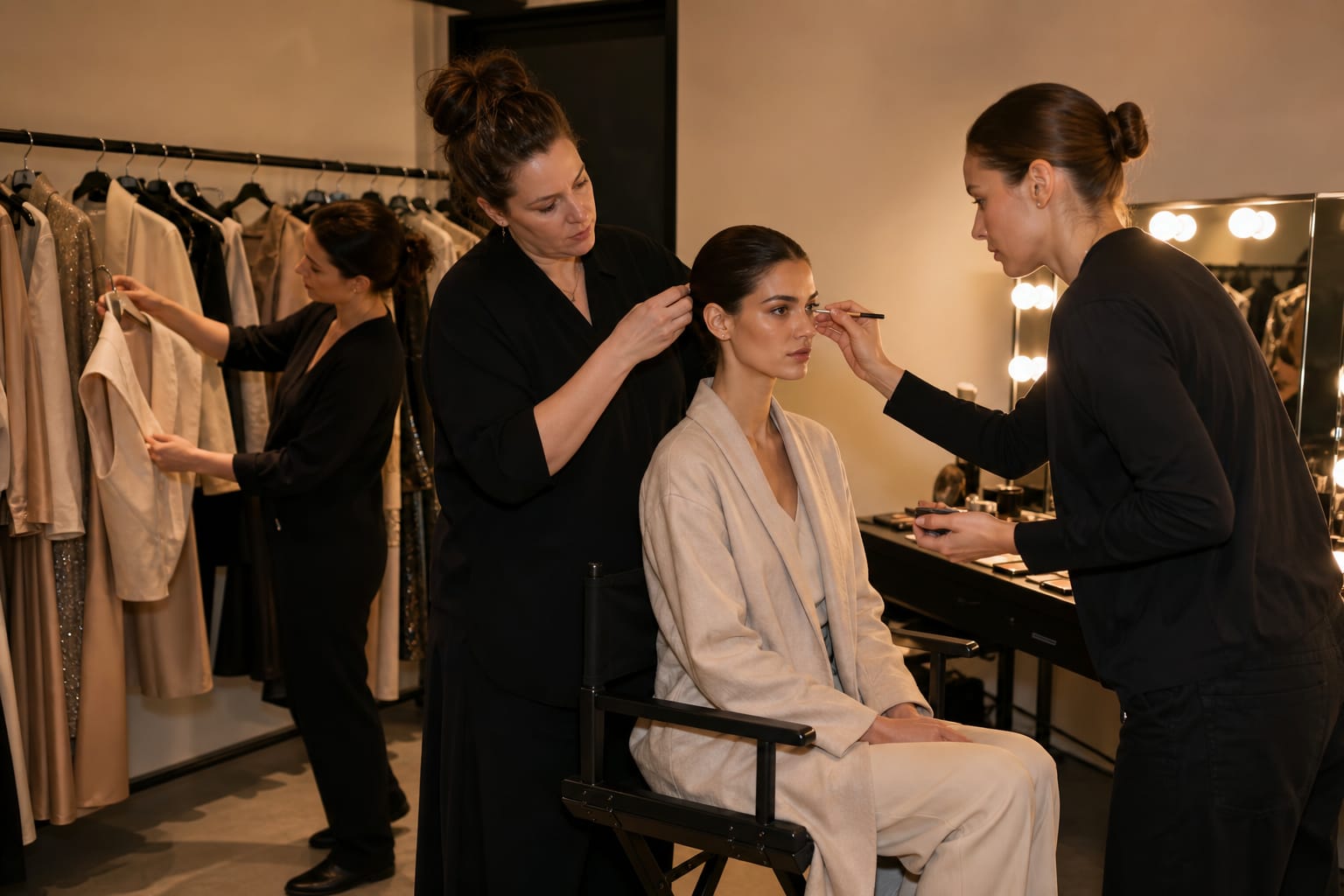
In the busiest days of a major fashion week, an in-demand model may walk two to four shows across the city, so time planning and stamina matter as much as the walk. The walk itself, how to carry your body, where to look and how to turn at the end of the runway is broken down step by step in our guide on how to walk like a model. Backstage vocabulary is in the glossary under backstage.
Editorial work and tearsheets
The runway season and magazine work feed each other. After a strong fashion week, editors and photographers book models for fashion stories, and good editorials in turn catch the eye of houses and campaign clients. That is why a high fashion model's book is usually built from editorials and show pictures.
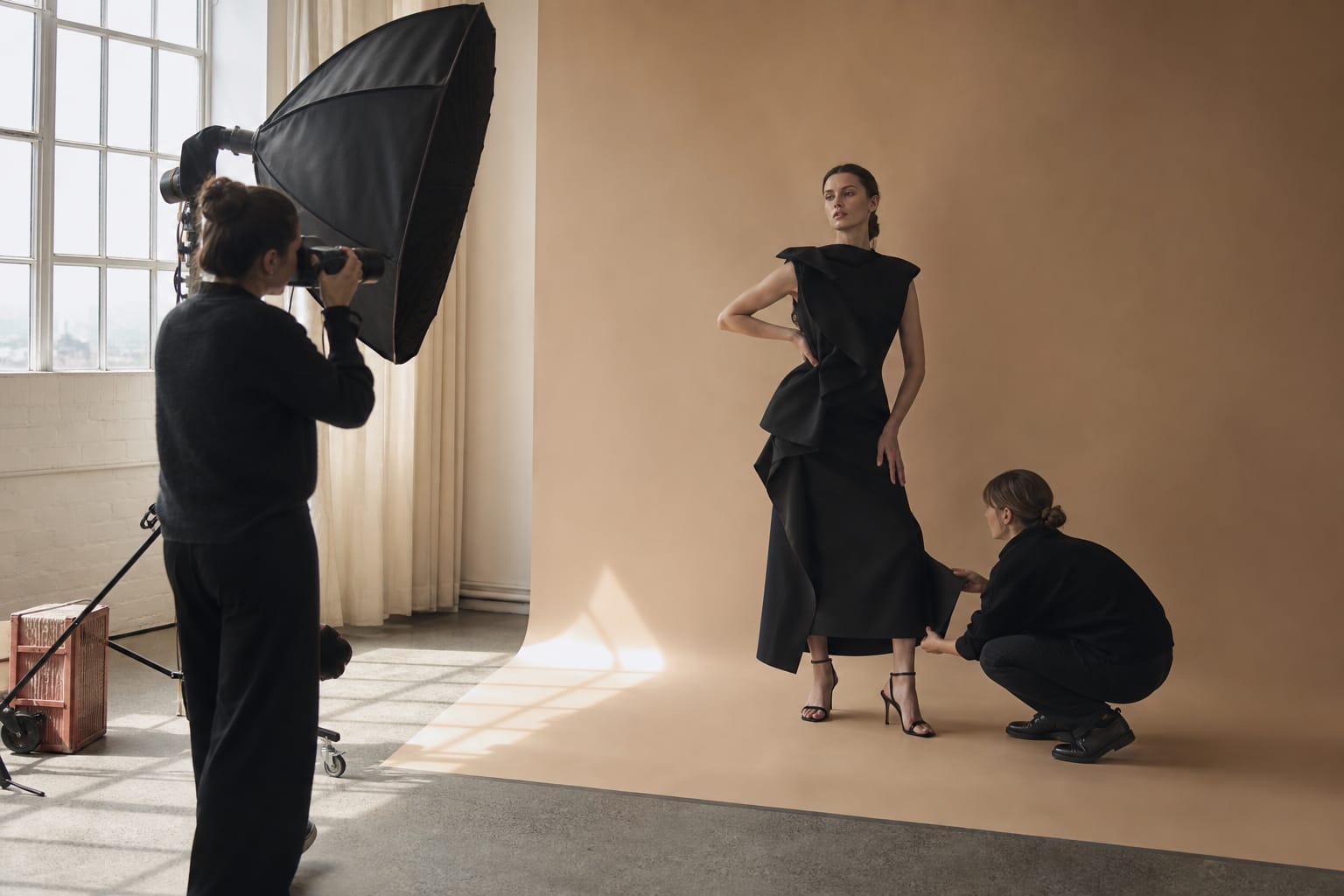
When the issue comes out, the agency requests the tearsheet and adds it to the model's book. What belongs in a portfolio and how to put one together is in our guide to the modeling portfolio, and the card agencies send to clients is covered in composite card for models. The term is defined under tearsheet.
How much do runway models make?
The short answer: less than most people expect. A new face may get a few hundred euros per show at smaller houses, or clothes instead of a fee, and some prestigious shows pay newcomers very little because the exposure is the point. Once travel, accommodation and agency commission are counted, a model's first fashion weeks often end at zero or in debt to the agency.
The runway pays off through what it opens up: campaigns, beauty and fragrance contracts, editorials and a higher day rate for commercial work. Figures by city, show type and fashion week budget are in our separate article on how much runway models make, and the wider picture is in how much do models make.
Health and the model charter
The runway was criticised for years for using models who were too young and too thin. Over the last decade several sets of rules have appeared, and anyone planning to work abroad should know them.
The LVMH and Kering charter (2017)
The two largest luxury groups agreed a joint charter that applies to all of their fashion houses. The key points:
- Women's size FR 32 and men's FR 42 are removed from casting requirements: women must be FR 34 or above, men FR 44 or above.
- Models under 16 are not hired for shows or shoots in which they represent adults.
- Models aged 16 to 18 do not work between 10 pm and 6 am, must be accompanied by a chaperone (who can be a parent), and agencies must make sure they keep up with school.
- Models must present a medical certificate issued less than six months earlier, and a psychologist must be available to them during working hours.
- If call time is more than four hours before the show, it has to be negotiated with the agency; after 8 pm the brand provides transport home.
More on the chaperone role in the glossary under chaperone.
French law
Since 2017, models in France may only work with a doctor's certificate on their health that takes body mass index into account. The certificate is valid for up to two years. Commercial photographs in which a model's silhouette has been made thinner or larger with software must carry the label "photographie retouchée".
New York and the CFDA
The Council of Fashion Designers of America has issued model health guidance since 2007 and now encourages designers not to hire models under 18 for runway shows. Since 19 June 2025 New York State's Fashion Workers Act has been in force: model management companies must register, may not charge more than 20 percent commission or take fees when a model signs, and representation agreements may not run longer than three years or renew automatically.
About your body and weight
No show and no contract is worth your health. We do not suggest changing your weight to fit a sample size. If an agency or client pressures you to lose weight, that is a sign to look for another agency. If you feel pressure about your body or eating, talk to a doctor. In the US you can call or text 988; in the UK, Beat's helpline is 0808 801 0677.
How to become a runway model
Most runway careers outside the fashion capitals follow the same path: a mother agency at home discovers and develops the model, then places them with agencies in Paris, Milan, London or New York. Those are called placement agencies. Both terms are explained in the glossary: mother agency and placement agency.
- Pictures and measurements. Simple snapshots without make-up or filters are enough to start: front, profile and a headshot. These are called digitals or polaroids. You do not need a professional shoot for a first application.
- Apply to an agency. Supermodels, based in Lithuania, invites women aged 14 to 22 who are at least 170 cm tall and men aged 16 to 25 between 185 and 190 cm. Applying is free and can be done online at any time. How applications are assessed is explained in the Supermodels open call.
- Development. The agency arranges test shoots, coaches the walk and posing and builds the book. What a test costs and whether the model should pay for it is covered in model test shoot.
- Placement abroad. Once the book is ready, the mother agency introduces the model to agencies abroad. First trips are often to Asia or smaller European markets, where models gain experience and pictures. What to know before working in China is in modeling in China.
- The contract. Before signing with an agency abroad, understand the commission, advances and contract length. What to check is in our guide to the modeling contract.
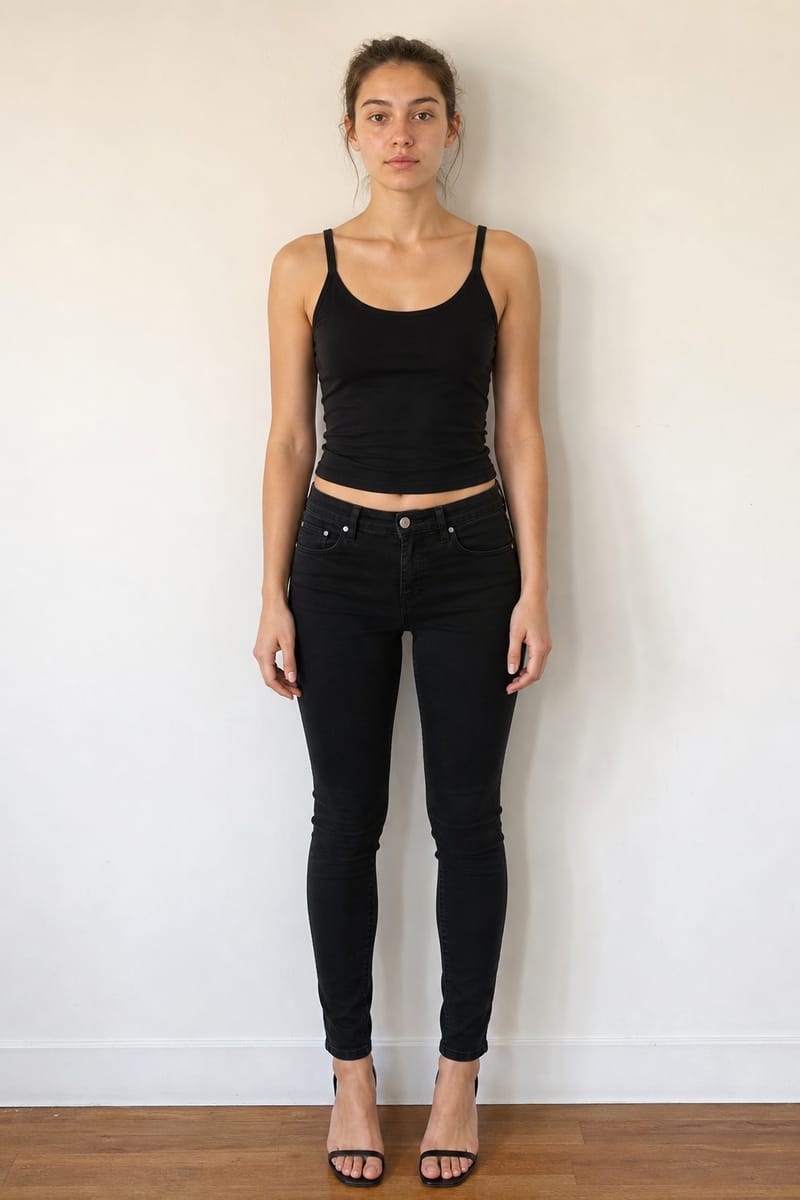
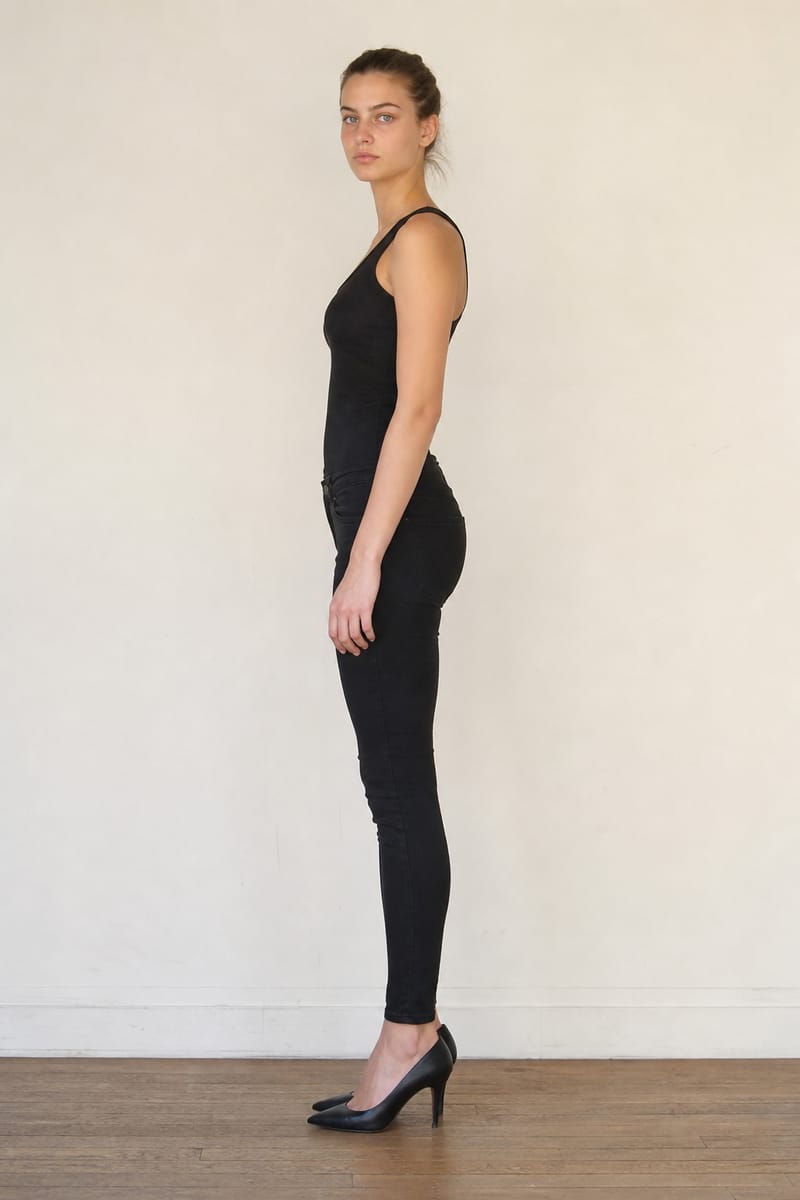
Pictures this simple are all an application needs: a fitted black top, natural hair, daylight and the whole body in frame. Exactly what to shoot is listed under model digitals.
Learn it with professionals
The walk, posing and casting preparation are at the core of the Supermodels Masterclass, an online course led by Jurgita Kiguolė, head of Supermodels, who has prepared models for fashion weeks for more than 20 years. It teaches posing, the runway walk and casting preparation, and explains how agencies, contracts and fashion markets work. The course is in Lithuanian.
Supermodels Masterclass: posing, runway, castings
For in-person coaching, Supermodels runs model training in Vilnius and Kaunas. How it differs from a modeling school and when a school is worth it is covered in modeling school.
A runway career from a small market: Edita Vilkevičiūtė
Edita Vilkevičiūtė shows how far the path from a small country can go. Born in Kaunas, Lithuania, in 1989, she started modeling after a contest she entered while on holiday in Palanga. Her runway debut was the Just Cavalli spring/summer 2006 show in Milan. She went on to walk for Chanel, Balenciaga, Louis Vuitton, Miu Miu and Dries van Noten in Paris, and in the spring/summer 2009 season alone she walked more than 35 shows. In 2015 Forbes included her among the world's highest-paid models. She is 175 cm tall, a reminder that height guidelines are not a hard cutoff.
The models on the highest-paid lists, and what put them there, are covered in highest-paid models.
Mistakes to avoid
Scam warning signs
An agency that charges a registration fee or a "mandatory" shoot or course, promises Paris shows without seeing any pictures, only talks through social media and has no real address. A professional agency earns from commission, not from fees paid by models.
On-the-job mistakes
Being late to castings, using your phone backstage, cutting or colouring your hair mid-season without asking, measurements changing without the agency knowing. Reputations travel fast in fashion.
Two more common mistakes. First, believing the runway is the only path: many successful models earn mostly from commercial work, and fashion weeks are only part of their career. Second, signing a long contract with an agency abroad without understanding which costs will be deducted from future fees. How to read that account is explained in how do models get paid.
Other kinds of modeling are covered across this series: types of modeling, commercial modeling and petite modeling. A directory of agencies by country is in our modeling agencies section.
Frequently asked questions
How tall do you have to be to be a runway model?
Women are usually 174–181 cm (about 5'8.5" to 5'11") and men 183–190 cm (6'0" to 6'3"). These are guidelines: some women work successfully at 172–175 cm, and Asian markets tend to be a little lower.
What is the difference between a runway model and a fashion model?
"Fashion model" is the broader term for a model working in shows, magazine shoots and fashion house campaigns. A runway model is the part of that work done in live presentations.
How old do you have to be to walk in fashion shows?
The LVMH and Kering charter bars models under 16 from shows in which they represent adults; models aged 16 to 18 work only during the day and with a chaperone. The CFDA in New York encourages designers not to book models under 18 for runway shows.
What is a high fashion model?
A model who works for luxury fashion houses: their shows, campaigns and the top magazines. Most are runway and editorial models at the same time.
What is an editorial model?
A model booked mainly for magazine fashion stories, usually with a distinctive face that suits creative, idea-led shoots. Editorials pay little, but tearsheets build a model's reputation and lead to campaigns.
Do you have to pay to get into fashion week?
No. Applying to and being scouted by a professional agency is free. Agencies abroad usually advance travel and accommodation and deduct them from later earnings, so discuss those costs before you travel.
Do runway models need to learn to walk?
Yes, although agencies often prefer a natural walk that they refine. What matters is straight posture, an even pace, feet landing on one line and a calm gaze. Our guide on how to walk like a model covers it step by step.
Sources
- LVMH and Kering: "The Charter on the Working Relations with Fashion Models and Their Well-being", September 2017 (charter text, checked October 2026).
- France: Decree No. 2017-738 of 4 May 2017 and the ministerial order of the same date on the medical certificate for models (valid up to two years; "photographie retouchée" label).
- CFDA: "Initiative for Health, Safety and Diversity" and guidance for New York Fashion Week participants.
- New York State Department of Labor: "New York State Fashion Workers Act FAQs" (in force from 19 June 2025; commission capped at 20 percent; agreements up to three years).
- Wikipedia: "Edita Vilkevičiūtė" (birth date and place, early career, shows and the 2015 Forbes list, citing Vogue Paris, Forbes and models.com).
- Supermodels application requirements (supermodels.lt, checked October 2026) and our guides on how to become a model and how much runway models make.
- Our modeling glossary and fashion calendar.


Comments (0)
No comments yet. Be the first!
Only logged-in users can comment. Register — and you'll be able to share your thoughts on this article.
Register