

In short
- Plus size models are represented either by separate "curve" (sometimes "plus") boards inside an agency or by specialist agencies. Some agencies have none, so check the site before you apply.
- An agency earns commission when the model works. You should not pay to apply, to be seen, for photos or to "secure a spot".
- Before signing, check the agency exists, ask for clients and references, and read the contract. In New York the commission an agency may take from a model is capped at 20%; UK practice differs: see the commission section.
- Supermodels invites plus size models too: girls aged 14 to 22 and at least 170 cm, three photos up to 4 MB each.
For most plus size models the agency is the main route to work: it finds bookings, negotiates fees, handles contracts and invoices. Choosing where to apply therefore matters more than perfecting your photos. This guide explains how agencies and curve boards work, what to send, how to tell a real agency from a scam, and where castings are announced.
It belongs to a cluster: start with the plus size modeling guide, follow the steps in how to become a plus size model, and see general selection criteria in how to choose a modeling agency.
How plus size modeling agencies work
An agency represents a model to clients: brands, photographers, advertising agencies. The client pays the agency, and the agency pays the model after taking commission and deducting expenses it advanced. The flow is explained in how do models get paid.
 Model training with SupermodelsTry it in practice with an agency teamIn the model training we work on the walk, posing and working on camera, one to one or in a small group.About the trainingfrom €69
Agencies group their models into boards. Large international agencies run curve boards: Wilhelmina shows a separate Curve board on its website, and Ford has a Curve board in its New York section. UK agency Models Direct publishes a dedicated plus size application page. "Curve" and "plus" are mostly used interchangeably, though many agencies now prefer "curve".
In smaller markets a local agency often acts as a mother agency: it scouts, prepares and contracts the model and places her or him with agencies abroad. How that relationship works is covered in modeling contract.
Board, agency or specialist agency
| Type | What it is | What to expect |
|---|---|---|
| Curve or plus board in a large agency | Separate bookers, clients and requirements | More international work, stricter selection |
| Specialist plus size agency | Represents only plus size or varied body types | Criteria vary, applications are often simpler |
| Commercial agency | Represents people of different ages and body types | Catalogues, advertising, healthcare and finance campaigns |
| Local mother agency | Selects, prepares and sends models abroad | Contract, documents, travel, first bookings |
Where you fit depends on height, measurements, age and what clients are asking for. Sizing terms are in what is considered plus size, and what agencies publish as requirements is in plus size model requirements.
What to send an agency
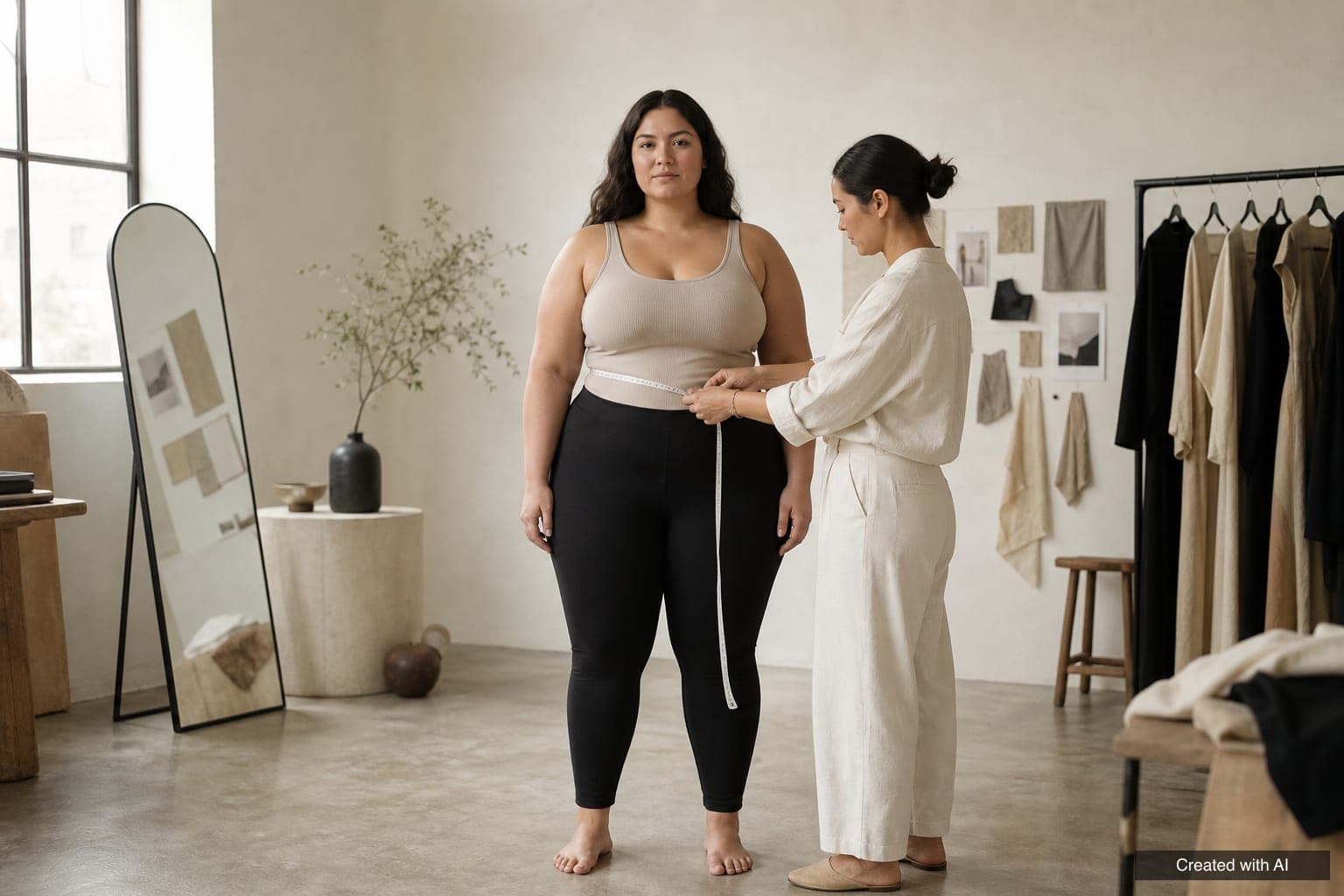
- Accurate measurements: height, bust, waist, hips, shoe and clothing size. Sizes differ between countries, so give centimetres or inches too (see the size guide).
- Simple photos: face from the front, profile and full length, in daylight, unretouched, in fitted clothes so your shape is visible.
- Contact details: phone, email, city, age. If you are under 18, add a parent or guardian's contact.
- A social profile, if the agency form asks for it.
Online Model Academy, a modeling education company, notes that the one real difference on a curve application is clothing: wear fitted clothes, because a booker cannot judge proportion through a loose dress. A professional shoot is not required for an application, and the FTC reminds applicants that a real agency does not make you pay for photographs. For prices, see model test shoot. Once an agency signs you, it will ask for a card with your measurements: composite card for models shows what it looks like.
Supermodels and plus size
Supermodels is a Lithuanian agency founded in 2001. It states that in 2020 it opened a separate division for non-standard-size models and distinctive personalities (called "Asmenybės" in Lithuanian) and that it is the first agency in Lithuania representing professional plus size models. Invited to register:
- girls aged 14 to 22, at least 170 cm;
- plus size models;
- young men aged 16 to 25, 185 to 190 cm.
An application needs three photos (face, profile, full length), each up to 4 MB, and your measurements. You can send it through the form or by email to info@supermodels.lt. Supermodels says becoming one of its models costs nothing and no fees apply. It announces open calls with dates and cities every year; they are on the Supermodels open call page.
You can browse other agencies in the modeling agency directory.
How to vet an agency
The US Federal Trade Commission (FTC) advises researching the company before you sign and getting everything in writing. A practical checklist:
- Confirm the company is real. Is there an official website, address, company number and phone? An agency doing business in New York must register with the New York State Department of Labor, and the list of registered agencies is public (the Model Management Registry).
- Ask for clients and models. A real agency can name clients it has worked with and models who got jobs. Ask for contacts and check them yourself.
- Search for reviews and complaints. The FTC suggests searching the agency's name with words like "scam", "review" and "complaint".
- Read the contract in advance and ask for time to consider. The Model Alliance advises getting a lawyer's advice and reminds models that contract terms are negotiable.
- Check who pays what. Commission, expense rules and payment deadlines must be written down.
Fees and commission
A real agency earns only when you do. The FTC says real agencies will not ask you to pay for a test shoot, for your photographs or to secure a spot, and that the contract should state what percentage of your earnings the agency takes.
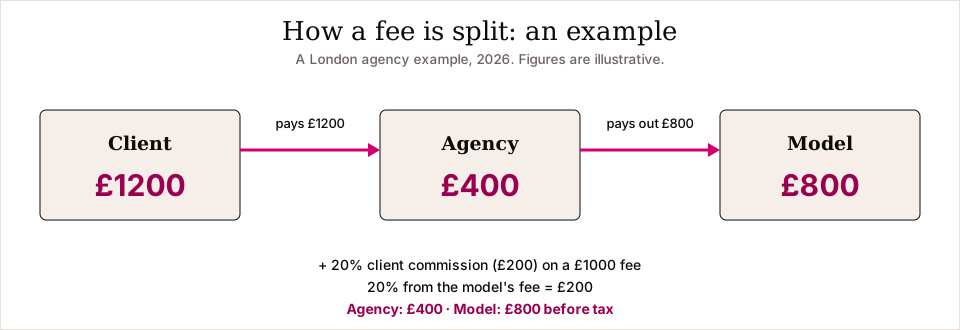
The rate depends on country and contract, and sources give different figures:
| Source | What it says |
|---|---|
| New York State Department of Labor (Fashion Workers Act, from 19 June 2025) | An agency may not charge a model more than 20% commission. Signing fees and deposits are banned. A representation agreement cannot run longer than three years or renew automatically without the model's approval. The model must receive a deal memo with the total compensation before work starts, and written approval is needed for costs the agency advances and later deducts. |
| The Diversity Agency (UK) | Example: the client pays a GBP 1,000 day rate plus 20% client commission, so GBP 1,200 goes to the agency. The agency keeps the GBP 200 and 20% of the GBP 1,000, leaving the model GBP 800 before tax. |
So an agency's income can come in two parts, one from the model and one added on top for the client. Both should be written in your contract. The New York rules apply in New York, not elsewhere, but they show what you can reasonably expect. The contract, not the website, decides what applies to you: see modeling contract.
Casting calls and open calls
Look for castings in official places:
- agency websites and their social accounts, which often announce open calls with dates and cities;
- through an agency that already represents you: it receives casting requests and chooses which to accept;
- posts by clients and photographers, but only after you have checked the company or person.
Preparation and what happens at a casting are in model casting: how to prepare. Before you go anywhere unfamiliar, tell someone you trust, bring a friend or parent, and never meet alone with someone you do not know about "modeling work": the Model Alliance gives the same advice.
Scam signs
Walk away if they: ask for money for an application, photos or "registration"; guarantee work or big earnings; insist you use only their photographer or make-up artist; rush you to sign; have a website with no contacts or clients; or a stranger on social media asks for intimate photos or money.
| Sign | Why it is a problem |
|---|---|
| Fee for applying or "a spot" | FTC: real agencies do not ask. In New York, signing fees are banned by law. |
| Guaranteed work or earnings | Bookings are irregular even for successful models. There are no guarantees. |
| Must use their photographer | FTC: an agency should not require it. |
| Pressure to sign today | If an offer is good today, it should be good tomorrow. |
| No clients, models or address | FTC advises asking for a list of clients and models. |
| Asks you to pay in unusual ways (gift cards, cryptocurrency, wire transfers) | FTC: a sign it wants your money, not your career. |
Training courses are a separate service from an agency. The FTC draws the line: schools teach for a fee up front, agencies earn when you work. More in modeling school. If you have paid a scammer, act quickly: contact your bank and report it. In the US, the FTC takes reports at ReportFraud.ftc.gov.
What to do and what to avoid
- Apply only through contacts you found on the agency's own website.
- Take your time to sign, and read the contract with someone you trust.
- Do not publish ID documents or photos you would not want others to see.
- Do not chase the title "model": real work comes through a casting, a booker and a contract.
- Do not change your weight for an agency without a doctor's advice. Your health matters more than any booking. If you notice signs of disordered eating, see a doctor; in Lithuania the support line is 116 123.
For the work itself and its pay, see plus size modeling jobs and pay.
FAQ
Is there a plus size modeling agency in Lithuania?
Supermodels states that since 2020 it has had a division for non-standard-size models and represents professional plus size models. Check any other agency yourself before applying.
How much commission does an agency take?
It depends on country and contract. In New York an agency may take no more than 20% from a model. A UK agency describes 20% from the model plus 20% added for the client. Always read the contract.
Can an agency ask for money for photos or an application?
A real agency does not. The FTC says you should not pay for a test shoot, photographs or to secure a spot.
What is the difference between curve and plus size?
Mostly they are synonyms, though more agencies now say "curve". Size ranges vary by agency: one lists 12 to 18 (UK), another works from about 8 to 18 (US).
Where do I find casting calls?
On agency websites and social accounts. Supermodels announces open calls with dates and cities every year. Check offers from strangers carefully.
Do you need an agency to become a plus size model?
Not always, but an agency usually gives access to steadier bookings and handles contracts. You can start by applying to one with unfiltered photos.
Sources and recommended reading
- US Federal Trade Commission, Modeling Scams (consumer.ftc.gov, read October 2026).
- New York State Department of Labor, New York State Fashion Workers Act FAQs (commission cap, deposits, contract term, registry).
- Model Alliance, Modeling Scams and Fashion Workers Act.
- Models Direct, Plus Size Models Wanted (plus size application, size range).
- Online Model Academy, Plus Size Modeling Agencies: How to Get Signed.
- The Diversity Agency, How Much Do UK Models Earn in 2026 (UK commission example).
- Supermodels application and agency information (supermodels.lt/registracija, supermodels.lt/agentura, read October 2026).
- Jurgita: modeling agency directory.
Comments (0)
No comments yet. Be the first!
Only logged-in users can comment. Register — and you'll be able to share your thoughts on this article.
Register