

In short
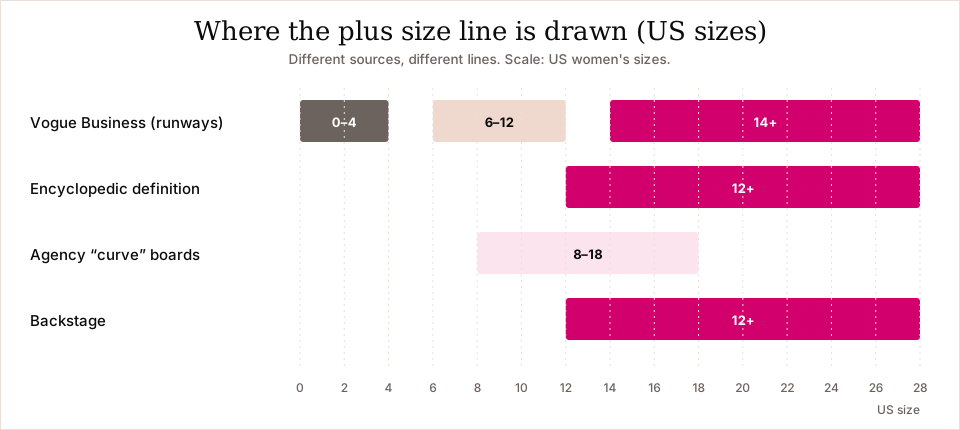
- There is no single cutoff. Vogue Business counts US 14 and up as plus size (EU 46+), while British agencies start the plus-size board at UK 14 (EU 42+).
- The gap comes from different scales: a UK size is a US size plus 4, and an EU size is a US size plus 32. A "size 14" in New York and in London are different bodies.
- Between straight and plus sits a mid-size range. Vogue Business puts it at US 6-12 (EU 38-44).
- For agencies, the label matters less than your measurements: bust, waist, hips, height and proportions. You can check yours in Jurgita's size guide.
What is considered plus size depends on who is asking. Ask "what size is plus size?" and you will hear "14 and up", "size 12", "anything over a 16" and, in Europe, "46 and above". All of them can be right, because the answers use different scales and serve different purposes. A runway analyst, an online shop and a modeling agency do not draw the line in the same place.
This article puts together what the sources publish: an industry report on runway sizes, British and German agencies, guides written for new models and a peer-reviewed study on the average women's clothing size. Where figures differ, we give the range and say who says what. It is one of the articles in our plus-size modeling series.
The short answer: where the line is drawn
Based on the sources below (checked October 2026), the line falls like this:
| Source | How it defines plus size | In EU sizes |
|---|---|---|
| Vogue Business (runway report, US scale) | Straight 0-4, mid-size 6-12, plus-size 14 and up | Straight 32-36, mid 38-44, plus 46+ |
| The Diversity Agency, London (UK scale) | A plus-size model fits a UK 14 or above; UK 14-16 is often briefed as "mid-size" | Plus 42+, mid-size 42-44 |
| Models Direct, UK (UK scale) | Plus-size women are typically size 12 to 18 | 40-46 |
| Online Model Academy (US scale) | Curve boards run roughly US 8 to 18, with the densest client demand at 10-16 | 40-50, mostly 42-48 |
| Backstage (US scale) | Plus-size models are typically US 12 and up | 44+ |
So the answers span about six EU sizes, from 40 to 46. If you need one practical answer for the fashion market, it is this: plus size starts somewhere between EU 42 and 46 (UK 14-18, US 10-14), and the exact line depends on who is drawing it and why.
US, UK and EU size chart
Most of the confusion comes from the same number meaning different sizes in different countries. The table below shows the equivalents and body measurements from the European size table that also powers Jurgita's clothing size guide.
| EU | UK | US | Bust, cm | Waist, cm | Hips, cm |
|---|---|---|---|---|---|
| 38 | 10 | 6 | 88 | 72 | 96 |
| 40 | 12 | 8 | 92 | 76 | 100 |
| 42 | 14 | 10 | 96 | 80 | 104 |
| 44 | 16 | 12 | 100 | 84 | 108 |
| 46 | 18 | 14 | 104 | 88 | 112 |
| 48 | 20 | 16 | 110 | 94 | 118 |
| 50 | 22 | 18 | 116 | 100 | 124 |
| 52 | 24 | 20 | 122 | 106 | 130 |
This is why Vogue Business's "US 14" and a British agency's "UK 14" are not the same line: the first is an EU 46, the second an EU 42. That is four sizes and roughly 8 cm of hip circumference. When you read a foreign article or fill in an application, always check which scale it uses.
The table shows average European measurements. Brands cut their patterns differently, so the same size can fit differently from label to label. Measure yourself rather than trusting the tag alone.
Why the sources disagree
No international standard says where plus size begins. The differences come from several places.
- Different scales. US, UK and EU number their sizes differently, so the same figure means a different body (see the chart above).
- Different purposes. Vogue Business counts runway looks, so its line is an analytical tool. An agency decides which board to offer clients. A shop decides which sizes to manufacture.
- Different retail reality. Vogue Business notes that in retail, US 14-16 is often the upper end of a standard range rather than a true extended range: most brands in its analysis stop at US 14 or 16.
One more data point explains why the line is contested at all. A peer-reviewed study that compared US national health survey measurements (NHANES, 1988-2010) with ASTM sizing standards found that the average American woman wears a Misses 16-18, which corresponds to a Women's Plus 20W (Christel and Dunn, 2017). It is a US study, not a European one, but the point carries: the "plus" label covers a very common body, and size standards lag behind what people wear.
Mid-size: between straight and plus
A third category has appeared in recent years: mid-size. In Vogue Business's runway report it is defined as US 6-12, or EU 38-44. These are women who are above the typical runway sample size but still fit in many brands' standard ranges.
The Diversity Agency briefs UK 14-16 as "mid-size" and says these sizes are booked heavily for high-street e-commerce, lifestyle and beauty, with sportswear brands briefing there a lot. For a model, mid-size can be a bridge to curve campaigns, but also a working niche of its own.
The report numbers show how little room each group takes on the biggest stages. Across 182 shows and presentations in the Fall/Winter 2026 season, 97.6% of 7,817 looks were straight-size (US 0-4), 2.1% mid-size and 0.3% plus-size. That is a measure of what appears on the major runways, not of how many people wear those sizes, and it is why commercial work (catalogues, e-commerce, advertising) is where most plus-size models work.
Curve, plus size, curvy: what is the difference
- Plus size is a size reference. Brands and casting briefs use it.
- Curve is the name agencies give their boards for the same models. The Diversity Agency says there is no functional difference between "curve" and "plus size", and Online Model Academy notes that agencies use the words interchangeably, though many now prefer "curve".
- Curvy is an everyday word, not a professional one. Casting briefs do not use it.
For how the industry defines the term, see the plus-size model entry in our modeling glossary.
Is a size 12 or size 14 model plus size?
Searches for "size 12 model" and "size 14 model" are common, and the answer depends on the scale and the market.
- US 12 (EU 44): Backstage gives US 12 as the lower end for plus-size models, while Vogue Business still counts it as mid-size.
- UK 12 (EU 40): Models Direct includes it in its plus-size range (12-18), while on the Vogue Business scale it is US 8, still mid-size.
- US 14 or UK 14: US 14 (EU 46) is Vogue Business's plus-size line; UK 14 (EU 42) is where British agencies start their plus-size boards.
In practice, what matters to a model is not the label but which board an agency will place you on and which sizes clients are shooting. The Diversity Agency says demand is growing at the upper end of the range too (UK 24-30+), where it says the market is still under-supplied.
 Model training with SupermodelsTry it in practice with an agency teamIn the model training we work on the walk, posing and working on camera, one to one or in a small group.About the trainingfrom €69
How to check your own size
The size on a tag is a rough guide. A more reliable route:
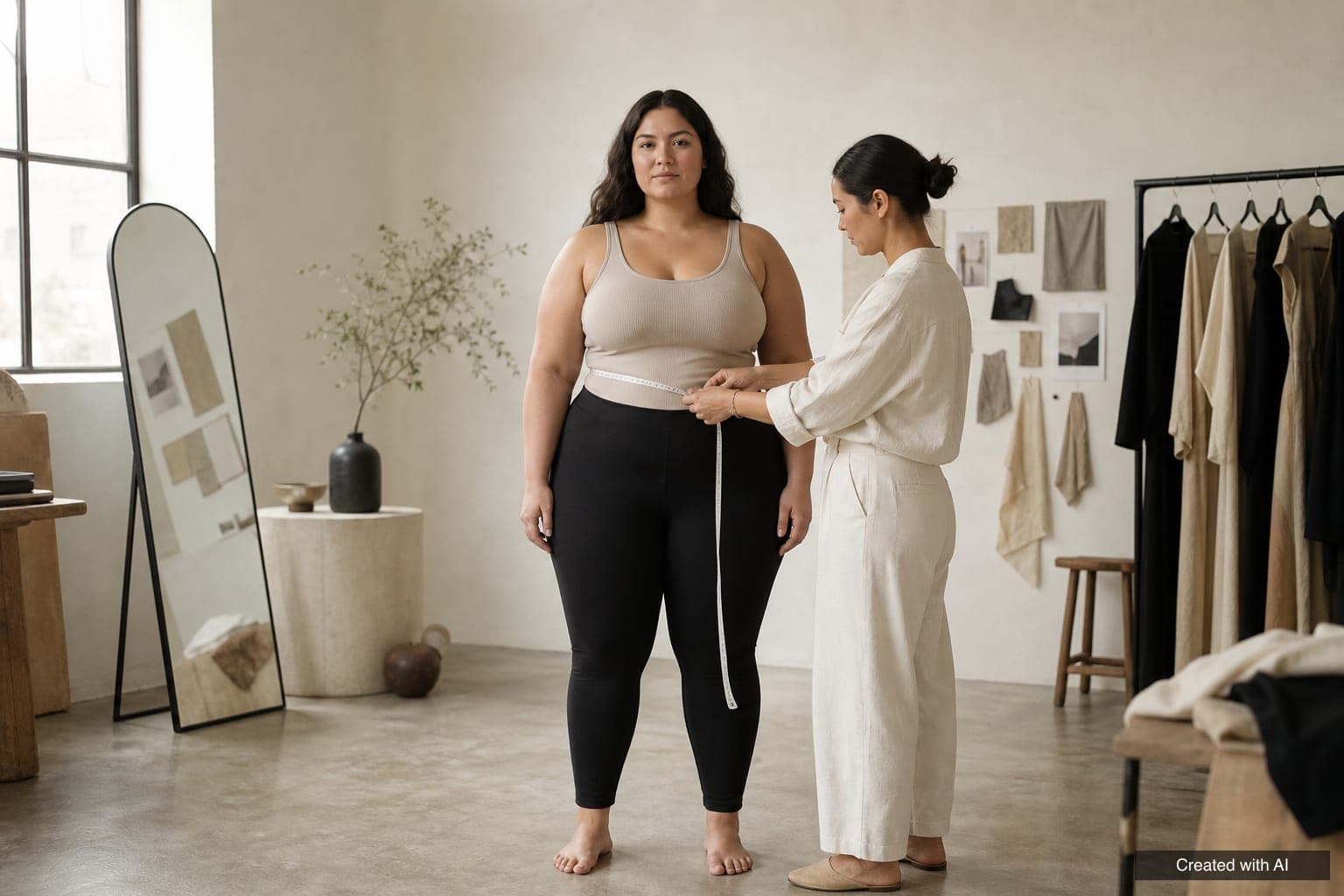
- Measure your bust (at the fullest point), waist (at the narrowest) and hips (at the widest) in centimetres or inches, over underwear or fitted clothing.
- Compare with Jurgita's size guide: enter your measurements to get a size in EU, UK, US and French scales. Bra sizes have their own calculator.
- If your three measurements fall into different sizes, the largest usually decides the garment size, and fit is often adjusted from there.
- When talking to an agency or client, always give the size together with the scale (for example "EU 44 / UK 16") and your real measurements.
For garment types and cuts, see the clothing guide, and for dress shapes by figure, read plus-size dresses: how to choose. Agency expectations on height, measurements and age are covered in plus-size model requirements, and the first steps are in how to become a plus-size model.
What to do and what to avoid
Do: state your size with the scale, measure yourself, give real numbers, check the agency's own definition before applying, and look at whether the agency's board already includes models of your size. Supermodels invites plus-size models to apply, with more flexible height requirements.
Avoid: giving the size you want to be instead of the one you are, relying on letter sizes alone, mixing up US and UK scales, or changing your weight just to fall into a category. Agencies measure again, and numbers that do not match waste everyone's time.
Size is not a measure of health or worth. On health, the NHS points out that body mass index (BMI) is only one measure: it cannot tell muscle from fat, and people from some ethnic backgrounds face a higher chance of health problems at a lower BMI. For decisions about your body, talk to your doctor rather than a clothing label.
Frequently asked questions
What size is considered plus size?
There is no single cutoff. Vogue Business counts US 14 and up (EU 46+), British agencies count UK 14 and up (EU 42+), and other agencies start at US 12 (EU 44). In practice the line sits between EU 42 and 46.
Is a size 12 plus size?
It depends on the scale. US 12 (EU 44) is mid-size in Vogue Business's report but the entry point for plus-size models in some US guides. UK 12 (EU 40) is within Models Direct's plus-size range of 12-18.
Is a size 14 plus size?
US 14 (EU 46) is plus size by the Vogue Business definition. UK 14 (EU 42) is where British agencies such as The Diversity Agency start their plus-size or curve board, and it is also often briefed as mid-size.
What is the difference between a mid-size and a plus-size model?
Vogue Business defines mid-size as US 6-12 (EU 38-44) and plus-size as US 14 and up (EU 46+). Agencies draw the line differently, and mid-size is increasingly its own working niche.
Why are US and UK sizes different?
The scales are offset: a UK size is a US size plus 4. US 14 equals UK 18 and EU 46, while UK 14 equals US 10 and EU 42.
Are curve and plus size the same thing?
In practice, yes. "Curve" is the name agencies give their boards, and "plus size" is the term more often used in casting briefs and searches. Agencies use the two interchangeably.
Do I need to change my weight to fit a category?
No. Agencies work with your current measurements and recommend giving real numbers. For anything to do with weight or eating, talk to a doctor.
Sources and recommended reading
- Vogue Business, "The Vogue Business Fall/Winter 2026 Size Inclusivity Report" (23 March 2026): vogue.com.
- The Diversity Agency (London), "How to Become a Plus-Size / Curve Model in the UK", checked October 2026.
- Models Direct (UK), "Plus Size Models Wanted", checked October 2026.
- Online Model Academy, "Plus Size Modeling Agencies: How to Get Signed", checked October 2026.
- Backstage, "Top Plus-Size Modeling Agencies in the U.S." (2023), checked October 2026.
- D. A. Christel and S. C. Dunn, "Average American women's clothing size: comparing National Health and Nutritional Examination Surveys (1988-2010) to ASTM International Misses & Women's Plus Size clothing", International Journal of Fashion Design, Technology and Education, 2017: doi.org.
- NHS, "Calculate your body mass index (BMI) for adults": nhs.uk.
- Jurgita size guide and modeling glossary, checked October 2026.
Comments (0)
No comments yet. Be the first!
Only logged-in users can comment. Register — and you'll be able to share your thoughts on this article.
Register