

In short
- A UGC price has several parts: the base fee for the video, usage rights (where and for how long), ads run through the creator's account, raw footage, extra variations and exclusivity.
- Marketplace data put the average UGC job at around $200 in 2025. Build your rate card from your working time and the scope of usage, not from one headline number.
- Ads through your account (whitelisting, Meta partnership ads, TikTok Spark Ads) are a separate service with a separate permission and term.
- Copyright transfers and licences should always be in writing, with channels, term, territory and fee spelled out. Courts in many countries read vague licences narrowly.
New UGC creators ask one question first: how much should I charge per video. Fair question, incomplete answer. The same 30-second clip might sit on a product page for a month, or run as a paid ad across Europe with no end date. In the first case the base fee is enough. In the second the brand will make many times more from your work, so it should pay more.
This article splits a UGC rate into its parts, explains usage rights, whitelisting and Spark Ads codes, gives a sample rate card and lists what belongs in the contract. If you are just starting, read our UGC creator guide first.
How much a UGC video costs in 2026
Most public numbers come from international creator platforms. They reflect US, UK and Canadian demand and each platform's own pricing.
| Source | What it measures | Figure |
|---|---|---|
| Collabstr 2026 report | Average UGC job on the platform | $197 in 2025 ($209 in 2024) |
| Collabstr 2026 report | Share of all collaborations under $300 | About 80%, only 2% above $1,000 |
| Billo creator information | Creator payout for a 15-second video | From $30 for new creators, from $70 for premium creators |
| PPC.io pricing review | Average single UGC video | $212, most between $150 and $300 |
Why do platforms differ? Billo sets the briefs and pays a fixed payout, while on Collabstr creators set their own prices. Experienced creators with a strong portfolio and a clear niche charge more, beginners less. The biggest driver is not video length but how widely the brand will use it.
What makes up a UGC rate
Base fee
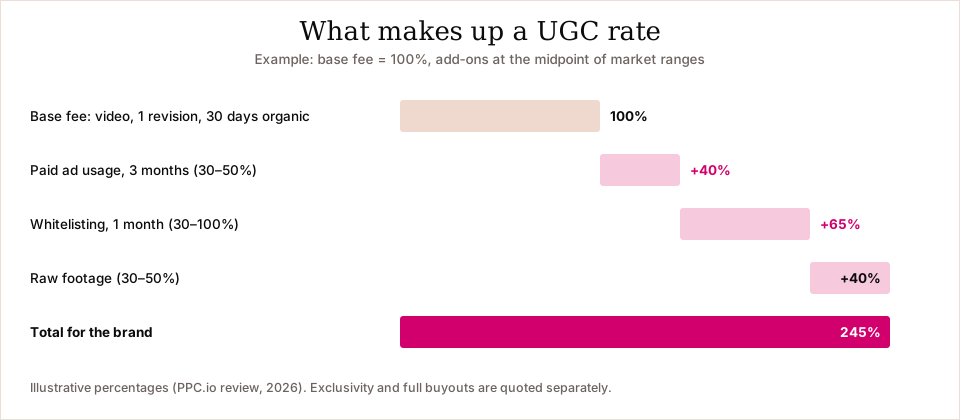
Pay for the work: script, filming, editing, one or two rounds of revisions and short organic use on the brand's own profiles. Price it from real time. One 30-second video with prep, filming and editing often takes two to four hours.
Usage rights
A fee for running the video in paid ads, on the website, in emails or in stores beyond the base period. Pricing reviews note that creators add 30 to 50% of the base fee for extended usage. Longer terms and more countries mean a bigger add-on.
Whitelisting
When a brand runs ads under your name, it uses your account and your face as well as the video. Reviews put this at an extra 30 to 100% of the base fee per month.
Raw footage
All unedited clips, from which the brand can cut new ads. Creators often ask 30 to 50% of the base fee.
Variations and exclusivity
Extra hooks, endings, languages or formats are separate line items. Exclusivity means you cannot work with competitors for a set time, and that has a price. Our glossary entry on exclusivity explains why; the logic is the same for models and UGC creators.
Sample UGC rate card
A rate card is a one-page price list you send to brands. Below is a structure with percentages; fill in the base fee from your own time and market.
| Service | Included | Price |
|---|---|---|
| One video up to 30 s | Script, filming, editing, one revision round, organic use on the brand's profiles for 30 days | Base fee (B) |
| Extra hook | A different first 3 to 5 seconds for the same video | Agreed separately |
| Paid ad usage, 3 months | One region, listed channels | +30 to 50% of B |
| Whitelisting | Meta or TikTok permission for a stated term | +30 to 100% of B per month |
| Raw footage | All unedited clips | +30 to 50% of B |
| Exclusivity | No competitors in a named category for a set time | Quoted separately |
The percentages are market reference points, not rules. State prices in one currency, say whether tax is included and set a payment deadline. How model day rates and usage fees are calculated is covered in modeling rates.
Usage rights: what they are and how to define them
Usage rights answer three questions: where, for how long and in what way the brand may use your content. A short definition is in our modeling glossary.
- Channels. Organic posts on the brand's profiles, paid social ads, website and online store, email, out-of-home, TV, in-store screens.
- Term. 30 days, 3 months, 6 months, a year. "In perpetuity" is a separate and expensive decision called a full buyout.
- Territory. One country, a region, the EU, worldwide.
- Edits. Whether the brand may cut, add text, combine with other clips or translate.
- Licence type. Non-exclusive (you can sell similar content to others) or exclusive.
The law usually backs a precise contract. In the US, a transfer of copyright ownership needs a signed written instrument (17 U.S.C. § 204(a)). Lithuanian copyright law, as an EU example, requires licences to state the uses, licence type, territory, term and fee; if no territory is named the licence covers only Lithuania, and if uses are not listed only those needed for the purpose of the contract are granted. Using a person's likeness in advertising needs that person's consent in most jurisdictions, for example under New York Civil Rights Law §§ 50 and 51 or Article 2.22 of the Lithuanian Civil Code.
Digital replicas and AI. Some contracts allow a brand to use your face and voice to generate AI content. Negotiate that separately and charge for it separately. Read more in our glossary entry on the digital replica.
Whitelisting and partnership ads: ads in your name
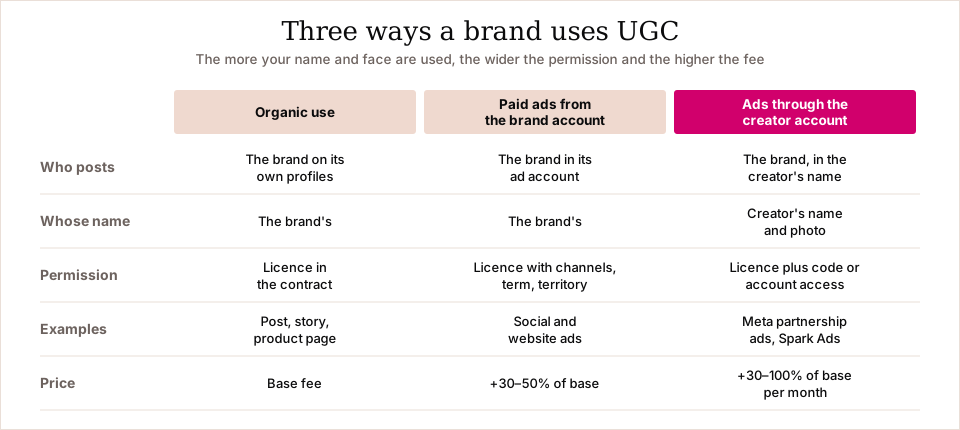
In marketing, whitelisting means a brand runs ads through a creator's account: the ad shows your name and profile picture at the top, while the brand controls budget, audience and schedule. Each platform has its own name for it.
Meta: partnership ads
Meta now calls its former branded content ads partnership ads. A creator can give permission for a single post, by tagging the brand in the paid partnership label and turning on the option that lets the brand boost it, or by creating a partnership ad code and sharing it. A creator can also grant account-level permission, which lets the brand create ads in the creator's name without a specific post. Account-level access is much broader, so the contract needs clear limits.
TikTok: Spark Ads
Spark Ads is TikTok's format for promoting a real organic post. According to TikTok's documentation, all views, comments, shares and follows from the promotion are attributed to the original post. The creator turns on ad authorization in the post settings and generates a code with a chosen duration; creator platforms list 7, 30, 60 and 365-day options. A sparked video cannot be deleted until it is unauthorized, and videos up to 10 minutes can be sparked.

A practical rule: the permission term in the app should match the term paid for in the contract. If the brand paid for 30 days, do not hand over a 365-day code for convenience.
What to put in a UGC contract
A UGC contract can be short, but it needs these points:
- Deliverables. Number of videos, length, formats, number of hooks, photos, raw footage.
- Timeline. When the product ships, when the first cut is due, how long revisions take.
- Revisions. How many rounds are included and the price of an extra one. A changed brief after filming is a new job.
- Usage rights. Channels, term, territory, licence type, whether edits are allowed.
- Whitelisting. Platform, permission type, duration, who moderates comments.
- Exclusivity. Category, list of competitors, length and price.
- Product. Whether you keep it, return it, or its value counts toward the fee.
- Payment. Amount, tax, deposit, deadline, late fees.
- Claims. Who is responsible for product claims. The creator follows the brief; the brand answers for its accuracy.
- Cancellation. What is paid if the job is cancelled after filming.
- AI and digital replicas. Not allowed, or allowed only for a separate fee.


In modeling, an agency negotiates these points. What a fair model agreement looks like is in our modeling contract guide, and the tax side is in model taxes.
How to negotiate UGC rates
- Always ask where the content will run. You cannot quote without that answer.
- Offer bundles. Three videos with variations in one shoot cost the brand less and use your time better.
- Cut scope, not the base fee. If the budget is small, offer a shorter term or fewer channels.
- Ask new clients for a deposit. 30 to 50% before filming is common.
- Review your rates every six months. Every stronger portfolio piece makes your work worth more.
What to avoid
- "All rights in perpetuity" for the base fee. That is a full buyout and costs several times more.
- Account-level permissions with no end date. The brand could create ads in your name that you never see.
- Open-ended revisions. "Until we like it" is not a term.
- Quoting without tax in mind. What lands in your account is less than the invoice.
- Unpaid exclusivity. If you cannot work with competitors, that has to be paid for.
- Pricing by follower count. UGC pay depends on the work and the usage, not on your audience.
FAQ
How much should I charge for one UGC video?
Marketplace data put the average UGC job at about $200 in 2025 (Collabstr reports $197). Some platforms pay new creators from $30 for a 15-second video. Paid ad usage and longer terms are charged on top.
What is whitelisting in UGC?
It means the brand runs ads through the creator's account, showing the creator's name and photo, while the brand controls budget and targeting. Meta calls it partnership ads, TikTok calls it Spark Ads.
How long does a Spark Ads code last?
The creator chooses the duration when generating the code. The usual options are 7, 30, 60 and 365 days. Match it to the period paid for in the contract.
Can I use client UGC in my portfolio?
Usually, if the contract does not forbid it. Put it in writing, because some brands do not want ads shown before launch.
What are paid usage rights?
Permission for the brand to use your content in paid advertising for a set term, territory and set of channels. It is priced on top of the base fee for making the video.
Should I charge more for raw footage?
Yes. Raw clips let the brand cut many new ads, so pricing reviews often show creators asking 30 to 50% of the base fee for them.
Sources
- Collabstr, Annual Influencer Marketing Report 2026 (average UGC job $209 to $197, 80% of collaborations under $300, 2% above $1,000), checked October 2026.
- Billo, UGC Content Creator (creator payouts from $30 and $70 for a 15-second video), checked October 2026.
- PPC.io, UGC Rates in 2026: What 6 Marketplaces Charge (average $212, add-ons for usage, raw footage and whitelisting), checked October 2026.
- TikTok Ads Help, About Spark Ads (format, 10-minute limit, sparked videos cannot be deleted before unauthorizing).
- Insense creator help, What is the timeframe for TikTok Spark Ads campaigns? (7, 30, 60 and 365-day authorizations).
- Meta Business Help Center, About partnership ad permissions and Create a partnership ad code.
- U.S. Code, 17 U.S.C. § 204; New York Civil Rights Law, § 50 and § 51.
- Republic of Lithuania Law on Copyright and Related Rights, Articles 38 and 40; Civil Code, Article 2.22.


Comments (0)
No comments yet. Be the first!
Only logged-in users can comment. Register — and you'll be able to share your thoughts on this article.
Register