


In short
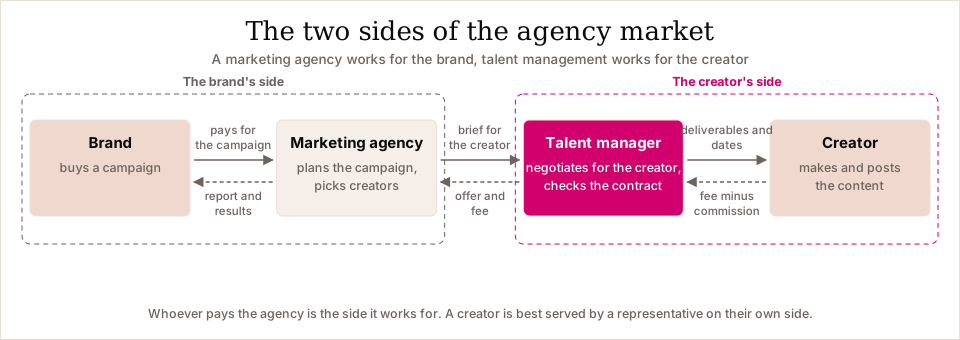
- "Influencer agency" covers two different businesses. A marketing agency works for the brand and picks creators for campaigns. A talent management agency works for the creator: it finds deals, negotiates and checks contracts.
- Talent managers earn a commission on the creator's deals, set in the contract. Around 20% is common at modeling agencies, and New York's Fashion Workers Act caps model management commission at 20%.
- A legitimate agency does not charge you to sign up, take a course or buy photos as a condition of representation. An upfront fee is the clearest sign of a fake agency.
- Modeling agencies represent models for shoots, campaigns and shows. A following helps a model, but managing an influencer's posts is a separate service. To start modeling, apply free through the Supermodels open call.
Once a creator's account starts growing, the DMs fill up: brands want to collaborate and agencies invite you to "join the roster". Some of them help you earn more and work more safely, some only want a cut, and some are plain scams. To tell them apart you need to understand how the business works and who pays whom.
This guide explains the difference between an influencer marketing agency and talent management, what a manager does for a creator, how commission works, whether modeling agencies sign influencers, when you need representation and what to read in the contract before you sign. For the map of creator jobs, start with our content creator guide.
What is an influencer agency?
An influencer agency is a company that sits between brands and content creators. The first question to ask any agency is simple: who do you work for? The answer tells you whose interests it will defend in a negotiation.
Influencer marketing agency
The brand hires it. The agency plans the campaign, shortlists creators, agrees on fees, reviews content and reports results. Its job is to get the client as much as possible for as little as possible. For a creator, this agency is a client, not a representative.
Talent management agency
The creator chooses it. A manager pitches the creator, answers inbound requests, negotiates fee and rights, checks contracts, invoices and chases payment. It goes by talent management, creator management or influencer management. Its job is to get the creator more, because its commission depends on it.
Modeling agency
It represents models for shoots, advertising campaigns, catalogs and shows. The agency's booker pitches the model to clients, handles options and bookings, and negotiates the day rate and usage. Much of it resembles talent management, but the product is different: the model's work in front of the camera rather than posts on their own account.
Influencer marketing agency vs talent management
| Marketing agency | Talent management | |
|---|---|---|
| Works for | The brand | The creator |
| Who pays the agency | The brand, per campaign | The creator, as commission on deals |
| What it does for you | Offers a booking and a brief | Finds deals, negotiates, checks contracts |
| How many creators | Many, different for each campaign | A limited roster, long-term relationship |
| Contract with you | For one campaign | A long-term representation agreement |
| When it helps | When you want more bookings | When deals multiply and fees grow |
Some firms do both. Then ask directly: if the brand is your client and I am your creator, whose side are you on when my fee is negotiated? An honest answer and a clear contract beat any promise.
What a talent manager does for a creator
- Finds deals. Pitches the creator to brands and marketing agencies, handles inbound requests and filters out poor offers.
- Negotiates. Fee, number of deliverables, deadlines, usage rights, exclusivity and payment terms.
- Checks contracts. Looks for clauses that hand over too many rights, block too wide a circle of competitors or delay payment.
- Handles money. Invoices, chases late payments and sends the creator a statement.
- Plans. Keeps the calendar so deals do not clash and the creator does not burn out.
- Protects reputation. Reminds you to disclose ads and steps in when there is a dispute with a client or a backlash online.


How much does an influencer agency charge?
Talent managers usually take no flat fee; they keep a percentage of the deals they bring in or handle. The exact rate is set in the contract and varies by market and agency. At modeling agencies, an agency commission of around 20% is standard. New York State's Fashion Workers Act, in force since 19 June 2025, bars model management companies from taking more than 20% of a model's pay. The state's Department of Labor notes that social media influencers and content creators have to consider whether their work falls within the Act's definition of a model.
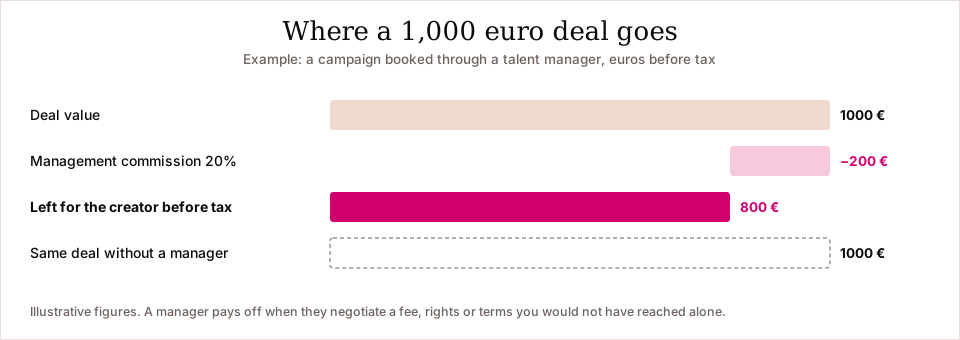
Before you sign, settle three questions. Is commission charged on all your income or only on deals the agency brought in? Does it apply to clients who found you on their own? Will the agency keep taking commission on renewals and repeat bookings after the contract ends? These clauses often matter more than the percentage itself.
Some places also license agents. In California, the Talent Agencies Act requires anyone who procures engagements for artists to hold a talent agency license from the Labor Commissioner. If an agency books work in a regulated market, ask which license it holds.
Do modeling agencies sign influencers?
Modeling agencies represent models first: shoots, campaigns, catalogs and runway. Clients now often check a model's social profile, and some pay separately for a post on the model's own account, so a following is an asset. Still, an agency judges looks, proportions and how a person comes across on camera without filters before it looks at follower counts.
Supermodels is a Vilnius modeling agency founded in 2001 and a member of the international association of model agencies M.A.M.A. It signs a representation agreement with every model and places models abroad with NEXT, Wilhelmina, Elite, Women and other international agencies. Alongside its women, men and new faces boards, a special division opened in 2020 represents plus-size and non-standard models and distinctive, charismatic people. If you want to model, apply through the free Supermodels open call: girls are accepted from 14 to 22, boys from 16 to 25.
How modeling differs from being an Instagram model or an influencer is covered in Instagram model. For representation terms, see the glossary entry representation agreement and our guide on how to choose a modeling agency.
 Model training with SupermodelsTry it in practice with an agency teamIn the model training we work on the walk, posing and working on camera, one to one or in a small group.About the trainingfrom €69
When you need an agency and when you don't
| Your situation | What to do |
|---|---|
| Audience still growing, occasional bookings | Negotiate yourself and learn contracts and rates. At this stage an agency often has little to sell. |
| Several deals a month, hard to keep up with replies | Time to look for a manager, or at least an assistant for requests and invoices. |
| Long-term contracts, ambassador deals, foreign clients | A representative with legal experience usually pays for themselves. |
| You want to model in campaigns and shows | You need a modeling agency, not influencer management. |
| You make UGC for brands | Platforms and your own negotiation are often enough; a manager helps once clients multiply. |
What creators earn, and when fees grow large enough for a manager to pay off, is in how much do influencers make. UGC pricing and rights are covered in UGC rates and usage rights.
How to prepare for a meeting with an agency
An agency, like a brand, first wants to understand what it could sell. Prepare a short pitch that can be read in two minutes.
- Native analytics. Followers, reach, views, audience countries, age and gender over the last 30 and 90 days, as screenshots from the platform rather than rounded numbers.
- Best work. 5 to 10 posts or videos that show your style and results, especially brand work.
- Past deals. Who you worked with, which formats, what results. You need not share your rates at first, but know them yourself.
- Limits. Which brands or topics you will not promote and how much content you can realistically make each month.
- Goals. More deals, higher fees, foreign clients, an ambassadorship or modeling work. The answer decides which agency fits.
A model's pitch is different: the agency wants natural photos without make-up or filters, plus height and measurements. See model digitals and our comp card guide.
How to choose an influencer agency: questions before you sign
- Who do you work for? Creators, brands or both? How do you handle a conflict of interest?
- Who is on your roster? Ask for a few creators you represent and talk to them.
- What deals have you closed for creators like me? Examples with brands and formats, not general phrases.
- How many creators does one manager handle? If it is hundreds, there will be no personal attention.
- How is commission calculated and when will I be paid? Does money pass through the agency's account, and how many days until it reaches you?
- Can I see the original client contracts? A transparent agency shows them.
- How do I end the agreement? Notice period, and what survives termination.

Contract clauses you have to read
- Exclusivity. Whether the agency is your only representative, in which territory and for which work. See exclusivity.
- Term and renewal. How many years, whether it renews automatically and how to stop that.
- Post-term commission. Whether the agency keeps a share of clients it introduced, and for how long after the end.
- Usage rights. Who decides where and for how long a client can use your content or likeness. See usage rights and digital replica.
- Money flow. How many days the agency takes to pay you and what statement you receive.
- Content approval. Whether you can turn down a booking that clashes with your values.
- Disclosure. Who is responsible for labelling ads. The FTC holds both brands and influencers responsible, and Lithuania's consumer authority asks brands to put the disclosure duty into their contracts with creators.
More on reading an agreement is in our modeling contract guide. A contract for a minor creator or model is always signed by the parents as well.
Fake agencies and scams
The creator market attracts scammers just as modeling does. Common signs:
- a fee for sign-up, a "place on the roster", a profile review, a course or a shoot as a condition of representation;
- guaranteed deals or income before they have seen your analytics;
- messages from new accounts with no website, company number or real roster;
- pressure to sign the same day without taking the contract away to read;
- a request for your account password.
A real agency earns commission on your work. More warning signs are in our glossary entry on modeling scams.
What to avoid
- Contracts with no way out. A long exclusive deal with no clear termination route can lock your career.
- Commission on everything. Especially on deals you found yourself before the agency arrived.
- Invisible money. If you cannot see what the client paid, you cannot check the commission.
- Rights given away forever. Unlimited use of your content or likeness should cost extra or be limited.
- Agencies that only see numbers. They will not help when the numbers dip.
FAQ
What does an influencer agency do?
It depends on the type. A marketing agency works for the brand and picks creators for campaigns. A talent management agency works for the creator: it finds deals, negotiates fee and rights, checks contracts and handles payments.
How much does an influencer manager take?
Talent managers usually take a commission on deals, set in the contract. Around 20% is common at modeling agencies, and New York caps model management commission at 20%. A legitimate agency charges no upfront fee.
Do modeling agencies sign influencers?
Modeling agencies represent models for shoots, campaigns and shows. A model's following is an asset, but managing influencer posts is a separate service. To start modeling, you can apply free through the Supermodels open call.
When does an influencer need a manager?
When deals come in so fast that negotiation and contracts take more time than creating, or when fees are large enough that one bad clause would cost more than the commission. Early on, negotiating yourself is usually enough.
How do I spot a fake influencer agency?
It charges for sign-up, courses or shoots, promises guaranteed income, has no company details or real roster, pushes you to sign at once or asks for your account password.
What is the difference between talent management and an influencer marketing agency?
Talent management represents the creator and earns commission on their deals. A marketing agency represents the brand and is paid by the client per campaign, so in negotiations it aims for a lower fee.
Sources
- New York State Department of Labor, New York State Fashion Workers Act FAQs (20% commission cap, question on influencers and content creators), checked October 2026.
- Morgan Lewis, New York State Enacts Fashion Workers Act, 2025 (definitions of model management company and model, 20% cap).
- California Labor Code, section 1700.5 (Talent Agencies Act license requirement).
- US Federal Trade Commission, Disclosures 101 for Social Media Influencers.
- Lithuanian State Consumer Rights Protection Authority (VVTAT), Guidelines on marking advertising on social media, 2019 (point 34 on disclosure clauses in brand contracts; in Lithuanian).
- Jurgita modeling glossary: agency commission and representation agreement.
- Supermodels agency information and application terms (supermodels.lt, checked October 2026).





Comments (0)
No comments yet. Be the first!
Only logged-in users can comment. Register — and you'll be able to share your thoughts on this article.
Register