

In short
- A petite model is a model shorter than the height fashion agencies ask for. For women that usually means roughly 5'1" to 5'7" (155 to 170 cm), for men up to about 5'9" (175 cm). In clothing, petite sizes are cut for women 5'4" (163 cm) and under.
- Runway and high-fashion work are almost closed to petite models. US bookers say they look for 5'9" and up, and that 5'8" is already the borderline.
- The work is elsewhere: e-commerce, petite clothing lines, beauty and cosmetics, commercial print, parts work. Here your face, skin, proportions and how you work with a camera matter more than height.
- Give your real height. An agency that promises a 5'2" girl the runway, or asks for a registration fee, is not a professional agency.
"I'm 5'4", can I be a model?" is one of the questions model agencies hear most. The honest answer is neither a flat yes nor a flat no. A petite model can work, but not everywhere: the runway and high fashion almost always stay closed, while in commercial, beauty and e-commerce photography height matters far less.
This guide explains what height counts as petite in modeling, why the fashion industry holds on to height rules so firmly, where petite models get booked, which measurements you need, how to pose so you read taller in a frame, and how to tell a real opportunity from a promise you will be asked to pay for.
What is a petite model
A petite model is a model below the height needed for fashion weeks and major fashion house campaigns. The term is borrowed from clothing, where "petite" is a size range, and in modeling it means "shorter than fashion standard". There is a short definition in our modeling glossary too.
 Model training with SupermodelsTry it in practice with an agency teamIn the model training we work on the walk, posing and working on camera, one to one or in a small group.About the trainingfrom €69
It is not a lesser kind of model, just a different market. Most petite models are commercial models: their clients are brands selling clothes, cosmetics, jewellery or services to a wide audience. Those clients care that the shopper recognises herself in the picture, not that the model looks as if she has just walked off a Paris runway.
Many agencies do not run a separate petite board. Petite models are represented on the commercial, e-commerce or parts board, and some agencies add a "petite" filter to their search. London commercial agency Hired Hands Models, for example, lists "Petite Models" among its categories next to e-commerce, body parts and mature models.
What height counts as petite
There is no single standard, because clothing makers and model agencies measure height differently. In clothing, petite is a size range: US retailers such as Macy's cut petite clothing for women 5'4" (163 cm) and under. Those pieces have shorter sleeves and hems, a higher waistline and a shorter distance from shoulder to bust.
In modeling the line sits higher. The Photo Studio in Australia, which prepares models for agencies, gives petite female models a range of roughly 5'1" to 5'7" (155 to 170 cm), and male models 5'4" to 5'9" (163 to 175 cm). In other words, many women of average height already count as "petite" by modeling standards.
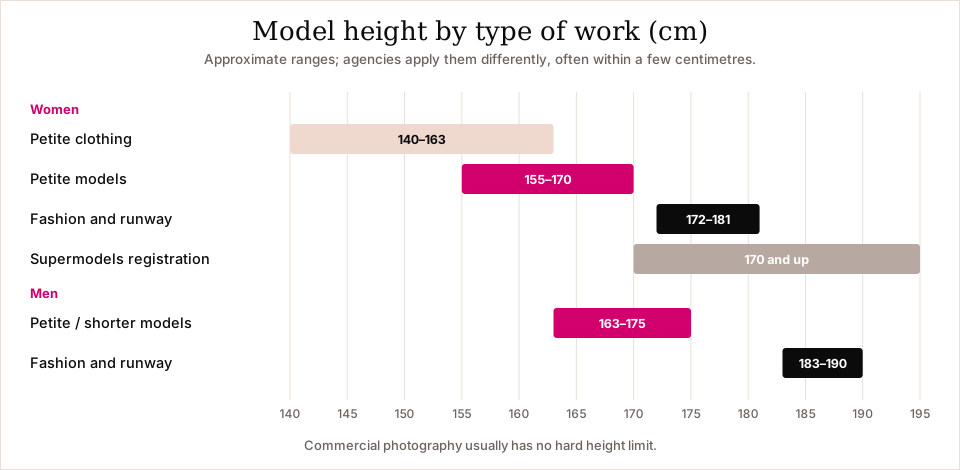
| What | Women | Men | Source or note |
|---|---|---|---|
| Petite clothing sizes | 5'4" (163 cm) and under | usually no separate range | US retailer size charts |
| Petite models | about 5'1" to 5'7" (155 to 170 cm) | about 5'4" to 5'9" (163 to 175 cm) | varies by an inch or two per agency |
| Commercial photography | no hard limit | no hard limit | face, age and type matter more |
| Fashion and runway | usually 5'8" to 5'11" (172 to 181 cm) | 6'0" to 6'3" (183 to 190 cm) | see how to become a model |
How agencies measure, and which numbers go on your card, is covered in the glossary entries on model height requirements and model measurements.
Why the runway asks for height
The height rule is not just a matter of taste. Collection samples are made in one size and one length, and the same garment is worn by several models during a show or a campaign shoot. If a dress hem and trouser length are set for a 5'10" model, they will be far too long on a 5'3" model, and nobody has time to take them up each time. Our glossary entry on sample size explains this in more detail.
The second reason is proportion on the runway. When dozens of models walk one after another, designers want a consistent line so that the audience sees the clothes rather than a series of different bodies. The third is habit: tall models have long been the fashion week norm, and clients expect them.
Bookers say so plainly. Sarah Whicker, a booker at Boss Models in New York, told Backstage that 5'8" is the borderline and that at 5'7" or 5'6" things start to become unrealistic, unless the face could carry beauty contracts. Tim Ayers, agency director at Model Club in Boston, added in the same piece that 5'9" is the absolute minimum for them, and that a 5'5" girl who wants to do runway would be told they have no client for that. For more on what a runway model is, see the glossary entry, and for the walk itself, our guide on how to walk like a model.
Where petite models work
Wherever the camera is close and the clothing is made for the shopper, height matters less. These are the areas where petite models get most of their bookings.
Petite clothing lines and e-commerce
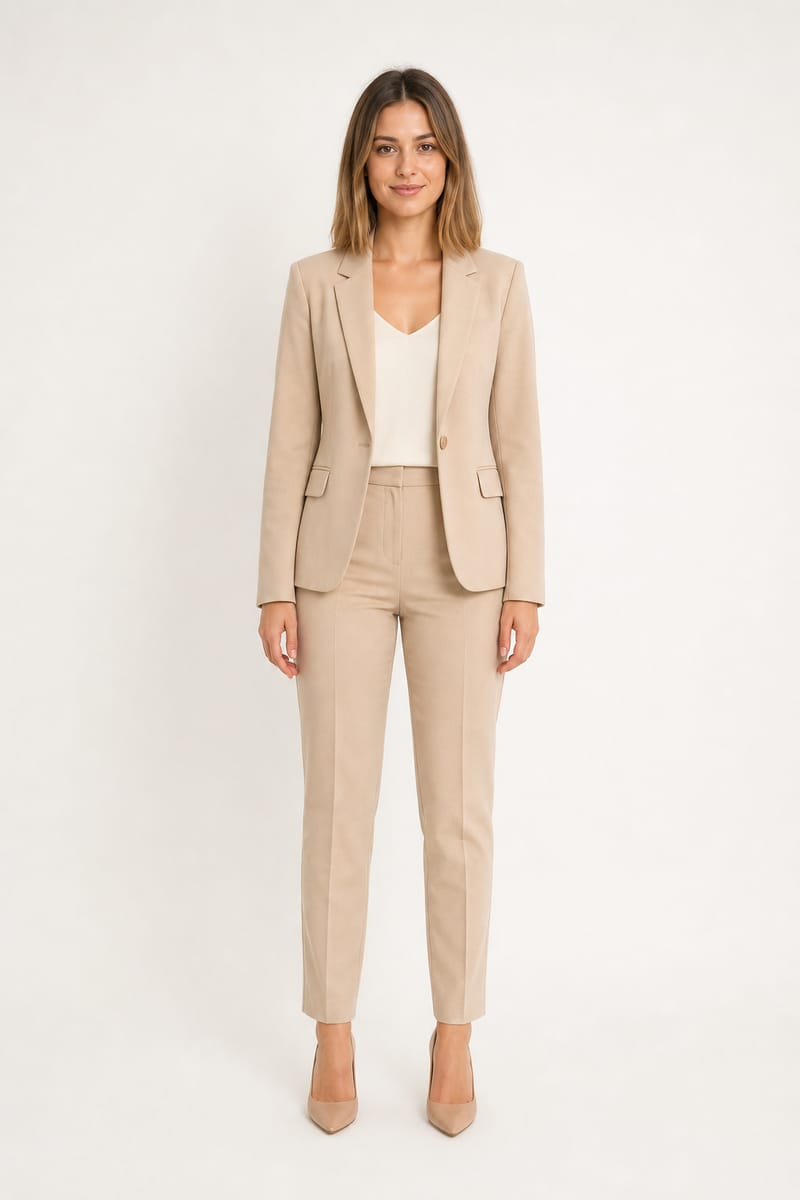
Brands with petite lines need to show their clothes on a body of the same height, otherwise the shopper cannot see how a piece will look on her. E-commerce shoots move quickly: one outfit after another on a white or light background, a few poses each. Our glossary entry on e-commerce modeling describes this kind of day.
Beauty and cosmetics
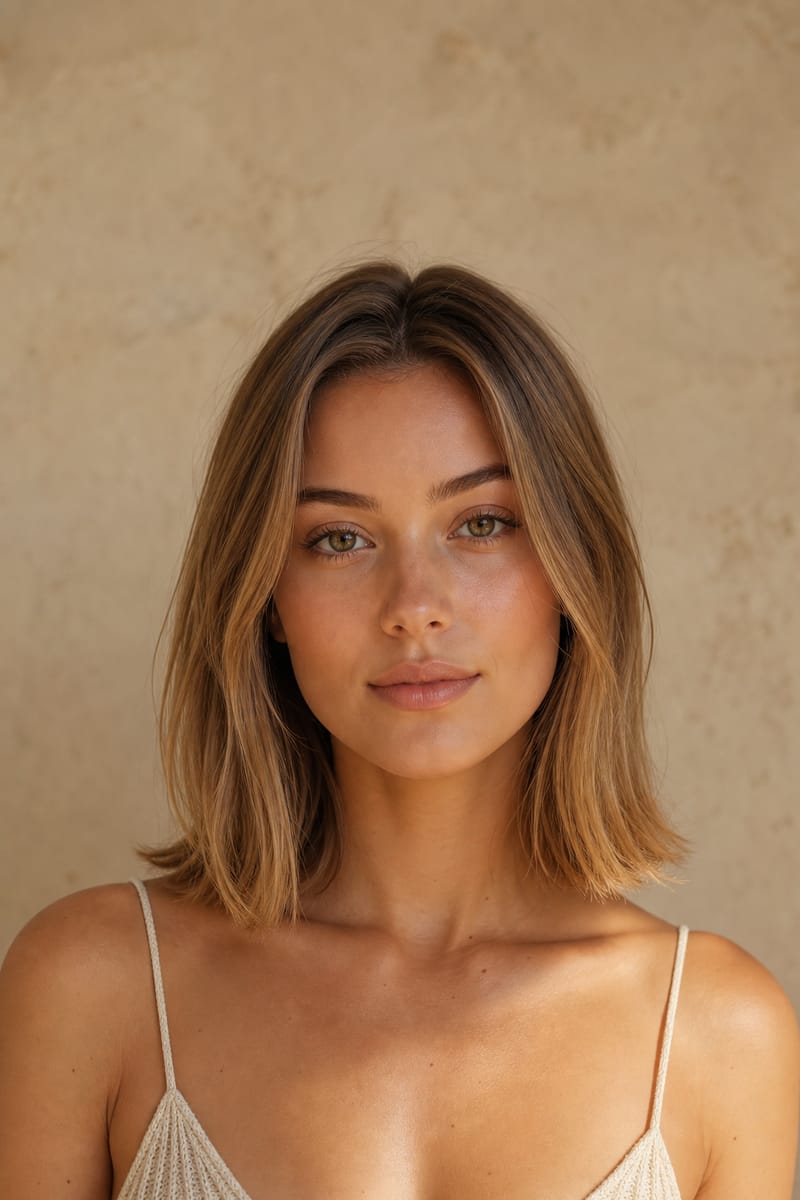
A beauty shot shows only the face, neck and shoulders, so height plays no part. What counts is skin, facial symmetry, teeth, hair and the ability to hold a precise expression. The Boss Models booker said the same: a face strong enough for beauty contracts can sometimes outweigh missing inches. See what a beauty shot is in the glossary.
Commercial advertising
For bank, phone, food or travel ads, clients look for people who look like their customers. The model acts out a situation: a family breakfast, coffee with a friend, a day at the laptop. Height only becomes an issue when a couple has to match. Our guide to commercial modeling covers this market in depth.
Parts work and fittings
Height is irrelevant for hand, foot and leg shots, but parts modeling exists as a separate profession only in the largest advertising markets. Our article on hand and foot models explains where the work is. Makers of petite lines also hire fit models whose bodies match their base petite size; what that job involves is explained in our fit model guide.
Social media and brand content
Some brands now use social content in their advertising: short videos of a real person showing how a piece fits. Here being petite can even be an advantage, because plenty of shoppers search specifically for "petite" try-ons. This is closer to content creation than to classic modeling.
Requirements and measurements
A petite model gets more leeway on height, but the other requirements stay. Agencies look at proportions, skin, face and how you come across on camera. The table compares what petite, commercial and fashion work ask for.
| What is assessed | Petite model | Commercial model | Fashion (runway) model |
|---|---|---|---|
| Height | about 5'1" to 5'7" (155 to 170 cm) | any, depending on the role | usually 5'8" to 5'11" (172 to 181 cm) |
| Clothing size | usually US 0 to 4 (XS to S), proportionate frame | varied | sample size, usually US 2 to 4 |
| Proportions | longer legs and neck help you read taller | less important | very important |
| Face and skin | very important, lots of beauty and close-up work | natural look, smile | distinctive, memorable |
| Shoe size | often US 6 to 7.5 (EU 36 to 38), matters for footwear | not important | matched to samples |
| Age | wide, plenty of work for adults | any | usually start at 15 to 21 |
Write down your measurements accurately: height without shoes, bust, waist and hips, clothing and shoe size. If you are unsure of your size, check it against the charts in our size guide. Inaccurate numbers usually come out at the first fitting, and that costs trust.
A note on Supermodels, the Lithuanian agency behind this magazine: its registration terms ask for girls of at least 170 cm (5'7") and boys of 185 to 190 cm, with more flexible height rules for plus size models. The full terms are in our article on the Supermodels open call. If you are 170 cm or taller, it is worth applying; if you are shorter, it is fairer to know that up front.
Short male models
For men the height rule is even stricter. Fashion work usually asks for 6'0" to 6'3" (183 to 190 cm), because menswear and suit samples are cut for a tall body. Men under about 5'10" rarely work at fashion weeks.
Commercial photography is a different story. Advertising needs fathers, colleagues, athletes and students, and height often does not matter. Some agencies treat roughly 5'4" to 5'9" as the petite range for men. If that is you, aim for commercial, fitness or acting work rather than the runway. Our guide to male models covers the men's market in more detail.
Poses that lengthen
A good petite model knows how to pose so that she reads taller in the frame. That is not a trick: the photographer and the model work together on line, angle and proportion. These are the three poses worth learning first.
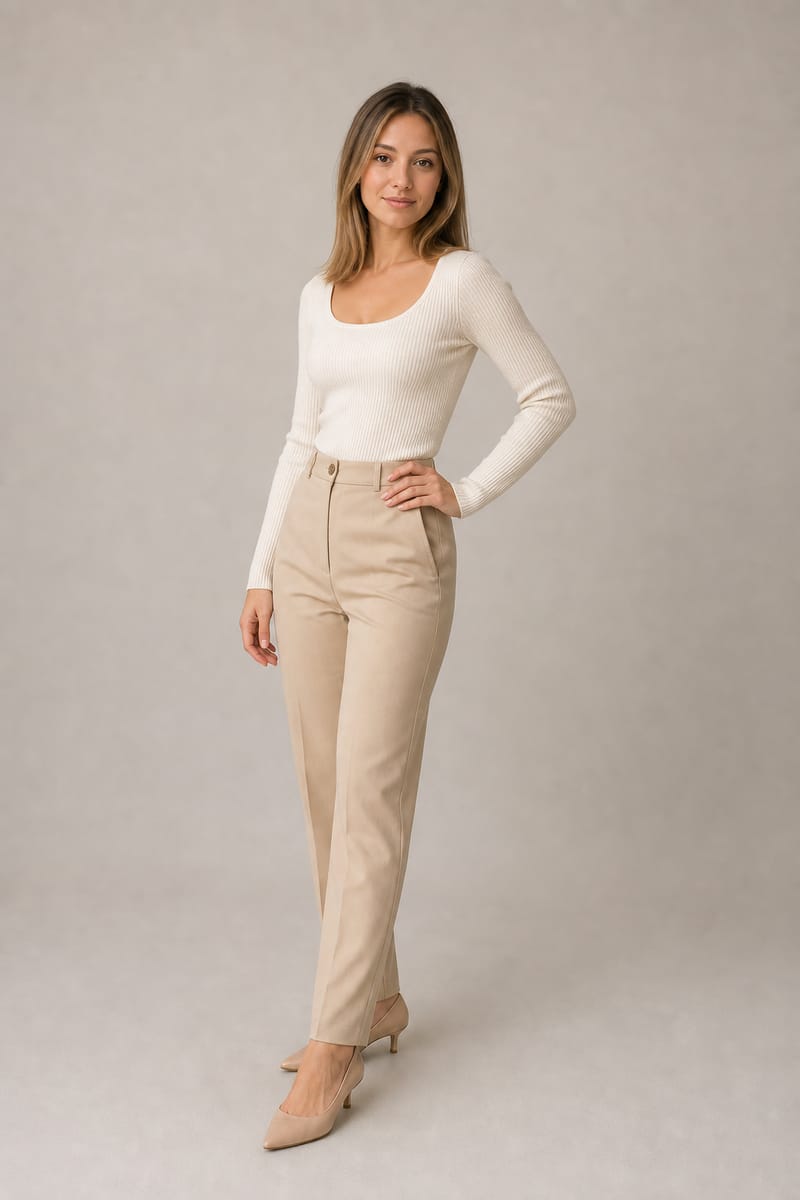
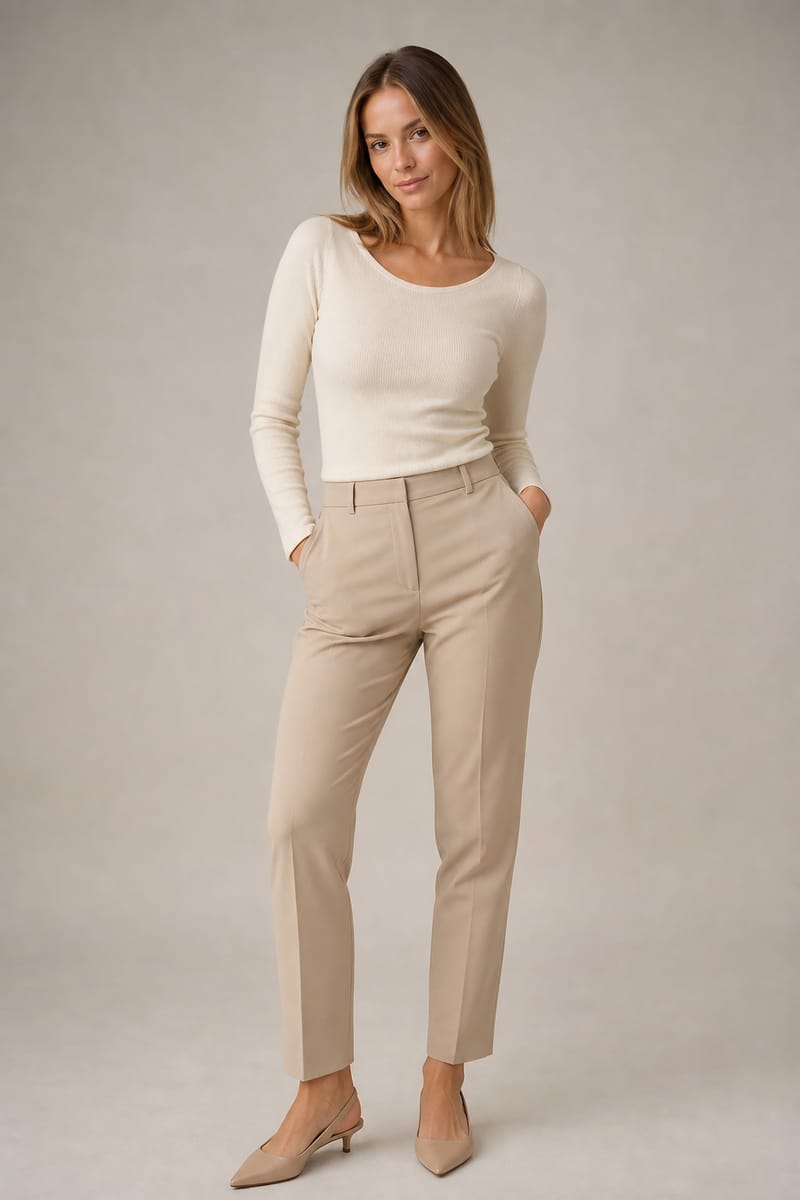
1. Three-quarter turn. Turn about 45 degrees to the camera, shift your weight onto the back leg, extend the front leg and point that foot towards the lens. The leg line gets longer and the waist looks narrower. This is the core e-commerce pose.
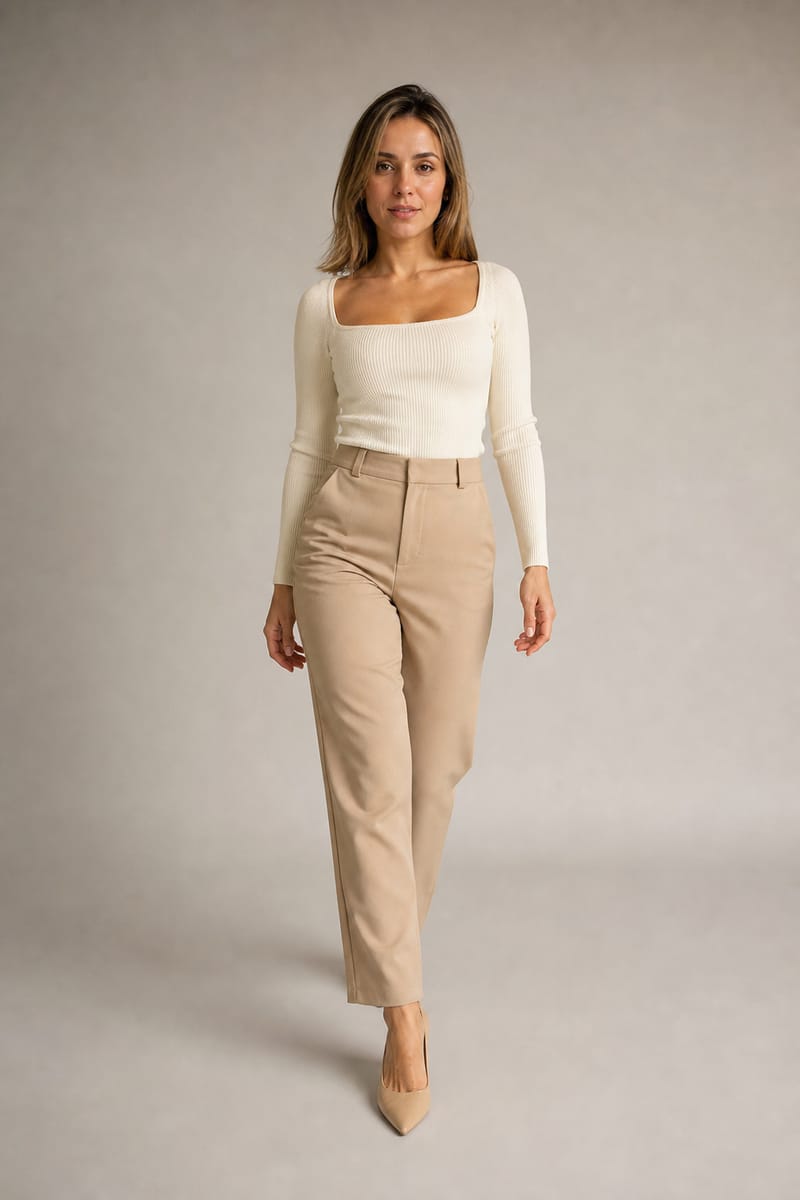
2. Step to camera from a low angle. When the photographer holds the camera at waist height or slightly below, legs look longer in the frame. A step towards the lens with the front leg extended adds to the effect. Just do not let the camera go too low, or the face starts to distort.
3. Long neck, chin forward. Drop and relax your shoulders, lengthen your neck, and push your chin slightly forward and down. That removes any double chin and makes you look taller, even in a close crop.
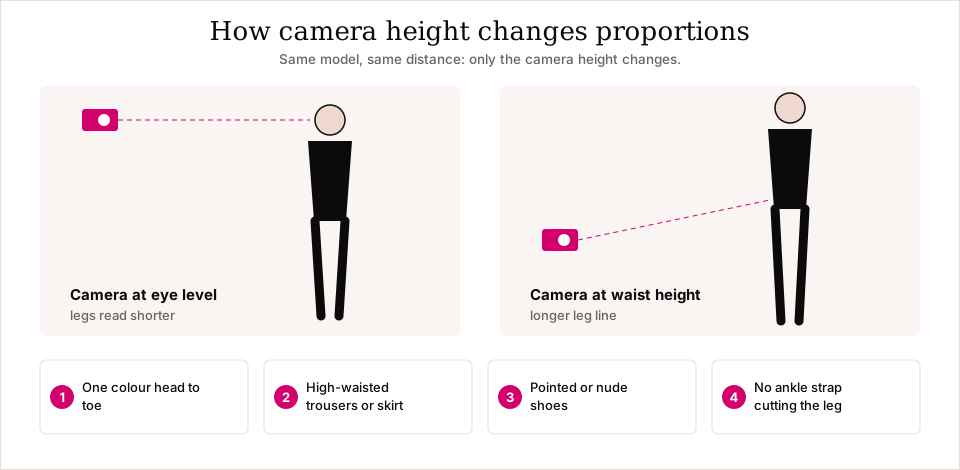
Styling helps as well: one colour head to toe, high-waisted trousers, pointed or nude shoes, and no ankle straps cutting the leg line. More poses with pictures are in our guide to model poses, and if the shoot calls for heels, read how to walk in heels.
How to start as a petite model
- Decide which market fits you. Be honest with yourself: at 5'3" your direction is commercial, beauty and e-commerce photography, not fashion weeks.
- Take digitals. Three simple daylight photos without filters: face, profile, full length. What they are and how to take them is explained in the glossary entry on model digitals.
- Write down your real height and measurements. Do not add inches. The agency will measure you at the first meeting, and a lie does more harm than the inches you are missing.
- Look for an agency with commercial clients. A fashion agency that represents only runway models will most likely turn you down. How to check an agency before you sign is covered in our guide on how to choose a modeling agency.
- Build a portfolio for your market. Bright commercial frames, close beauty crops and clothing shots suit a petite model better than dramatic fashion work. See which pictures you need in our modeling portfolio guide, and what a test shoot costs.
- Learn to work with a camera. Posing matters more for a petite model than for a tall one, because the long line has to be created.
Posing, working on camera and preparing for castings are what Supermodels teaches in its model training in Vilnius and Kaunas, and the same material is available online at your own pace.
Supermodels Masterclass: posing and casting preparation
Famous shorter models
Any conversation about petite models comes back to Kate Moss. Her height is given as 5'7" (about 170 cm), and she became one of the best-known models of the 1990s, walking and shooting for Calvin Klein and other major houses. By everyday standards that is not short, but for a model it was an exception.
That is exactly why her example needs care. Backstage wrote that Moss's story is regularly used to sell expensive courses and photo packages to girls who will never make it to the runway. The Boss Models booker called her a one-in-a-million case.
The realistic path is not to become "the next Kate Moss" but a model in steady commercial demand. Plenty of petite models make a living from e-commerce, beauty and advertising work that the general public never notices.
Petite modeling in Lithuania and smaller markets
Smaller markets such as Lithuania usually have no separate petite board. Many local clients, especially e-commerce shops and advertisers, book through agencies or photographers, and height is not always decisive. Still, samples in such markets are mostly made in a standard size S for average or taller women.
The international contracts that agencies in smaller markets offer their models are mostly in fashion markets, where height rules are strict. For a petite model the realistic start is local commercial photography, beauty salons and brand campaigns, building a portfolio and experience as you go.
If you are unsure whether your numbers fit, start with our guide on how to become a model, which lists the requirements for every type of model. Other niches where height does not decide everything are covered in plus size model requirements and how much models make.
What to avoid
Promises that should stop you:
- "With your face height doesn't matter, we'll make you a runway model", said to a 5'2" girl. A professional fashion agency does not promise that.
- A fee for registration, "catalogue placement" or a compulsory shoot with the agency's own photographer.
- Expensive "modeling courses" that supposedly guarantee work afterwards.
- Requests to send private photos in underwear or without clothes through social media.
The most common tricks are described in our glossary entry on modeling scams.
Also avoid trying to "change" your body for a modeling career. Height cannot be changed, and losing weight or risky diets will not turn you into a fashion model. If you feel pressure about your body, talk to someone close to you or to a doctor, and in an emergency call your local emergency number.
FAQ
What is the minimum height for a model?
For fashion and runway work women usually need at least 5'8" (172 cm) and men 6'0" (183 cm). Commercial, beauty and e-commerce photography has no hard limit; petite models are usually around 5'1" to 5'7".
Can I be a model at 5'3"?
Yes, but not a runway model. The realistic routes are e-commerce, petite clothing lines, beauty and cosmetics advertising, commercial photography and social content for brands.
What does petite model mean?
A model shorter than the fashion agency standard, usually working in commercial, e-commerce and beauty photography. In clothing, petite sizes are for women 5'4" and under.
Do petite modeling agencies exist?
Some agencies, mostly in large markets, have a petite filter or represent petite models on their commercial board. Separate petite-only agencies are rare, so look for agencies with strong commercial and e-commerce clients.
Can short men be models?
Fashion work usually asks for 6'0" to 6'3". Shorter men mainly work in commercial, fitness and acting-led advertising, where height matters less.
How can I look taller in photos?
Pose at a three-quarter turn with the front leg extended, ask for the camera at waist height, lengthen your neck, and choose one colour head to toe, high-waisted trousers and pointed shoes.
Sources
- Backstage, For Petite Women, Modeling Is a Tall Order (interviews with bookers at Boss Models and Model Club).
- Macy's, Petite Size and Fit Advice (petite clothing for women 5'4" and under).
- Wikipedia, Petite size.
- The Photo Studio, How To Become A Petite Model (petite height ranges).
- Hired Hands Models, model categories (including Petite Models).
- Supermodels model agency, registration terms (supermodels.lt).

Comments (0)
No comments yet. Be the first!
Only logged-in users can comment. Register — and you'll be able to share your thoughts on this article.
Register