


In short
- Clothes for larger women have been made at scale since 1904 (Lane Bryant), and the first body acceptance organization in the US dates from 1969. The two stories met on magazine covers only in the last decade.
- Runway progress is not a straight line. Vogue Business counted plus-size (US 14+) models in just 0.3% of looks at Fall/Winter 2026 shows, down from 0.6% in Fall 2023.
- Model health is regulated in places: France requires a doctor's certificate to work as a model and a label on retouched commercial photos of models.
- For a viewer or shopper the useful question is whether the clothes in a campaign are made in the size the campaign shows.
When people talk about body diversity in fashion they usually mean two different places: the runway and the shop. The runway shows what fashion wants to look at. The shop shows who it makes clothes for. For a long time the two did not match, and they still do not.
This guide collects the history, the latest numbers from the season reports, the criticism, the question of model health and the laws. Numbers were checked against the original reports, and where methods differ we say so. For the work itself, see our plus-size modeling guide.
A short history: from larger sizes to body positivity
Plus-size fashion existed long before the label. The clothing industry and the body acceptance movement developed separately and only met in the last ten years.
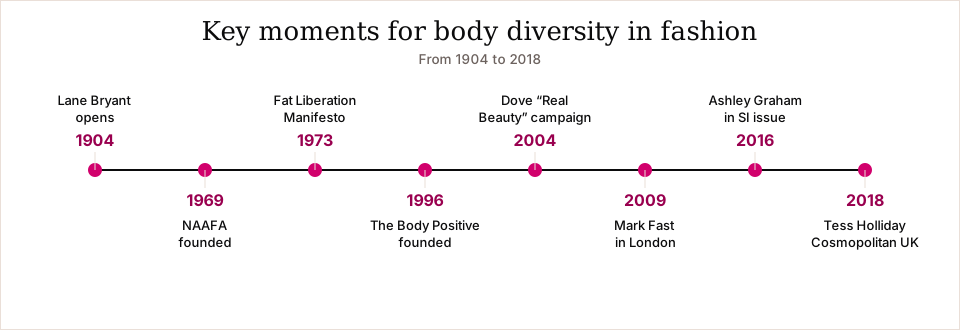
| Year | What happened | Why it matters |
|---|---|---|
| 1904 | Lena Bryant opens a small shop on Fifth Avenue in New York, the start of Lane Bryant | She began with maternity dresses. Larger sizes soon became the core business: sales reached $5 million by 1923. |
| 1969 | Bill Fabrey founds NAAFA (first called the National Association to Aid Fat Americans) | NAAFA describes itself as the first documented fat rights organization in the world. |
| 1973 | The Fat Underground publishes the Fat Liberation Manifesto | Demanded equal rights and attacked the weight-loss industry. |
| 1996 | Connie Sobczak and Elizabeth Scott found the nonprofit The Body Positive | Set up as a community to help people leave body hatred behind. |
| 2004 | Dove launches the Campaign for Real Beauty | Ads used everyday women instead of professional models. It drew both praise and criticism. |
| 2009 | Mark Fast shows models in UK sizes 12 to 14 at London Fashion Week | A stylist walked out over the casting, showing how narrow the "normal" runway body was. |
| 2016 | Ashley Graham makes her Sports Illustrated Swimsuit debut | She had appeared in an ad in the issue the year before. |
| 2018 | Tess Holliday appears on the October cover of Cosmopolitan UK | The cover drew support and criticism, including a debate about health. |
Critics of the Dove campaign noted that it still showed women who fit conventional standards. A campaign and a change in an industry are not the same thing.
What body positivity means, and how it differs from body neutrality
Body positivity is first of all the idea that a person's worth does not depend on the size or shape of their body. The Body Positive built it as a community and training program, not as a fashion trend. On social media the phrase became a hashtag and a loosely defined style. Body neutrality is a related idea: think less about how your body looks and more about what it lets you do.
Evidence on effects is thin. In a 2019 experiment, Cohen and colleagues showed young women a short set of body positive Instagram posts, and viewing them was associated with better mood, higher body satisfaction and greater body appreciation. That is a short-term result in laboratory conditions, so it does not show long-term effects.
Runway numbers: what the season reports show
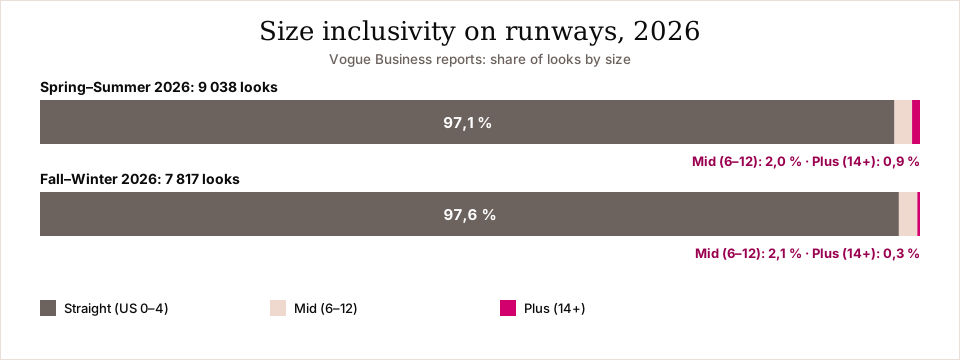
Two newsrooms have counted diversity on the runway. theFashionSpot counted model appearances (castings), for example in its 2017 and 2022 reports. Since Fall 2023, Vogue Business has counted every look by size group: straight size (US 0-4), mid size (US 6-12) and plus size (US 14+).
| Report | Scope | Plus size | Mid size |
|---|---|---|---|
| theFashionSpot, Fall 2017 | 7,035 castings, 241 shows | 30 castings (0.43%) | - |
| theFashionSpot, Fall 2022 | 4,409 appearances, 193 presentations | 103 appearances (2.34%), a record at the time | - |
| Vogue Business, Spring/Summer 2026 | 9,038 looks, 198 shows | 0.9% | 2% |
| Vogue Business, Fall/Winter 2026 | 7,817 looks, 182 shows | 0.3% | 2.1% |
The two series cannot be compared directly: one counts appearances, the other looks, and the size cut-offs differ. Across seven seasons, Vogue Business found straight-size models rising from 95.6% (Fall 2023) to 97.6% (Fall 2026), mid-size falling from 3.8% to 2.1%, and plus-size looks halving from 0.6% to 0.3%. The temporary peaks came in the Spring 2024 and Spring 2025 seasons.
Fashion capitals differ
At Fall/Winter 2026, London was again the most inclusive: 6.5% mid-size and 0.8% plus-size looks. New York showed 0.4% plus-size, and Milan and Paris 0.1% each. Just nine of 65 Paris brands included any mid or plus-size model.
The publication ties this to a more conservative climate, "self-optimization" trends and growing GLP-1 use. That is the editors' interpretation, not a proven cause.
 Model training with SupermodelsThe walk is best seen on videoWe film how you walk now and work on posture, stride and the turn until the walk is yours.About the trainingfrom €69
Runway versus shop: is it the same thing?
A model on a runway still has to be found in the store. In a 2025 Vogue Business survey of almost 700 consumers, 27% of plus-size respondents said they "can never" or "usually can't" find their size among luxury brands, against 16% of mid-size and 12% of straight-size respondents. Feeling alienated by the fashion industry because of size was reported by 68% of plus-size, 34% of mid-size and 17% of straight-size respondents.
The 2026 report also checked brand websites. Most brands stop at US 14 or 16 (UK 18 to 20 in our clothing size chart), and the largest sizes were the most likely to be sold out. Designer Karoline Vitto points to cost: for a small brand each extra size means more grading, sampling and refitting. The Paris label Ester Manas, which sells a wide range, said 60% to 70% of its online customers are plus-size.
Criticism and debate
Tokenism
One of the most common complaints is that a brand casts a single plus-size model but does not make clothes in that size. A Vogue Business editor wrote in 2026 that the same few curve models appear season after season, and when they are unavailable the brand returns to 100% straight-size.
Health and what size shows
Arguments often move to whether showing plus-size models "promotes" an unhealthy lifestyle. Two points help. First, the World Health Organization defines overweight in adults as a BMI of 25 or more and obesity as 30 or more, but BMI is only a surrogate marker of fatness, and measures such as waist circumference help with a diagnosis. Second, the size visible in a photo says nothing about one person's health. That is a question for a doctor, not for a viewer.
The opposite criticism: progress running backwards
Part of today's criticism points the other way. Vogue Business writes that some brands have moved not only away from plus-size but towards very thin casting, and that people of any size feel pressure to be thinner. That is editorial opinion, but the survey adds to it: 48% of respondents said they feel pressure to lose weight to feel fashionable, and of those, most (63%) cited difficulty finding their size in shops as a source, while 36% cited runway shows.
Health and body image in the modeling world
Research on eating disorders among models is mixed. In 2022 Hungarian researchers compared 179 female models with 261 controls. The models' mean BMI was 18.1 against 22.1 for controls. Questionnaire-based rates of probable anorexia and bulimia did not differ significantly, but subclinical anorexia symptoms were found in 14.6% of models and 2.7% of controls. The authors note that earlier studies also found little difference in clinical disorders but more subclinical symptoms. This is one study and does not describe every model.
Pressure to change your body is not limited to one size. What matters most is the working rules: whether the agency and clients ask only for what is compatible with health. If you or someone close to you is struggling with eating or body image, a first step is your family doctor or a national eating disorder helpline.
Laws and self-regulation in Europe
Governments and the industry have regulated two areas: model health and the labeling of retouched images.
| Country or body | Year | What it sets |
|---|---|---|
| Spain (Madrid fashion week) | 2006 | In September, Pasarela Cibeles, backed by the Madrid regional government, became the first major fashion week to screen models by BMI (minimum 18). According to CNN it turned away about 30% of the women who took part in the previous event. |
| Italy (Milan) | 2006 | The New York Times reported a December agreement between the city and the industry banning models with a BMI below 18.5. |
| Israel | 2012-2013 | The law bars the use of models with a BMI below 18.5 in advertising and requires a clear label on photos where a model's body has been reduced digitally. A 2022 review notes it has no sanctions and little evidence on effects. |
| France | 2016-2017 | Labour Code art. L7123-2-1: working as a model requires a doctor's certificate assessing overall health "in particular with regard to body mass index". It is valid for up to two years. An agency or client that ignores the rule risks six months in prison and a €75,000 fine. Since 1 October 2017, commercial photos of models whose body has been slimmed or thickened by retouching must carry the words "Photographie retouchée" (fine of €37,500, up to 30% of the advertising spend). |
| LVMH and Kering | 2017 | Voluntary charter: French sizes 32 (women) and 42 (men) dropped from casting requirements, with at least 34 and 44 offered; a health certificate under six months old; no models under 16 in adult shows; psychologist support. |
| Norway | 2021 | Standard label required on advertising and paid influencer posts where body shape, size or skin is retouched. |
France sets no single mandatory BMI number. The order of 4 May 2017 says that for adults BMI is considered especially when the value approaches moderate to severe thinness, and for those under 18 when it is below the 3rd percentile. These rules protect model health, but they do not solve representation: a certificate does not require a wider size range, and a "retouched" label only says the image was changed.
What it means for models
The runway numbers suggest that for plus-size and mid-size models most work is commercial: catalogues, e-commerce, lingerie, swimwear and advertising. High-fashion bookings are scarce. Judge an agency by the bookings it has for your size, not by promises.
- Ask the agency which clients it has for your size and ask for examples.
- Read the modeling contract before you sign, especially the parts on retouching and image use.
- Give accurate measurements, and talk to your doctor before any weight change ahead of a casting.
- Build a portfolio that shows your natural body.
- Agencies that ask you to pay for registration or "representation" up front.
- Pressure to change weight fast before a casting or shoot.
- Retouching that changes your body beyond recognition without your knowledge.
- Using other models on social media as your benchmark.
For how to start, read how to become a model; for income, how much models make; and for choosing an agency, how to choose a modeling agency. Which sizes count as plus-size is explained in What is considered plus size, and the requirements are covered in plus-size model requirements. Applications to Supermodels are free: see the open call page.
What it means for viewers and shoppers
- Look for labels. In France, Israel and Norway retouched advertising has to be labeled. If you see the label, you know the body was altered.
- Check the size chart, not only the photo. A brand can show a plus-size model and make nothing above a US 12. Compare sizes in our size guide.
- Look at makers, not only models. Real diversity shows when a collection is sold in every size it pictures. In the Vogue Business survey, shop sizing, not the runway, was the biggest source of pressure.
To choose a dress by size and silhouette, read Plus-size dresses: how to choose. We cover the best-known plus-size models in a separate article, and the glossary has the term plus-size model.
Frequently asked questions
What is body positivity?
It is the view that a person's worth does not depend on the size or shape of their body. The nonprofit The Body Positive was founded in 1996. The roots of the movement go back to the fat acceptance movement that began in the US in 1969.
How many plus-size models are on the runway?
Very few. According to Vogue Business, at Fall/Winter 2026 plus-size (US 14+) models wore 0.3% of looks, mid-size (US 6-12) models 2.1% and straight-size (US 0-4) models 97.6%. In Spring/Summer 2026 it was 0.9%. London shows the most variety.
Do models in France need a medical certificate?
Yes. Labour Code art. L7123-2-1 makes a doctor's certificate, assessing overall health and in particular BMI, a condition of working as a model. The article dates from 28 January 2016, and the order of 4 May 2017 set the practical rules, including a validity of up to two years. Breaking the rule can mean up to six months in prison and a €75,000 fine.
Do retouched model photos have to be labeled?
In France, yes: since 1 October 2017, commercial photos of models whose body has been slimmed or thickened by retouching carry the words "Photographie retouchée". The fine is €37,500 and can reach 30% of the advertising spend. Israel has a similar rule, and Norway adopted one in 2021.
Is there work for plus-size models?
In commercial work such as catalogues, e-commerce and advertising, yes. High-fashion bookings are scarce worldwide. Ask any agency whether it has clients for your size.
Does body positivity encourage an unhealthy lifestyle?
The research we reviewed does not support that conclusion. In a 2019 experiment, viewing a short set of body positive posts was associated with better mood and body satisfaction in young women. Body size, however, does not describe any one person's health. For personal health questions, see a doctor.
Sources and recommended reading
- The Vogue Business Fall/Winter 2026 Size Inclusivity Report, 23 March 2026 (7,817 looks, 182 shows).
- Three Years on, What Have We Learned From the Vogue Business Size Inclusivity Report?, 23 March 2026 (seven-season trend).
- The Vogue Business Spring/Summer 2026 size inclusivity report, 13 October 2025 (9,038 looks, 198 shows).
- Sizing is stopping consumers from shopping, Vogue Business, 13 October 2025 (survey of almost 700 consumers).
- theFashionSpot: Runway Diversity Report, Fall 2017 and Diversity Report: Fashion Month Fall 2022.
- Légifrance: Code du travail, art. L7123-2-1; Arrêté du 4 mai 2017 relatif au certificat médical permettant l'exercice de l'activité de mannequin; Code de la santé publique, art. L2133-2 ("Photographie retouchée"); Code du travail, art. L7123-27 (penalties). Overview of how the rules apply: Village de la Justice, 10 May 2017.
- Latzer Y., Adatto R., Neumark-Sztainer D., Addressing eating disorders through legislation: the Israeli "Models' Law", Dialogues in Health, 2022. The date the law passed differs between sources (BBC and The Times of Israel give March 2012; the review also mentions December); it took effect in January 2013.
- Bogár N. et al., Frequency of disordered eating habits among fashion models, European Eating Disorders Review, 2022.
- Cohen R. et al., #BoPo on Instagram, New Media & Society, 2019.
- Kering, Charter on working relations with fashion models and their well-being, 5 September 2017.
- CNN, Skinny models banned from catwalk, 13 September 2006; The New York Times, "Italy: Milan Bans Too-Thin Models", 20 December 2006.
- World Health Organization, Obesity and overweight (adult BMI thresholds).
- NAAFA, history; The Body Positive, Our Story; Jewish Women's Archive, Lane Bryant Malsin; In-Mind, The good, the bad, and the ugly of the Dove Campaign for Real Beauty.

Comments (0)
No comments yet. Be the first!
Only logged-in users can comment. Register — and you'll be able to share your thoughts on this article.
Register